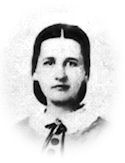
June 3rd, 1863. —I have been sick, dear Diary. I have not been able even to think at times and I am a fright. The fever made my hair drop out and I am wearing a black silk cap, which makes me look like the picture of the Jesuits.
So much has happened since I wrote here last. I miss Susie and Aunt Nancy and I am so sorry for Aunt Margaret. The whole country misses Uncle Daniel for he was such a fine officer, so splendidly equipped to command men.
My pupils have all gone away. I did not know when they went but the father died and the boys are scattered among their relatives. I hope they can go to school for they were actually learning a little.
Father says I can resume the book-keeping when I am well again. The call for troops made it necessary for Mr. Ansell and Mr. Edmondson, the brother-in-law, to enlist or leave the country. Rather than return to England they took the oath of allegiance to the Confederate Government and have joined the Gamble Artillery; that is, they expect to be in Colonel Gamble’s command. Mrs. Ansell will stay on in the house provided for the mill manager.
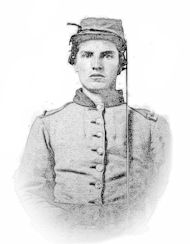
Dr. English has written to Father in regard to a wounded soldier he is bringing with him from a hospital in Virginia. The doctor went on to see his nephew, who was wounded in a skirmish near Harper’s Ferry, but when he reached the hospital his nephew had been dead two weeks. He found there a young Virginian, whose injuries were severe and painful; the surgeons in attendance said he was shot through both lungs, the bullet making what they term “a clean wound,” entering on one side cutting its way through and leaving the body in a direct line. They think if he could get to some quiet place, where his wound could receive close medical treatment he might recover. Of course Father wants him to come here.
We always keep Charley when the doctor goes and he is with us now. He is like a little brother to me and Father and Mother are more like parents to him than his own father. The doctor is a scientific man, not an M. D., but a Ph.D., and a long list of other letters, which mean so much to him. He is so wrapped up in his researches that he does not find his own young son very interesting. Charley is happy here, however, and we love the poor motherless boy.
Wednesday, 3d.—Reported Johnston has been fighting Yanks in the rear. Last night moved over hill to safer place, but very near works.
Camp White, June 2, 1863.
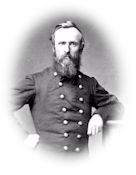
Dear Uncle: — Yes, I vote for you bank president. Signing the bills will be a bore, but then the signature can’t be counterfeited. . . .
Vicksburg appears to be a hard nut to crack. But with proper efforts to reinforce and supply Grant, he must, I think, succeed. The more obstinate the resistance, the more valuable will be the victory if we finally gain it. We are stronger here than we were. I now have a full brigade, four regiments infantry, a battery, and three campanies cavalry. We fortify all points deemed important.
Sincerely,
R. B. Hayes.
S. Birchard.
Tuesday, 2nd—Came in to Camp, find that my name has been sent on with others to be published as a deserter.
June 2.— Rode down to see Henry Dalton this morning. On my way I stopped at headquarters of the Army of the Potomac, and saw Oliver and Russell, and rode down with them to General Graham’s, where Dalton is. I took dinner there and spent the day. Received a box of very nice French candy from Hannah, which Dalton brought on. After leaving him, I rode over to the Engineer Brigade and found Captain Clapp away. Rode on and caught up with him on his way to headquarters. He and Captain Strang came over to see me. Day windy and pleasant.
Tuesday, 2d—We lay here in bivouac again all day. Our quartermaster drew some clothing for the regiment. I drew a pair of shoes, a shirt and a canteen. We are still without provisions. We spent the day in cleaning our clothing and equipments. There was some very heavy cannonading at Vicksburg today and we are expecting to receive orders to leave soon for the lines in the rear of Vicksburg.
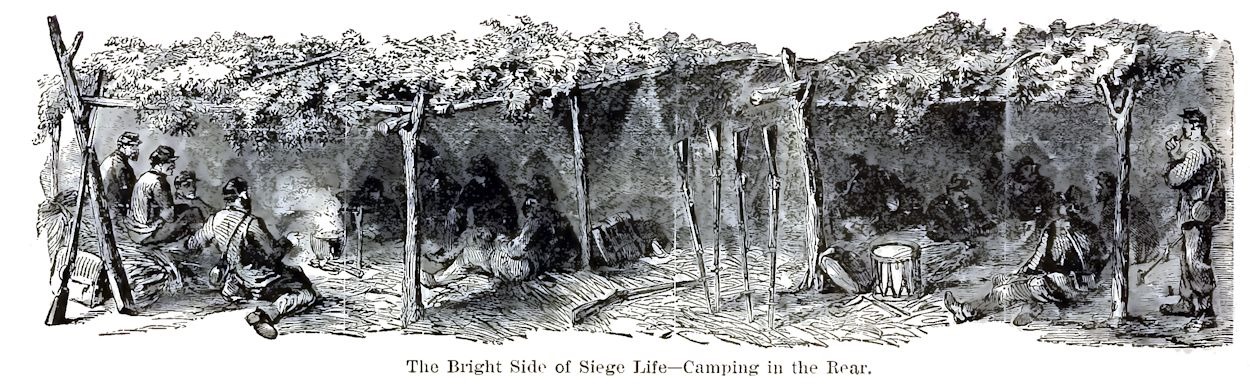
JUNE 2D.—We stayed in camp again all day, and I improved the time strolling through the camps, forts and rifle pits, which had been deserted by the Confederates. They seem to have left their quarters rather unceremoniously, for they abandoned siege guns, with tents, wagons, clothing and ammunition scattered about in confusion. I thought, while camped here, they seemed to feel quite secure. They frequently looked towards the Yazoo, and defied our boats to come up. However, when the boats did come, with Sherman in the rear, they beat a hasty retreat to the inside of Vicksburg.
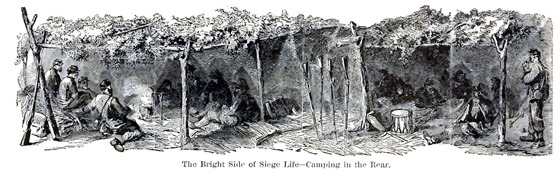
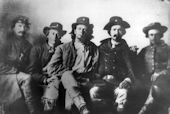
As our duties have been light to-day, the time has been occupied socially, by the boys reciting many little scenes of the past month. We conversed feelingly of those left behind on acount of sickness, or wounds, or death in battle. Only half our company is left now, and after two years more, what will have become of the rest? We shall fight on, perhaps, till the other half is gone. The friendship that now exists among our remnant is very firmly knit. Through our past two years of soldier life such ties of brotherhood have grown up as only companions in arms can know. And I trust before the end of another two years the old flag will again float secure in every State in the Nation.
Colonel Lyons.
Fort Donelson, June 2, 1863.—Weather cool and cloudy. River is rising a little. H and G returned today. Found no enemy. We have a rumor that Woodward, with 1,500 men and four pieces of artillery, is on Yellow Creek, thirty miles from here.
The fort progresses finely. We have all four of those 32-pounders in position now. The brigade band is about organized and we shall have lots of music soon, I suppose.
June 2 — We renewed our march this morning and crossed the Blue Ridge at Swift Run Gap. We marched to Standardsville and there turned off on the Madison Court House road, moved out five miles from Standardsville and camped. Our camp is in the edge of Madison County.
Standardsville, the county seat of Greene County, is a small village situated in a very rolling, hilly country, thirty-five miles southeast of Harrisonburg.
June 2, Tuesday. Chase, Blair, Bates, and myself were at the Cabinet-meeting. Seward was absent, but his son was present. So also was Judge Otto, Assistant Secretary of the Interior. Stanton, though absent, sent no representative. He condemns the practice of allowing assistants to be present in Cabinet council, a practice which was introduced by Seward, and says he will never submit or discuss any important question, when an assistant is present. I think this is the general feeling and the practice of all.
There was some discussion of affairs at Vicksburg. The importance of capturing that stronghold and opening the navigation of the river is appreciated by all, and confidence is expressed in Grant, but it seems that not enough was doing. The President said Halleck declares he can furnish no additional troops. As yet I have seen nothing to admire in the military management of General Halleck, whose mind is heavy and, if employed at all, is apparently engaged on something else than the public matter in hand. At this time when the resources of the nation should be called out and activity pervade all military operations, he sits back in his chair, doing comparatively nothing. It worries the President, yet he relies upon Halleck and apparently no one else in the War Department. No one more fully realizes the magnitude of the occasion, and the vast consequences involved, than the President; he wishes all to be done that can be done, but yet in army operations will not move or do except by the consent of the dull, stolid, inefficient, and incompetent General-in-Chief.
Stanton does not attend one half of the Cabinet-meetings. When he comes, he communicates little of importance. Not unfrequently he has a private conference with the President in the corner of the room, or with Seward in the library. Chase, Blair, and Bates have each expressed their mortification and chagrin that things were so conducted. To-day, as we came away, Blair joined me, and said he knew not what we were coming to; that he had tried to have things different.