Following the American Civil War Sesquicentennial with day by day writings of the time, currently 1863.

Friday, July 5, 2013

July 5.—This evening, General Kilpatrick captured a rebel train and a large number of prisoners, at a point near Monterey Gap, Va., and in the afternoon he defeated the rebel cavalry under J. E. B. Stuart, at Smithsburgh, Va.— (Doc. 32.)

—A small party of rebel cavalry entered Mechanicstown, Md., and after committing some depredations, retired, taking with them a quantity of flour and several horses.—The following order was officially promulgated at the headquarters of the army at Washington Commanding Officer Fort Monroe, Colonel Ludlow, Agent for the Exchange of Prisoners of War:

The President directs that you immediately place W. H. Lee and another officer selected by you, not below the rank of captain, prisoners of war, in close confinement and under strong guards; and that you notify Mr. R. Ould, confederate agent for exchange of prisoners of war, that if Captain H. W. Sawyer, First New-Jersey volunteer cavalry, and Captain John Flynn, Fifty-first Indiana volunteers, or any other officers or men in the service of the United States, not guilty of crimes punishable with death by the laws of war, shall be executed by the enemy, the afore-mentioned prisoners will be immediately hung in retaliation. It is also directed, that immediately on receiving official or other authentic information of the execution of Captain Sawyer and Captain Flynn, you will proceed to hang General Lee and the other rebel officer designated, as herein above directed, and that you notify Robert Ould, Esq., of said proceedings, and assure him that the Government of the United States will proceed to retaliate for every similar barbarous violation of the laws of civilized war.

H. W. Halleck, General-in-Chief.

—The steamer Harriet Pinckney, from Bermuda, arrived at Halifax, N. S., having on board C. L. Vallandigham.—At seven o’clock this morning, John Morgan, with four thousand cavalry, attacked the Twentieth Kentucky infantry, four hundred strong, under Colonel Hanson, at Lebanon, Kentucky. After a seven hours’ fight, Morgan’s forces commenced burning the town, setting fire to the railroad depot and six or seven houses. Colonel Hanson then surrendered, and Morgan’s forces left in the direction of Springfield.— (Docs. 47 and 108.)

—A battle took place near Bolton, Miss., between the National forces under General W. T. Sherman, and the rear-guard of the rebels under Joe Johnston, in which the latter were compelled to surrender their entire force. The Union loss was very slight, while the number of rebels captured amounted to over two thousand.—General James G. Blunt, having under his command portions of the Second and Sixth Kansas, Third Wisconsin, and Fourteenth Kansas regiments, left Fort Scott for the seat of war in the far West.
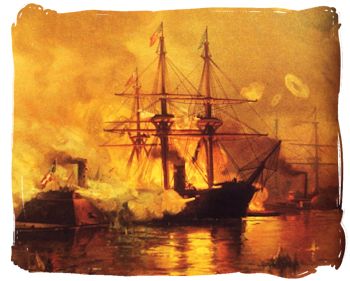
July 5th. At ten A. M., ship and crew inspected by the Commodore. Performed Divine service on the quarter-deck. Occasional firing at Port Hudson all this day.

Sunday, 5th.—Went over to river; saw about one hundred boats drawn up in front of town; among them several gunboats. Talked with a Federal soldier, Rufus Wells, who once lived at Ringgold.

Sunday, 5th—Came up to the foot of the mountains and camped.

Sunday, July 5. Like most other Sabbaths in the army, so was this; all day busy cleaning up the camp ground, tearing down the board shanties which former occupants had erected and using the material for flooring in our tents. We had our Fourth of July dinner today; bean soup, hoe cake and lemonade. Hill’s Point is not-a point in the river, as the stream here runs straight, but is a bluff some 25 feet higher than the river and about 20 rods wide. It is the terminus of the table-land beyond, and is formed by wide, deep ravines on either side which run back and soon ascend to the level of the table-land. Heretofore the enemy had a habit of running batteries down here and intercepting the boats coming up the river, forming a sort of blockade, causing our gunboats to waste right smart of ammunition, or necessitating the marching of troops across the country from Newbern to drive them out. During the siege last spring, they had a powerful battery here which caused Gen. Foster a heap of trouble. Since then he has occupied it himself. This is an intrenched camp, sporting three brass six-pounder field pieces. When or by whom these works were built is to me unknown, but they look like the work of the enemy. They contain a great number of angles; commencing on the edge of the bluff next the river, they run several rods along the edge of the ravines, then cross in front of the camp, and from any part of the line can be got direct, cross and enfilading fires. The three guns are in battery on the flanks and center. Major Atwood is in command, and in his absence, Capt. Foss of company F. Such is a description of our present, abiding place.

July 5th, 1863.

We have moved about one and one-half miles today. No doubt our northern friends think they have seen dusty roads, but if they could have seen us yesterday or today, they would have thought the dustiest time they ever saw was clean and airy in comparison. The road, and two or three rods on either side, was beaten into the finest powder, and the feet of men and horses caused it to rise in sooty clouds, which enveloped us in their stifling, smothering folds. There was no breeze to carry it away —no possibility of avoiding it. When we halted at night every man of us was a “free soiler,” and carried enough dirt on his person to make a “garden spot.” Thanks to a kind providence, water is plenty at this place, and we soon washed and forgot our miseries.

One of the boys just killed a huge rattlesnake a few feet from where I am writing.

July 5 — Sabbath morning has again rolled around and I (with many others) as a prisoner. The Yankees visited us today and we conversed freely and friendly together. We are treated with great hospitality by them. Today has been unusually calm. W.R. Clack

by John Beauchamp Jones

            JULY 5TH.—This morning the wires refused to work, being cut, no doubt, in Hanover County.

            The presence of the enemy in this vicinity, I think, since they refuse to fight, is designed to prevent us from sending more troops into Pennsylvania. I trust the President will think of this matter, if he is well enough; some of his generals here are incapable of thinking at all.

            We have just received intelligence of a great battle at Gettysburg, Pennsylvania. I have not heard the day; but the news was brought by flag of truce boat to City Point last night. The Yankee papers, I am told, claim a victory, but acknowledge a loss of five or six generals, among them Meade, commander-in-chief (vice Hooker), mortally wounded. But we still held the town, and “actions speak louder than words.”

            More troops are marching up into HanoverCounty.