Wednesday, 22d—We started this morning at daylight and marched all day. We stopped for the night along Baker’s Creek, just beyond Edward’s Station. The roads are alive with troops returning to Vicksburg. It is reported that Johnston’s army is falling back to Columbus, Mississippi.
Monday, July 22, 2013
Camp White, July 22, 1863.
Dearest: — Home again after an absence of two weeks, marching and hurrying all the time. The last week after Morgan has been the liveliest and jolliest campaign we ever had. We were at all the skirmishes and fighting after he reached Pomeroy. It was nothing but fun — no serious fighting at all. I think not over ten killed and forty wounded on our side in all of it. Unluckily McCook, father of Robert and the rest, was mortally wounded. This hurt me but all the rest was mere frolic. Morgan’s men were only anxious to get away. There was no fight in them when attacked by us. You will no doubt see great claims on all sides as to the merits of his captors. The cavalry, gunboats, militia, and our infantry each claim the victory as their peculiar property. The truth is, all were essential parties to the success. The cavalry who pursued him so long deserve the lion’s share. The gunboats and militia did their part. We can truly claim that Morgan would have crossed and escaped with his men at Pomeroy if we had not headed him there and defeated his attempt. It is not yet certain whether Morgan himself will be caught. But it is of small importance. His force which has so long been the terror of the border, and which has kept employed all our cavalry in Kentucky is now gone. Our victorious cavalry can now operate in the enemy’s country.
I thought of you often. We were quartered on steamboats — men were singing, bands playing. Our band was back and with us, and such lively times as one rarely sees. Almost everybody got quantities of trophies. I got nothing but a spur and two volumes captured from the Twentieth Kentucky, Captain H. C. Breman, and now recaptured by us. Morgan’s raid will always be remembered by our men as one of the happiest events of their lives.
Love to the dear boys and Grandmother. Joe is unwell and is in a room in town.
Affectionately,
B
Mrs. Hayes.
Steamboat Victress, Ohio River, July 22, 1863.
Dear Uncle: — We have been after Morgan for a week. The Twenty-third was in all the fighting at Pomeroy and Buffington and took two hundred and six prisoners. The Rebs couldn’t fight soldiers at all. We lost one man. We had a most glorious time. We go up the Kanawha again today.
Sincerely,
R. B. Hayes.
S. Birchard.
[July 22, 1863].— [On the] 16th, at Fayette, heard that Morgan was in Ohio at Piketon, leaving there for Gallipolis. General Scammon wisely and promptly determined to head him [off] by sending me. (This was after a sharp controversy.) [The] Seventeenth with [the] Twenty-third and Thirteenth took steamboats from Loup Creek for Gallipolis. [The] 18th at Gallipolis heard Morgan had pushed by up the Ohio as if to cross at Pomeroy.
Sunday, 19th, [at] Pomeroy. Halted; found the militia waiting in position for Morgan. About noon he came; the Twenty-third went out to meet him; found him in force; sent for [the] Thirteenth; formed lines of battle. Morgan ditto. Seeing we were “regulars and not militia” (words of inspection of Rebels), he hurried off, with some loss. We had one wounded, in his hand — Clemens, Company B.
[The] 20th, at daylight, found Morgan at Buffington Island. He was here attacked by General Judah’s cavalry and the gunboats. Not much fighting by Rebels, but great confusion, loss of artillery, etc., etc.
On to Hockingport; guarded the ferries over the Ohio at Lee’s Creek, Belleville, and Hocking.
[The] 21st, back to Gallipolis. Morgan’s army gone up. We got over two hundred prisoners. Everybody got some. No fight in them. The most successful and jolly little campaign we ever had.
[The] 22nd, Wednesday, home again in Camp White. [The] Thirteenth left at Point Pleasant; [the] Fifth sent to Gauley Bridge.
July 22, Wednesday. A delegation from Connecticut, appointed by the Legislature, called on me and consumed some time in relation to the coast defenses of the State and the waters of Long Island Sound. There is quite a panic along the whole New England coast. It is impossible to furnish all the vessels desired, and there is consequently the disagreeable result of refusal I have very little apprehension of danger from any rover or predatory excursion in that quarter, yet it is possible, as it is possible some Rebel may set my house on fire. Should a rover make a dash in the Sound, do damage, and escape, great and heavy would be the maledictions on me after these formal applications. I am many times a day reminded and told of my responsibility.
Called last evening to see young Dahlgren. Was shocked to hear the gallant young fellow had lost his leg. Shall be glad if he does not lose his life, which I much fear.
Mr. Gooch and Mr. Hooper[1] continue to be very troublesome in regard to the Charlestown Navy Yard, which they are disposed to take into their hands, so far at least as to make it subservient to their election and party aspirations.
[1] Daniel W. Gooch and Samuel Hooper, Republican Congressmen from Massachusetts
July 22.—Major-General John G. Foster, pursuant to instructions from the War Department, commenced the enlistment of colored troops within the lines of the Department of Virginia and North-Carolina; and the unoccupied land on Roanoke Island was set apart for the use of the families of negro soldiers and other contrabands in the service of the United States.—The rebel privateer Florida was at Bermuda, being delayed there by the refusal of the naval authorities to furnish her with coal.
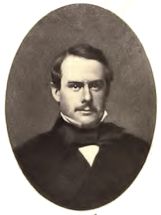
Charles Francis Adams, Jr., to his father
Camp of the 1st Mass. Cavy Hillsboro, Va., July 22, 1863
Here we are and we enjoy this as more of a settled rest than we have had since the 30th of May. So I pulled out your old letters and read them over, re-read them with Gettysburg, Vicksburg, Port Hudson and Morris Island still ringing in my ears, and with our wondrous successes of July absorbing my thoughts. Does Europe want more? If it does I think it will get more, but I am lost in astonishment at the strength the North is developing. Can the South stand up against it? War is a dangerous game and the South has all that desperate courage which makes one a majority; so, while there is a single chance left I feel no safety. But for the last few days I had dwelt much during long marches on our relative positions as compared with two years ago. Two years ago at this time we fought the stampede of Bull-Run, and the two years that have passed have proved exactly the time necessary to develop our strength. Do you realise what prodigious victories we have won this summer? Men and money are the sinews of war. While we have reduced gold fifty per cent in five months, we have settled the question of a negro soldiery, and at last enforced the draft, thus opening an unlimited supply of recruits. Two years have thus brought us to just what we never had before, plenty of money and plenty of men. The negro regiment question is our greatest victory of the war so far, and, I can assure you, that in the army, these are so much of a success that they will soon be the fashion. General Andrews, formerly of the 2nd Massachusetts and one of the bravest and most reliable officers in the service, is organizing a corps of these soldiers in South Carolina, and he writes to officers here that, though he went out with all a conservative’s prejudices against their use, he has seen them do well under indifferent officers and he is confident that under good officers they will make troops equal to the best. This is a great deal from Andrews. I almost wish I had gone into that movement, but perhaps it’s just as well.
As to the conscription, the army is delighted with that and only regrets that it had no chance to discuss the matter with the gentlemen of New York. We, who have borne the heat and burden of the day, are tired and disgusted at seeing men bought by immense bounties, leaving home one day to return a hero the next, ovations to regiments with unthinned ranks. The three years men received no bounty. Now we do so much want to see all those who kiss our Lady Peace at home come in for a share of our laurels. So the army feels none the less pleased because it sees an iron hand on the rioters at home.
But having finished with our moral victories, I have not begun on our physical. Probably I can tell you little about those except that I really at last believe that we are learning to outfight the rebels on even fields, in spite of their dash and fanatical desperation. Does Europe want more? Europe however seems to me now out of the question. I may look at these things from too much of an army point of view, just as you take everything from your London watch-tower; but it does now seem to me that if any European nation, and especially England, and next to her France, wants hard knocks with little gain, they need only to meddle with us. Two years ago our soldiers would have dreaded foreign armies and especially French ” Zouayes.” That’s played out. If the Mexicans can make a fight, we can win a victory. Eighty thousand French soldiers might now make an impression through a campaign which would use them up; but in case of a war with us the whole English standing army could not save Canada from being overrun. How I would like to raid it through Canada, and how we would astonish the regular cavalry of Europe.
You will laugh at all this and say: “Why, victory has turned his head! How he does crow!! And that too before he’s out of the woods.” Not at all. It is not success in the field which delights me, it is feeling and seeing the strength behind me which this rebellion has just sufficed to call forth. Europe looked to see us exhausted and calling for mediation, without money and without recruits, and behold! the whole African race comes forward to fill our ranks at just the moment when by a wise conscription we are for the first time strong enough without them, and all this time the very war which was to destroy us reduces gold from 175 to 125. At last, oh Lord! at last!! Three months ago powerful and energetic foreign intervention would have saved Vicksburg to the South, cost us New Orleans and cost us the Mississippi. Today we have all these and will not lose them easily and, if European nations care to interfere, they may injure us in a small degree as we shall injure them; but, thank God! we have secured the material issues of this great struggle. For the rest I would the South East might have its own way and depart in peace. I am tired equally of them and of this war.
You cannot tell how I long to hear from you and to know how all this affects you in London. I know it must make you very happy, but how does it affect you socially? . . .
July 23
As we still continue here I may as well lucubrate a little further. I notice that you and Henry dwell a great deal upon the apparent exhaustion of the rebel resources and their lack of men and supplies. As I yesterday dwelt on our successes, I will today give my experiences on their reverses, and that experience is by no means that of the newspaper reporters. I have lately seen and talked with considerable numbers of rebel prisoners, beside passing over some rebel territory, and that, too, in “desolated” Virginia. That the rebels have no money or currency is very apparent, but I see no evidence that they are either starving or destitute. Wherever we have been in Virginia we find cattle and corn in abundance, and the people seem comfortable. We find few men and few blacks but no suffering. I see that all accounts agree in placing the flower of the rebel army in Virginia. This may well be, for finer fighting material it would be hard to find. I am struck by their immensely improved condition since a year ago at Antietam. Judging by my means of observation, and I saw great numbers of prisoners, having myself at one time charge of a squad of five hundred from every Southern State, I should say that Lee’s army at Gettysburg was in every respect superior to the Army of the Potomac, superior in numbers, better officered, a better fighting material, as well armed, better clothed and as well fed. The spirit of his army was much better than that of ours, and I saw no evidence of their ever having been on short rations or demoralised by want or misfortune. Their tone was the very best. All said they were sick of the war, but scouted the idea of going home or giving it up until they had won their cause. I must say my opinion of the confederates and Southrons improved on near acquaintance in the early days of July.
You will ask why we were not defeated then at Gettysburg? We just escaped it by the skin of our teeth and the strength of our position. This regiment came into the field on the evening of the second day and in the midst of the battle. At sunset we were whipped and night saved the army. I never felt such sickening anxiety. We went into camp a mile and a half from the front and in rear of the right wing, in a wood. At sunset the enemy outflanked us and our men began to give way. Presently they came swarming through our camp in demoralised squads — wounded and well, officers and men — so that we were forced out and obliged to move back. Then it was resolved to fall back that night twenty miles, but fortunately at midnight this determination was reconsidered, our position was strengthened and next day the enemy were fairly whipped out.
Now, for the future, how do things stand? I guess Lee has 60,000 men left, but he is outflanked at the South West and at Charleston, and he must still make head against the large and now confident army. Southern affairs do seem desperate. They seem to me in just that condition from which genius alone could restore them and here is where, to my mind, the rebels have sustained their most vital loss. Stonewall Jackson would have given them this chance had he lived. In Virginia alone since the war began have they held their own, and what have they done in Virginia which they did not owe to Jackson? Now his loss to them seems to me to be irreparable and almost decisive. In a single campaign the South has lost Jackson and Vicksburg, and if they are not desperate, I do not know what can bring them to it. I do believe Jackson had genius and in that respect stands alone in the annals of this most stupid and uninspired of struggles. Certainly his death excited throughout this army a deep regret which was lost only in a sense of intense relief. Today I am sure, as Americans, this army takes a pride in “Stonewall” second only to that of the Virginians and confederates. To have fought against him is next to having fought under him.
As for Lee, how can we have faith in him? He might have crushed Burnside at Fredericksburg and yet he let him escape. Hooker got away, but then Lee was glad enough to let him go, for, at the start, Lee was surprised, out-generaled, and on the verge of utter destruction. Jackson seemed to have saved the army which Lee jeopardized. As to Lee’s two invasions, he cannot brag much on Antietam, for Jackson almost destroyed Pope only to enable Lee to get pounded to a mummy in Maryland. And now finally at Gettysburg, with every chance in his favor, and against a dispirited army and a new General, he has incurred a disaster to the Southern army which belittles our defeat at Fredericksburg or their own at Malvern Hill. Thus I cannot share in the general admiration of Lee. Jackson was his right hand man and his right hand is gone. For the rest I do not see that they are stronger in Generals than we. . . .
July 22—Left this morning at 5, marched through Winchester three miles, and halted.
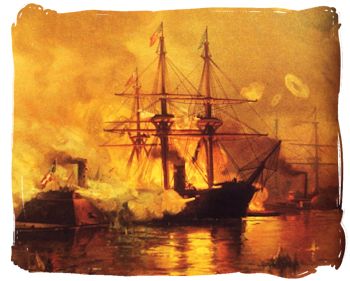
July 22d. Between the hours of four and eight A. M. steamer Crescent City came down the river with troops—some of Banks’s army. During the remainder of this day got ready, hoisted into launch, and sent one nine-inch Dahlgren and one thirty pounder Parrott rifle on shore; at six P. M. steamer Tennessee got under way and steamed down the river, with Admiral Farragut on board. Weather pleasant, but very warm.
Vicksburg, Wednesday, July 22. Teams and men gathering rebel pieces and caissons. Company cook started to-day, and all the Battery to be in one mess, much to the dissatisfaction of the boys. No mail.


