Monday, 13th—Came on through Lafayette and six miles beyond. I and Bob Ship, Tom Peterson and Jim McGuire stayed all night about one mile from Camp. Rained very hard for a while. Music to-night.
Saturday, July 13, 2013
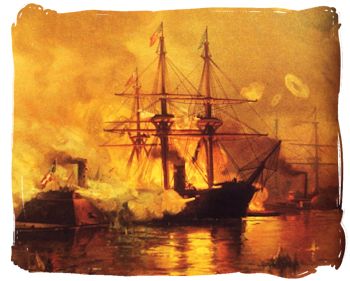
July 13th. At one thirty A. M., the U. S. mail steamer Creole came up the river; at seven o’clock, U. S. mail steamer George Cromwell, arrived; at ten thirty, a heavy rain shower came up from the southward and westward which lasted about an hour. Carpenters were engaged repairing ship’s side. The boatswain and crew engaged repairing rigging and getting ship ready for sea, for a homeward bound trip. Lieut. John C. Watson left the ship to go on board of Flag-ship Tennessee, and report for duty to the Admiral, having been temporarily detached from the Hartford.
Monday, 13th.—Marched eighteen miles; passed through Champion Hills battleground. Gave out in my hips so that I could not walk; got to ride in wagon. Camped near Raymond; nice country.
July 13 — We marched out this morning at 4 o’clock and struck camp at 6 o’clock p.m. in 8 1/2 miles of Raymond — distance 15 miles. I had a pretty severe chill this evening with fever. WRC

by John Beauchamp Jones
JULY 13TH.—The Enquirer says the President has got a letter from Gen. Lee (why not give it to the people?) stating that his operations in Pennsylvania and Maryland have been successful and satisfactory, and that we have now some 15,000 to 18,000 prisoners, besides the 4000 or 5000 paroled. Nonsense!
Lee and Meade have been facing each other two or three days, drawn up in battle array, and a decisive battle may have occurred ere this. The wires have been cut between Martinsburg and Hagerstown.
Not another word have we from either Charleston or Jackson; but we learn that monitors, gun-boats, and transports are coming up the James River.
Altogether, this is another dark day in our history. It has been officially ascertained that Pemberton surrendered, with Vicksburg, 22,000 men! He has lost, during the year, not less than 40,000! And Lovell (another Northern general) lost Fort Jackson and New Orleans. When will the government put “none but Southerners on guard?”
Letters to-day from the Governors of South Carolina, Alabama, and North Carolina show that all are offended at the Confederate government. Judge Campbell’s judicial profundity (and he is the department’s correspondent) is unfortunate at this crisis, when, not great principles, but quick and successful fighting, alone can serve.
It appears that President Lincoln has made a speech in Washington in exultation over the fall of Vicksburg, and the defeat of an army contending against the principle that all men were created equal. He means the negro—we mean that white men were created equal—that we are equal to Northern white people, and have a right, which we do not deny to them, of living under a government of our own choice.
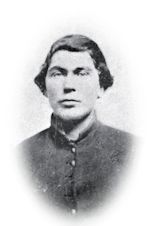
Vicksburg, Monday, July 13. Heavy rain last night. Cloudy and stormy all day to-day. Policed off all the grounds under the Battery. Evie and myself went about two miles to the right in the afternoon on horseback, got cane enough for bunks. Prisoners all marched out to-day except the sick; Colonel Sanborn, inspecting officer, taking all contraband articles from them.
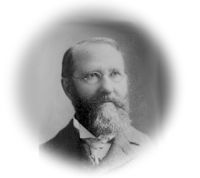
July 13. — Since the army entered Port Hudson, I have taken two long rambles: the first, to the corner of the works opposite our “right centre,” the point at which we were stationed; the other, to what is called the “citadel,” at the southern end of the defences on the river-bank. It was only very strong curiosity that drew me out for these walks. We all find ourselves much debilitated. Our fare, always hard enough, has lately been harder than ever. About the time of the surrender, there was a period of some days during which I tasted nothing but our hard-bread — which now is often wormy — and our coarse coffee. Fat salt-pork, indeed, was served out to us; but that, for me, is out of the question, in this climate. We are just finding out, now, the strait we were in. The rebels had actually blocked up the river at Donaldsonville, and destroyed our communications with New Orleans, whence we draw all our supplies, when Port Hudson surrendered.
The day after our entrance, however, I forgot my weakness, so far as I could, and started with Grider and McGill out upon the line of the Clinton and Port-Hudson Railroad for the “works.” I ought to say, that we find Port Hudson to be a little cluster of perhaps forty or fifty houses, on the edge of the bluff. The line of rebel intrenchments extends about this in the form of an irregular semicircle, — beginning on the river-bank, then running well back into the country, and returning to strike the bluff two or three miles below the village. The length of the line of intrenchments is said to be about seven miles. As we left the neighborhood of the little village, the country grew wild, cut and crossed, like the ground we had occupied outside, with ravines and little watercourses. The carcasses of animals were abundant, making the air foul; and often we came to old camps, — rows of huts built of logs and mud. Many of the huts were pierced by our shot, which seem to have penetrated to every part of the space within the enclosure. Every few steps, the foot trod upon a fragment of exploded .shell, or a Parrott bolt, or round shot. Not far from the breastwork, we came to a redoubt which contained a ruined cannon. It was a large siege-piece, facing, through its embrasure, one of our cavaliers, which contained, I remember, a formidable Parrott gun. This poor cannon was deeply dented here and there throughout its length, its carriage splintered; and it was turned on to its side, so that the trunnions were vertical. The last shot of our Parrott, so the rebels told us, had struck at the muzzle, just splintering the lip of the piece, then fairly entering the bore. We could feel an obstruction in the bore of the gun, with the rammer, which we supposed was the bolt. We were told that the shot struck just as a brave and skilful officer was sighting the piece; and that a certain dark stain, still visible on the earth near by, was his life-blood, poured out then and there. This cannon was not upon the outer intrenchments. The precision of our artillery-fire, the rebels assure us, was something wonderful; and we found ample evidence of it. Every gun at all exposed was sure to be detected by the sharp eyes of our cannoneers; and then its fate was sealed. At last, the rebels only dared to place their guns in the rear, concealing their whereabouts as much as possible: but then they were not safe, as in the case of this piece.
From this point, we soon came to the memorable angle where our sap approached. Every step, the evidences of the past storm became more numerous. The trees had lost their tops, the shells had hollowed out huge holes in the ground, and even weeds and bushes showed where the fire had swept. We came fairly to the outer works: and here the appearance of things was as if a tornado had swept across, whose hail had had the power to penetrate every thing; or rather as if the spot had received such a fiery storm as fell upon Sodom and Gomorrah. The few trees still standing were splintered into match-wood up their sides, or had lost their tops; and, in some cases, the solid balls had pierced them through and through, leaving them standing, tall and thick, with perforated trunks! The rough buildings near, which we had been able to see so plainly, were shattered in every way; and hardly a square foot could be found upon their timbers not marked by a bullet. The surface of the earth was ploughed and seared; the sand-bags on the breastwork, that I have looked at so often from our cover, were pierced and powder-stained; and, in the old rifle-pits, bloody sacking told where there had been killed and wounded men. It was very interesting to look over toward our approaches and hiding-places. Here ran our sap, touching at last the parapet; there rose the outside of the towering cavalier; there was the pile of cotton-bales, protecting an exposed part of the military road, behind which I had often crept; and there (how very close and plain!) was the prostrate tree where Cyrus Stowell was shot. I must have stood in the very tracks of the riflemen who did it. It was a little melancholy to think of the haunts as abandoned that had held so much life; where, for twenty-five days, we had undergone peril and hardship. We found the rebels had had no better cover than we, and that our fire had been more sharp and deadly even than theirs.
The preparations the rebels had been making against our third assault were in plain view here. We knew they had been hard at work. Mysterious sounds had come over into our sap; and a pickaxe or shovel would occasionally be thrust up into view, over the parapet. Where the breach was to have been made, a space of ground was thickly planted with hard-wood stakes, sharply pointed. A second parapet, for riflemen, had been constructed, and a cannon posted to throw grape. In the ground were buried enormous shell, ready to be discharged. The wires connecting with these ran near our feet, and we were forced to step with care. Had Heaven been a little less kind, it would have been our fate to charge at this very spot.
The “Citadel,” at the southern end of the intrenchments, was the goal of an excursion on the day following. It was a walk of a mile and a half. Here the siege operations had been of greater magnitude than at our approach. The effects of the enormous artillery of the fleet appeared as they could not be seen elsewhere. Here, too, the rebels had placed along the bluff their most formidable guns,—the mouths that had spoken so thunderously the doom of the ” Mississippi,” stranded on the shore opposite there, that night in March, when we listened in the woods. We found great cavities, where the large bombs had exploded. If the earth was soft, it is not exaggerating much to say that these were large enough for cellars to small houses. If the earth was hard, they were large enough to make rifle-pits for a soldier. We came to smooth, round holes, a foot or so in diameter, bored down into the earth out of sight. I thought, at first, they were ventilators to some deep bomb-proof or subterranean passage of the enemy; but they were too numerous and too irregularly disposed for that. They were made by descending shot. Presently we found some projectiles,—gigantic bolts of iron, — two feet long and eight inches thick, and cone-shaped at one end. We could not begin to lift them, nor many of the fragments of the exploded shells.
The shells were the missiles whose wonderful flight I had watched so often, alone, at midnight, from the top of the slope above the ravine of the color-guard. The southern horizon would light up with the wide-spreading glare of the discharge; then came the majestic planetary sweep of the ascending bomb, revealed by its revolving fuse, far into the zenith, —the deep, swinging roar, the stern music of the rushing sphere; then the awful fall from the perihelion of its tremendous orbit, and the earthquake crash at last! In such manner, once perhaps, a circling world, with fire-charged heart, burst into the asteroids!
As we approached the southern defences, we found them to be evidently of older construction and more formidable character than the defences we had before seen. The citadel was an outlying work, in front of a double or triple line of parapets. Less than an eighth of a mile opposite, across a depression, was a seventeen-gun battery of ours, which had added its force to that of the fleet. From this battery, toward the river, ran a trench, perhaps forty rods in length. Opening from the trench, a zigzag sap approached the citadel, — so dug that troops could come up to its walls without exposure. The approach touched the hostile parapet, and ended in a mine, which was nearly completed at the time of the surrender; and ran — a deep resounding cavern — far under the feet of the defenders. It was designed, by means of this, to blow this whole part of the fortification into the air.
The clash of the hostile forces here had been tremendous. It was impossible to think of the Northern power, except as a terrible fiery tide, which, responding to some tempest-breathing of God, had hurled itself upon this outpost. I came when the storm was gone, and could see the mark of the sublime impact. The sea had torn its ragged, zigzag way through the bosom of hill and plain, —dashed against battlement and cliff, and roared at the base, until it had hollowed out for itself deep-penetrating channels. Everywhere it had scattered its fiery spume. Within the citadel lay siege-guns and field-pieces, broken and dented by blows mightier than those of trip-hammers; wheels, torn to bits; solid oaken beams, riven as by lightning; stubborn parapets, dashed through almost as a locomotive’s plough dashes through a snow-drift, — these, and the bloody garments of men.
A photographist was quietly taking pictures on the parapet; one or two soldiers were strolling about: but the storm was gone, — the sapper gone from the mine, the gunner from beside his cannon-wheel, the rifleman from his sand-bag, still smutched from the muzzle of his piece. Then, as we came back, we saw the fierce, gray-headed old colonel, now our prisoner, who had commanded here, and breasted all this infernal force.
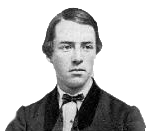
July 13. — General Wadsworth went to a council of war last night, and the opinion is that they voted not to attack the enemy to-day. The vote was as follows, I believe. Against it were General Sedgwick, French, Hays, Slocum; and in favor, Generals Wadsworth, Pleasonton, and Howard. General Meade was also understood to be in favor of an attack. It rained all day long, and the only excitement we had was from the rebs opening on us with artillery. They fired four or five shots, and then subsided. I rode along our lines this morning. Had our tents pitched. Briggs’s brigade joined us this evening.


