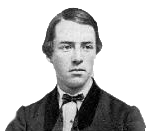
July 24. — The general sent Lieutenant Carson out to Waterloo with 20 cavalrymen, and five companies of infantry as a support. He saw nothing of the enemy except a straggler, whom he captured and sent in. He went a mile across the river, and then returned. He heard heavy firing towards Culpeper, proceeding from our cavalry, who crossed above here. In the evening Mrs. Wallach and her daughter came in from Culpeper. They said that when they left Culpeper there were no troops there. The firing was from our cavalry fighting infantry, near Annisville. General Ingalls arrived here this evening, and I obtained a paper from one of his party, the first I have seen for a week. I took a walk through the town during the afternoon. Saw some pretty girls, who would not even glance at us, however. The town is quite a pretty one, and has some neat cottages in it. Some of them reminded me very much of the houses on the Beverly shore. The population of Warrenton before the war was 2000. At present it cannot be over 600, and these mostly women and children. Almost all the families here are in mourning, but almost invariably, so I am told, give as the reason for wearing black, that some aged relative has died. I suppose they think that the Yankees would be glad to know of any one being killed in battle, and so refuse to tell.
July 2013

by John Beauchamp Jones
JULY 24TH—Nothing from Lee, or Johnston, or Beauregard, or Bragg—but ill luck is fated for them all. Our ladies, at least, would not despair. But a day may change the aspect; a brilliant success would have a marvelous effect upon a people who have so long suffered and bled for freedom.
They are getting on more comfortably, I learn, on the Eastern Shore of Virginia. Only about 25 of the enemy’s troops are said to be there, merely to guard the wires. In the Revolutionary war, and in the war of 1812, that peninsula escaped the horrors of war, being deemed then, as now, too insignificant to attract the cupidity of the invaders.
The Secretary of the Treasury sent an agent a few weeks ago with some $12,000,000 for disbursement in the trans-Mississippi country, but he has returned to this city, being unable to get through. He will now go to Havana, and thence to Texas; and hereafter money (if money it can be called) will be manufactured at Houston, where a paper treasury will be established.
Gen. Jos. E. Johnston has recently drawn for $20,000 in gold.
A letter from the Commissary-General to Gen. Lee states that we have but 1,800,000 pounds of bacon at Atlanta, and 500,000 pounds in this city, which is less than 30 days’ rations for Bragg’s and Lee’s armies. He says all attempts to get bacon from Europe have failed, and he fears they will fail, and hence, if the ration be not reduced to ¼ pound we shall soon have no meat on hand. Gen. Lee says he cannot be responsible if the soldiers fail for want of food.
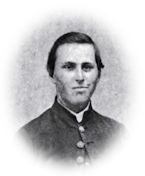
July 24th. Marching orders. Broke camp. After a short march, go into camp on high ground near the Potomac River. Plenty of water here where we could bathe and wash our clothes, hang them on the bushes and wait for them to dry. We also used the river water to drink and make coffee. The current ran very swift at this point.
(During my army life I drank, made coffee, fished, bathed, washed my clothes, waded through, its blue waters. When clear it was blue as one looked at it. When storms came it was yellow, the color of Virginia and Maryland mud.)

Thursday, 23d—We were off by 4 o’clock this morning and reached Big Black river bridge by noon. It had rained very hard here yesterday and last night, overflowing the river and causing the deep dust to become deep mud. This made our traveling very heavy, and since the rain set in again this afternoon, we moved on only about three miles and went into bivouac.
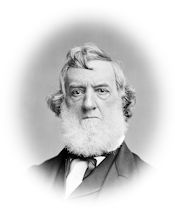
July 23, Thursday. I had a call on Monday morning from Senator Morgan and Sam J. Tilden of New York in relation to the draft. General Cochrane was present during the interview and took part in it. The gentlemen seemed to believe a draft cannot be enforced in New York.
Am feeling anxious respecting movements in Charleston Harbor. It is assumed on all hands by the people and the press that we shall be successful. I am less sanguine, though not without hopes. Fort Wagner should have been captured in the first assault. The Rebels were weaker then than they will be again, and we should have been as strong at the first attack as we can expect to be. Gillmore may have been a little premature, and had not the necessary force for the work.
Whiting, Solicitor of the War Department, has gone to Europe. Is sent out by Seward, I suppose, for there is much sounding of gongs over the mission instituted by the State Department to help Mr. Adams and our consuls in the matter of fitting, or of preventing the fitting out of naval vessels from England. This Solicitor Whiting has for several months been an important personage here. I have been assured from high authority he is a remarkable man. The Secretary of War uses him, and I am inclined to believe he uses the Secretary of War. This fraternity has made the little man much conceited. Mr. Seward, Mr. Chase, and even the President have each of them spoken to me of him, as capable, patriotic, and a volunteer in the civil service to help the Government and particularly the War Department.
I have found him affable, anxious to be useful, with some smartness; vain, egotistical, and friendly; voluble, ready, sharp, not always profound, nor wise, nor correct; cunning, assuming, presuming, and not very fastidious; such a man as Stanton would select and Seward use. Chase, finding him high in the good graces of the President and the Secretary of War, has taken frequent occasion to speak highly of Solicitor Whiting. My admiration is not as exalted as it should be, if he is all that those who ought to know represent him.
July 23.—The enrolment was resisted in the vicinity of Jarrettsville, Harford County, Md.— The First regiment of colored United States volunteers was completed at Philadelphia, Pa., and Colonel Benjamin Tilghman appointed to the command.—The draft took place in Auburn, N. Y., and every thing passed off with the best of order. The occasion, instead of being one of rioting, arson, and murder, was rather one of rejoicing and demonstrations of loyalty. The drafted men formed in procession, with a band of music, and marched through the streets cheering for the draft, the Union, etc., and in the evening listened to patriotic speeches from the Provost-Marshal, the Mayor and others.

July 23 — This afternoon we moved toward White Post. We heard cannonading this evening at Chester’s Gap near Front Royal.

Thursday, July 23d.
It is bad policy to keep us from seeing the prisoners; it just sets us wild about them. Put a creature you don’t care for in the least, in a situation that commands sympathy, and nine out of ten girls will fall desperately in love. Here are brave, self-sacrificing, noble men who have fought heroically for us, and have been forced to surrender by unpropitious fate, confined in a city peopled by their friends and kindred, and as totally isolated from them as though they inhabited the Dry Tortugas! Ladies are naturally hero-worshipers. We are dying to show these unfortunates that we are as proud of their bravery as though it had led to victory instead of defeat. Banks wills that they remain in privacy. Consequently our vivid imaginations are constantly occupied in depicting their sufferings, privations, heroism, and manifold virtues, until they have almost become as demigods to us. Even horrid little Captain C—— has a share of my sympathy in his misfortune! Fancy what must be my feelings where those I consider as gentlemen are concerned! It is all I can do to avoid a most tender compassion for a very few select ones. Miriam and I are looked on with envy by other young ladies because some twenty or thirty of our acquaintance have already arrived. To know a Port Hudson defender is considered as the greatest distinction one need desire. If they would only let us see the prisoners once to sympathize with, and offer to assist them, we would never care to call on them again until they are liberated. But this is aggravating. Of what benefit is it to send them lunch after lunch, when they seldom receive it? Colonel Steadman and six others, I am sure, did not receive theirs on Sunday. We sent with the baskets a number of cravats and some handkerchiefs I had embroidered for the Colonel.
Brother should forbid those gentlemen writing, too. Already a dozen notes have been received from them, and what can we do? We can’t tell them not to. Miriam received a letter from Major Spratley this morning, raving about the kindness of the ladies of New Orleans, full of hope of future successes, and vows to help deliver the noble ladies from the hands of their oppressors, etc. It is a wonder that such a patriotic effusion could be smuggled out. He kindly assures us that not only those of our acquaintance there, but all their brother officers, would be more than happy to see us in their prison. Position of affairs rather reversed since we last met!
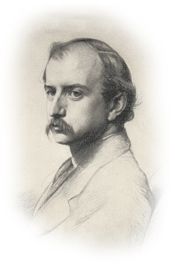
Henry Adams to Charles Francis Adams, Jr.
[London,] July 23, 1863
I positively tremble to think of receiving any more news from America since the batch that we received last Sunday. Why can’t we sink the steamers till some more good news comes? It is like an easterly storm after a glorious June day, this returning to the gloomy chronicle of varying successes and disasters, after exulting in the grand excitement of such triumphs as you sent us on the 4th. For once there was no drawback, unless I except anxiety about you. I wanted to hug the army of the Potomac. I wanted to get the whole of the army of Vicksburg drunk at my own expense. I wanted to fight some small man and lick him. Had I had a single friend in London capable of rising to the dignity of the occasion, I don’t know what might n’t have happened. But mediocrity prevailed and I passed the day in base repose.
It was on Sunday morning as I came down to breakfast that I saw a telegram from the Department announcing the fall of Vicksburg. Now, to appreciate the value of this, you must know that the one thing upon which the London press and the English people have been so positive as not to tolerate contradiction, was the impossibility of capturing Vicksburg. Nothing could induce them to believe that Grant’s army was not in extreme danger of having itself to capitulate. The Times of Saturday, down to the last moment, declared that the siege of Vicksburg grew more and more hopeless every day. Even now, it refuses, after receiving all the details, to admit the fact, and only says that Northern advices report it, but it is not yet confirmed. Nothing could exceed the energy with which everybody in England has reprobated the wicked waste of life that must be caused by the siege of this place during the sickly season, and ridiculed the idea of its capture. And now the announcement was just as though a bucket of iced-water were thrown into their faces. They could n’t and wouldn’t believe it. All their settled opinions were overthrown, and they were left dangling in the air. You never heard such a cackling as was kept up here on Sunday and Monday, and you can’t imagine how spiteful and vicious they all were. Sunday evening I was asked round to Monckton Milnes’ to meet a few people. Milnes’ himself is one of the warmest Americans in the world, and received me with a hug before the astonished company, crowing like a fighting cock. But the rest of the company were very cold. W. H. Russell was there, and I had a good deal of talk with him. He at least did not attempt to disguise the gravity of the occasion, nor to turn Lee’s defeat into a victory. I went with Mr. Milnes to the Cosmopolitan Club afterwards, where the people all looked at me as though I were objectionable. Of course I avoided the subject in conversation, but I saw very clearly how unpleasant the news was which I brought. So it has been everywhere. This is a sort of thing that can be neither denied, palliated, nor evaded; the disasters of the rebels are unredeemed by even any hope of success. Accordingly the emergency has produced here a mere access of spite, preparatory (if we suffer no reverse) to a revolution in tone.
It is now conceded at once that all idea of intervention is at an end. The war is to continue indefinitely, so far as Europe is concerned, and the only remaining chance of collision is in the case of the iron-dads. We are looking after them with considerable energy, and I think we shall settle them.
It is utterly impossible to describe to you the delight that we all felt here and that has not diminished even now. I can imagine the temporary insanity that must have prevailed over the North on the night of the 7th. Here our demonstrations were quiet, but, ye Gods, how we felt! Whether to laugh or to cry, one hardly knew. Some men preferred the one, some the other. The Chief was the picture of placid delight. As for me, as my effort has always been here to suppress all expression of feeling, I preserved sobriety in public, but for four days I’ve been internally singing Hosannahs and running riot in exultation. The future being doubtful, we are all the more determined to drink this one cup of success out. Our friends at home, Dana, John, and so on, are always so devilish afraid that we may see things in too rosy colors. They think it necessary to be correspondingly sombre in their advices. This time, luckily, we had no one to be so cruel as to knock us down from behind, when we were having all we could do to fight our English upas influence in front. We sat on the top of the ladder and did n’t care a copper who passed underneath. Your old friend Judge Goodrich was here on Monday, and you never saw a man in such a state. Even for him it was wonderful. He lunched with us and kept us in a perfect riot all the time, telling stories without limit and laughing till he almost screamed.
I am sorry to say, however, that all this is not likely to make our position here any pleasanter socially. All our experience has shown that as our success was great, so rose equally the spirit of hatred on this side. Never before since the Trent affair has it shown itself so universal and spiteful as now. I am myself more surprised at it than I have any right to be, and philosopher though I aspire to be, I do feel strongly impressed with a desire to see the time come when our success will compel silence and our prosperity will complete the revolution. As for war, it would be folly in us to go to war with this country. We have the means of destroying her without hurting ourselves.
In other respects the week has been a very quiet one. The season is over. The streets are full of Pickford’s vans carting furniture from the houses, and Belgravia and May Fair are the scene of dirt and littered straw, as you know them from the accounts of Pendennis. One night we went to the opera, but otherwise we have enjoyed peace, and I have been engaged in looking up routes and sights in the guide book of Scotland. Thither, if nothing prevents and no bad news or rebel plot interferes, we shall wend our way on the first of August. The rest of the family will probably make a visit or two, and I propose to make use of the opportunity to go on with Brooks and visit the Isle of Skye and the Hebrides, if we can. This is in imitation of Dr. Johnson, and I’ve no doubt, if we had good weather, it would be very jolly. But as for visiting people, the truth is I feel such a dislike for the whole nation, and so keen a sensitiveness to the least suspicion of being thought to pay court to any of them, and so abject a dread of ever giving any one the chance to put a slight upon me, that I avoid them and neither wish them to be my friends nor wish to be theirs. I have n’t the strength of character to retain resentments long, and some day in America I may astonish myself by defending these people for whom I entertain at present only a profound and lively contempt. But at present I am glad that my acquaintances are so few and I do not intend to increase the number.
You will no doubt be curious to know, if, as I say, I have no acquaintances, how I pass my time. Certainly I do pass it, however, and never have an unoccupied moment. My candles are seldom out before two o’clock in the morning, and my table is piled with half-read books and unfinished writing. For weeks together I only leave the house to mount my horse and after my ride, come back as I went. If it were not for your position and my own uneasy conscience, I should be as happy as a Virginia oyster, and as it is, I believe I never was so well off physically, morally and intellectually as this last year.
I send you another shirt and a copy of the Index, the southern organ, which I thought you would find more interesting this week than any other newspaper I can send. It seems to me to look to a cessation of organized armed resistance and an ultimate resort to the Polish fashion. I think we shall not stand much in their way there, if they like to live in a den of thieves.
July 23—Left at 5 this morning, went through Front Royal—seventeen miles to-day. Waded the south and north prongs of the Shenandoah River. We then took the road to Mananas Gap, marched three miles, when we met the enemy and had brisk firing until dark. Their line is very strong. They advanced in two lines in very fine order. When they got within range of our guns we opened on them, and they scattered like bluebirds. We had a beautiful view of this fight, as we are on the mountain. Neither of the armies can move without being seen by the other. Our corps of sharpshooters has been formed again since a few days ago. We were sent to the support of the other corps. We were within twenty yards of the enemy’s line until midnight, when we fell back in good order.


