Following the American Civil War Sesquicentennial with day by day writings of the time, currently 1863.

July 2013

Washington, D. C.

Newport, July 20, 1863.

My Dear Sir,—My last letters from England are not quite as favorable in regard to the attitude of the British cabinet on the question of joining France in the recognition of the Southern Confederacy, as all my previous advices have been hitherto.

My advices from well-informed friends had, until now, invariably most emphatically contradicted the many rumors of recognition and joint action by the French and English governments, set afloat for the last eighteen months by the Southern sympathizers.

The Palmerston ministry was, until now, a unit in its opposition to any departure from the strict neutrality observed since the beginning (if not in feeling, at least in official words and acts). It seems, however, now, that under the pressure of the press and a powerful opposition, and by the manœuvres of French diplomacy, but more than all, probably, under the influences of our reverses under Hooker, a minority in the ministry has changed its views, and has become favorable to an immediate recognition of the South, conjointly with France. At the last dates this was only a minority in the cabinet, but as for at least twelve days after the news from this side will continue most unfavorable to the Union cause, I fear that other members of the cabinet may change front, and that the British government may commit itself to some hasty action, from which it would be difficult to recede. There is no doubt but what all the late Southern movements have been principally directed toward the accomplishment of foreign recognition, soon to be followed by foreign aid. The mission of Stephens was planned and based upon the hopes of success on the part of Lee, and I have very little doubt but what the riots in New York were instigated by rebel agents, and were to serve as a prominent part of the schemes by which the utter hopelessness of a further struggle on the part of the North was to be made manifest to the world.

These schemes have been foiled by the bravery of our army, but it strikes me that our government might profit by the present moment in order to avoid forever hereafter the danger of foreign interference, which, with the known tendencies and sympathies of Napoleon, will always remain a strong incentive to the South for further resistance.

I think that the best and most statesmanlike step to be taken by the President at this juncture, when unprecedented successes have crowned our arms, would be issuing a proclamation addressed to the people of the revolted States, inviting them to return to their allegiance to the United States, to withdraw their citizens from the army of the so-called Confederacy, and to elect members to the Congress of the United States.

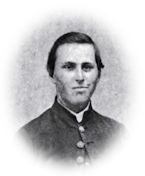
by John Beauchamp Jones

            JULY 20TH.—Nothing from Lee or from Johnston, except that the latter has abandoned Jackson. From Bragg’s army, I learn that a certain number of regiments were moving from Chattanooga toward Knoxville—and I suspect their destination is Lee’s army.

            But we have a dispatch from Beauregard, stating that he has again repulsed an attack of the enemy on the battery on Morris Island with heavy loss—perhaps 1500—while his is trifling.

            A thousand of the enemy’s forces were in Wytheville yesterday, and were severely handled by 130 of the home guards. They did but little injury to the railroad, and burned a few buildings.

            An indignant letter has been received from the Hon. W. Porcher Miles, who had applied for a sub-lieutenancy for Charles Porcher, who had served with merit in the 1st South Carolina Artillery, and was his relative. It seems that the President directed the Secretary to state that the appointment could not be given him because he was not 21 years of age. To this Mr. M. replies that several minors in the same regiment have been appointed. I think not.

            Governor Brown writes a long letter, protesting against the decision of the Confederate States Government, that the President shall appoint the colonel for the 51st Georgia Regiment, which the Governor says is contrary to the Confederate States Constitution. He will resist it.

            A Mrs. Allen, a lady of wealth here, has been arrested for giving information to the enemy. Her letters were intercepted. She is confined at the asylum St. Francis de Sales. The surgeon who attends there reports to-day that her mental excitement will probably drive her to madness. Her great fear seems to be that she will be soon sent to a common prison. There is much indignation that she should be assigned to such comfortable quarters—and I believe the Bishop (McGill) protests against having criminals imprisoned in his religious edifices. It is said she has long been sending treasonable letters to Baltimore—but the authorities do not have the names of her letter-carriers published. No doubt they had passports. [click to continue…]

July 20th. We left Upperville, near Snicker’s Gap. very early in the morning, having served in the 3d Corps, Army of the Potomac about five weeks. On the march back we met the 12th Corps, meeting the 5th and 20th Connecticut Regiments of that corps. Met Charlie Corey, a boyhood friend from my old home in Hanover, New London County. It was a short meeting but we talked fast. Charlie had been in service a little over two years in the 5th Regiment, while I had been in eleven months. His mother often read his letters to me before I came to be a soldier. A pleasant meeting for a few moments. On our backward march we kept pushing along, stopping to rest at one point. Blackberries grew wild, we picked our coffee cups full and ate them while we marched along. Nothing of special interest took place, but by the time we reached Harper’s Ferry, twenty miles march, we were tired and foot-sore. After a short rest and rations we were obliged to push on toward Sharpsburg, twenty miles further on. Darkness coming on we did not have the hot sun beating down upon us. The marching was over rough, stony roads, up hill and down. Reaching Sharpsburg along in the night, we learned the boys were in camp about two miles out of town, so we pushed on, reaching the camp at midnight, a march of about forty miles. The boys were sleeping, except the guard and the pickets. They did not know that we had arrived. We were glad to drop down on the ground and get sleep and rest after the severe march from Upperville, Virginia, to the town of Sharpsburg, Maryland. The command now numbered about two hundred. Consolidated into two companies. Our meeting was a very happy one. We talked over the events that had taken place during the past few weeks that we had been separated, and wondered how our boys in prison were getting along.

Sunday, 19th—Company E with three other companies, one from each regiment, went out on picket this morning. Our company is stationed on the south side of a vacant field. Off to the north on the other side of the field and just in the edge of the timber on high ground, we can see the rebel cavalry, but they are careful to keep their distance. We have fine times on picket now, with little danger of being attacked and plenty of fruit to eat. We have green corn, too, and the fields nearby are being pretty well picked over. One of the boys came in with a hundred ears of corn. He roasted fifteen of them in the campfire ashes, ate all of them, and declared that he could eat two or three more.

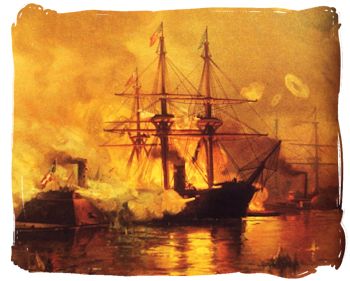
July 19.—At Charleston, S. C., a large side-wheel steamer, endeavoring to run into the harbor, was chased by the Canandaigua, and other outside blockaders, and finally driven upon the shoals by Commander George W. Powers, of the Kaatskill, then anchored abreast of Fort Wagner, on picket-duty. The steamer was fired by her crew, and was totally destroyed. —Rear-Admiral Dahlgren’s Report.

—Greenville and Sparta, N. C., were visited by the National forces, under the command of Brigadier-General Potter, and every thing at those places belonging to the rebel government destroyed.—(Doc. 101.)

—James B. Fry, Provost-Marshal General, issued the following circular: “Existing laws make a distinction in the matter of pay, bounties, or other allowances, between soldiers of African descent and other soldiers in the service of the United States. Men of African descent can only be accepted as substitutes for each other, under the Enrolment Act.”—The battle of Buffington Island, Ohio, was fought this day.—(Doc. 47.)

—At Cleveland, Ohio, Bishop Rappe preached a sermon in the cathedral, on the subject of riots in New-York. He was unsparing in bitter denunciation of the mob that had committed such outrages. He warned his hearers against any act that tended in any degree to provoke like scenes there. He said that the laws must be obeyed, and the conscription law quietly submitted to among the rest He urged the members of his flock to attend strictly to their business, and not even to discuss the question of the draft. If any of them were drafted, and could not procure exemption, they must do their duty to the country as soldiers. If the drafted man was poor, and no provision had been made by the city or county for the relief of his family, they should be cared for by the Church.

He warned them not to ill-treat the colored people. A colored man had as much right to live and to labor for his living as a white man had, and their right must be respected. It was cowardly and sinful to molest these people, because their skin was of a different color.

He also spoke against the practice of demanding extortionate wages. It was wrong and wicked to extort from employers more than the fair price of their labor.

Finally, he warned them not to provoke a breach of peace in any manner, and said that he had pledged his word, as a Catholic Bishop, to the citizens of Cleveland, that there should be no disturbance from the Catholic Irish, and he looked to them that his pledge should not be broken.

July 19th. At seven A. M., steamer Albatross came up the river, with the gunboat Sciota in tow, the latter being out of repair; at nine thirty this morning, inspected crew and ship, and at ten, called all hands to muster on quarterdeck, where Divine services were performed, Commodore Palmer’s clerk, Nathaniel P. S. Thomas, officiating. Read General Order No. 16, from Navy Department, Washington, D. C., upon the death of Rear-Admiral Foote, who died at the Astor House, N. Y., lately, surrounded by his numerous friends and associates, who deeply deplore his loss. He had been ordered to relieve Admiral Dupont, in command of the South Atlantic Blockading Squadron, off Charleston, and was on his way to perform that duty, when he was taken sick in the city of New York, and as I have stated, death ensued. This afternoon, gunboat Estrella went down the river, and the Arizona arrived from Vicksburg.

19th. Moved at daylight. Soon came upon rebel pickets and fired. Skirmishing. Dismounted 2 and 7 and went forward. One man wounded soon. Mich. Battery came up and one piece fired shell. Almost simultaneously Gen. Judah and gunboats opened. We heard musketry 10 minutes before ours. Before 10 minutes the rebels broke in a perfect rout, most complete, left wagons, cannon and any amount of plunder. I soon changed clothes, light clothes. Went with skirmishers, got several shots. Rested till 4 P. M. Marched up the river near Tupper’s Plains, and then bivouacked. Rather hungry—all of us.

Sunday, 19th.—Found some of 36th regiment here; having fine time eating watermelons and peaches. Drew three days’ rations; bought a dressed chicken and came very near killing myself eating; very sick for a little while.

19th.—When shall we recover from this fatal trip into Pennsylvania? General Pettigrew, of North Carolina, fell on the retreat, at a little skirmish near the Falling Waters. Thus our best men seem to be falling on the right hand and on the left. When speaking of General P’s death, a friend related a circumstance which interested me. General P. was severely wounded at the battle of “Seven Pines.” He was lying in a helpless condition, when a young soldier of another command saw him, and, immediately stooping to the ground, assisted him in getting on his back, and was bearing him to a place of safety, when he (the soldier) was struck by a ball and instantly killed. The General fell to the ground, and remained there, unable to move, until he was captured by the enemy. He was subsequently incarcerated in Fort Delaware. Having learned from the soldier, while on his back, that his name was White, from Westmoreland County, Virginia, as soon as the General was exchanged he inquired for the family, and found that the mother was a respectable widow who had had five sons on the field, but one of whom survived. He immediately wrote to her, expressing his deep sense of obligation to her son for his gracious effort to save his life, delicately inquired into her circumstances, and offered, if necessary, to make a liberal provision for her. I did not learn the widow’s reply.

We have had this week a visit of two days from Mrs. General Lee. She was on her way to the Hot Springs in pursuit of health, of which she stands greatly in need. She is a great sufferer from rheumatism, but is cheerful, notwithstanding her sufferings, bodily and mentally. She is, of course, unhappy about her imprisoned son, and, I should suppose, about the overpowering responsibilities of her noble husband; but of that you never hear a word from her. She left us this morning, in a box car, fitted up to suit an invalid, with a bed, chairs, etc. She was accompanied by the lovely wife of her captive son, also travelling in pursuit of health. Greater beauty and sweetness rarely fall to the lot of woman; and as I looked at the sad, delicate lineaments of her young face, I could but inwardly pray that the terrible threats denounced against her husband by Yankee authority might never reach her ear; for, though we do not believe that they will dare to offer him violence, yet the mere suggestion would be enough to make her very miserable. Yesterday morning we had quite a pleasant diversion, in attending a marriage in the village. Mr. —— performed the ceremony, and we afterwards breakfasted with the bridal party. We then proceeded to Richmond—they to spend their honeymoon in and around the city, and we to our duties there.

Sunday, July 19.—This morning Dr. Quintard preached to a crowded house. Almost every general in the army was present. I saw General Polk; he is really a noble-looking man. One of his daughters was with him. She is very pretty.

Dr. Q. preached a very fine sermon. His text was, “For we are journeying unto the place of which the Lord hath said, I will give it you.” In the afternoon Dr. Cannon preached a sequel to it; an excellent one.

The first was reminding us that, whether in peace or war, there was a journey we were all taking, that sooner or later would come to an end; and warning us to prepare to enter into that land which the Lord has prepared for those who keep his commandments. The last was telling us about the blessed rest which God had prepared for his people. How many such teachings do we despise!

“It is written, As I live, saith the Lord, every knee shall bow to me, and every tongue shall confess to God.”

We fall down and worship, but certainly not the Maker and Ruler of all things. There are few who would like being called the enemies of God, and yet has he not said, He that is not with me is against me? And are we not commanded to worship him with our whole heart? I know of many, apparently good men, who do not seem to think that they have any right to confess Christ before men; and these men know in their hearts that the Bible is no fable, and yet they reject its teachings every hour of their lives. When I ask these men why they live so, the answer often is that there are so many wicked men in the church. I sometimes ask them if that is the answer they intend giving the Judge of all on that great day when we shall have to give an account, not of what our neighbors have done, but what we ourselves have? I scarcely think the excuse will avail, that we went astray because our neighbor did, and because some in the Church


“Have erred, and some are slow to lead us right,

Stopping to pry, when stuff and lamp should he in hand.”


We do not reason thus about our worldly affairs. Why should we not use common sense regarding our spiritual ones? “To him that knoweth to do good, and doeth it not, to him it is sin.” There is no more sublime sight than the man of intellect and great mind, bowing in adoration to his Maker.

A good moral man without religion is like a mariner trying to find his way through the seas without a compass.


“God never meant that man should scale the heavens

By strides of human wisdom. In his works,

Though wondrous, he commands us in his word

To seek him rather where his mercy shines.”