11. — Moved to foot of Cotton Hill, Fayette side.
July 2013
11th. Started at daylight. Thede, Steve and I went ahead to town. Several met us with “Have you been to breakfast?” “Come with us.” We accepted an invitation of a gentleman, but a Mr. Lyon insisted on Thede and me going with him. Very pleasant people. Wanted to do everything for us. A girl, Emma, Ella or Anna Lyons, beautiful girl, 16 or 17 years. She went up town and we had a good visit here. Brought me some paper. Wrote home and to Fannie. Depot and bridges burned. Stores gutted. Levies made upon the people. A good many pretty girls—one Miss Reed. Oh it cheered our hearts to meet with such kindness and friends. Passed through Lexington and camped at 12 P. M. Morgan 25 miles.
July 11, Saturday. Am sorry to see in the New York Tribune an attempt to compliment me by doing injustice to Mr. Seward. On the question of the French tobacco we differed. I think it should remain in Richmond until the blockade is raised. In regard to the claims of Spain to a maritime jurisdiction of six miles, Mr. S., though at first confused and perplexed, seemed relieved by my suggestion. I apprehend that Mr. Fox, who is intimate with one of the correspondents of the Tribune, may, with the best intentions to myself, have said something which led to the article. It may have been Mr. Sumner, who is acquainted with the facts, and often tells the newspaper people things they ought not to know and publish.
I fear the Rebel army will escape, and am compelled to believe that some of our generals are willing it should. They are contented to have the War continue. Never before have they been so served nor their importance so felt and magnified, and when the War is over but few of them will retain their present importance.
I directed Colonel Harris a few days since to instruct the Marine Band when performing on public days to give us more martial and national music. This afternoon they begun strong. Nicolay soon came to me aggrieved; wanted more finished music to cultivate and refine the popular taste, — German and Italian airs, etc. Told him I was no proficient, but his refined music entertained the few effeminate and the refined; it was insipid to most of our fighting men, inspired no hearty zeal or rugged purpose. In days of peace we could lull into sentimentality, but should shake it off in these days. Martial music and not operatic airs are best adapted to all.
July 11. — The Maryland Brigade under General Kenly joined us to-day, and was assigned to Rowley’s division, thus putting Kenly in command of the division. Nothing new occurred to-day. Weather warm and sultry. A regular dog-day. General Newton went to a council of war this evening.
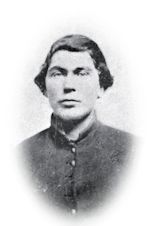
Vicksburg, Saturday, July 11. Very warm and dull. Officers all drunk. In the evening 1st Brigade band serenaded Captain Dillon, after which they were seated, treated and played and played and drank. Songs were sung and beautiful music played, but the demon of the bowl prevailed, the leader of the band soon became unable to go farther, and a scene befitting a groggery ensued. All seemed to have lost all respect for best principles. Too bad. These men left home with great pretensions of temperance; even now it would be difficult to convince those left behind otherwise; but whiskey is used by our officers more freely than water, and that too is what they draw for the men mostly. Many a dark thing behind the curtain in this world.
Troubled with toothache all day and at night Dr. Brady took it out at the third hitch. Oh!
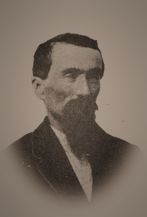
July 11 —In camp to-day. Weather hot. General Lee’s army is in line of battle about two miles from our camp, and near Hagerstown.
July 11.—This morning at daybreak the National forces on Morris Island, under the command of General Gillmore, attempted to carry Fort Wagner by assault. The parapets were gained, but the supports recoiled under the fire to which they were exposed, and could not be got up. Captain S. H. Gray, commanding twp companies of the Seventh Connecticut regiment, gives the following report of the affair: After the success of yesterday “we bivouacked for the night under easy range of Fort Wagner. About half-past two A.M., General Strong came and called the Lieutenant-Colonel out. Ho soon returned and said: ‘Turn out! we have got a job on hand.’ The men were soon out and into line, but rather slow to time, as they were tired with the work the day before.
“The programme was to try to take Fort Wagner by assault; we were to take the lead, and to be supported by the Seventy-sixth Pennsylvania and Ninth Maine. Silently we moved up to the advance-line of our pickets, our guns loaded and aimed, and bayonets fixed. We were then deployed into line of battle, (we had one hundred and ninety-one men and officers, all told,) reached and crossed the neck of land that approached the Fort, our right resting on the beach. We were deployed and ready for the start. Our orders were to move steadily forward until the pickets fired, then follow them close and rush for the works, and we were promised ready support. General Strong gave the order: ‘Aim low, and put your trust in God. Forward the Seventh!’ And forward we went, being not over five hundred yards from the Fort when we started.
“We had not gone far before the picket fired, and then we took the double-quick, and with a cheer rushed for the works. Before we reached the outer work, we got a murderous fire from the riflemen behind the works. A few fell— a check in the line. An encouraging word from the officers, and right gallantly we reached the outer works; over them with a will we went; down the opposite side, across the moat—there being about one foot of water in it—right up to the crest of the parapet; and there we lay, anxiously waiting for our support to come up so far as to make it a sure thing for us to rise up and go over with a bound; our men in the mean time busying themselves by picking off the sharpshooters and gunners. We lay so near the top that one had to put his head up and point across the parapet to kill his man.
“As near as I can ascertain, we were in this position from ten to twenty minutes, when both of the regiments that were to support us broke and fled, leaving us to take care of ourselves as best we might. As soon as the regiment in front broke and ran, they paid particular attention to our case. They threw hand-grenades over the parapet, and soon sent men into the flank of a bastion, which commanded the front upon which we lay. They had us there at a great disadvantage. The question was whether we should surrender as prisoners, attempt to carry the works, and to be entirely annihilated, (as they greatly outnumbered us,) or take the back-track and run the gauntlet for our lives.
“Upon consulting the Lieutenant-Colonel, he reluctantly gave the order to retreat. Lieutenant Phillips exclaimed: ‘For God’s sake, don’t let us retreat.’ As if by magic, the order was recalled, and although some had started, they returned; but the order had to be repeated, and down in and across the moat we went over the works. They had a perfect enfilading fire of small-arms for a thousand yards—besides, their pieces were giving us grape and canister. They fell on all sides of me, and I alone of four captains was spared, and out of one hundred and ninety-one officers and men that marched out to attack the foe, only eighty-eight returned safe to camp; and ever let it be said, to the credit of the Seventh Connecticut volunteers, that not one straggler could be discovered. Fifteen minutes after we got in camp, the roll was called, and but one man came in afterwards, and he was delayed in assisting a wounded comrade.
“Met General Strong coming off, and with tears in his eyes he said we had done our whole duty, and covered ourselves all over with glory, and if the support had come in time, that ‘we should have taken the works,’ and without a doubt we should have done so. But our loss is great. We had eleven officers in our mess. Now we have but four. It is hard, but such is the fate of war.
“Our attack on the tenth July was a fearful surprise to them. They had but few troops on this Island. Had they five thousand infantry here, the natural defences are of such a character, that we never could have taken it.”
The National losses in the actions of yesterday and to-day, were one hundred and fifty killed, wounded, and missing. Eleven pieces of heavy ordnance and a large quantity of camp equipage was taken from the rebels, who lost two hundred men in casualties. — General Gillmore’s Report.
—At New-York the draft was begun and carried on without any disturbance.—The First National Bank of Pennsylvania announced business at Philadelphia.—Lieutenant A. L. Sanborn, of the First regiment of colored volunteers, was killed at Norfolk, Va., by Dr. David M. Wright, a prominent rebel physician of that place.—A grand torchlight procession took place at New Orleans in honor of the capture of Port Hudson and Vicksburgh, and “to celebrate the redemption of the South-West from treason and rebellion.”—Vernon, Indiana, was visited by the rebels under John Morgan.—(Doc. 47.)
—The rebels evacuated Hagerstown, Md., last evening, but returned to the town again to-day.— A sharp engagement took place on the Hagerstown road, resulting in the defeat and pursuit of the rebels to Funkstown, where a strong rebel position was found.—William McKee, one of the proprietors of the St. Louis Democrat, was put under arrest by order of General Schofield, for the publication of the letter of President Lincoln to General Schofield, explaining the reasons for the removal of General Curtis, and for refusing to state in what manner such letter came into his hands.—The rebel forces under John Morgan reached Vienna, Indiana, at one o’clock this morning, and burned the dépôt and bridge belonging to the Jefferson Railroad at that place.— (Doc. 47.)
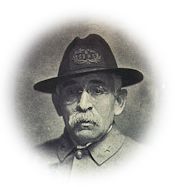
July 11—Orders read out to-day from our father, R. E. Lee, that we would fight the enemy once more on their own soil, as they were now in our front. That order got to them, and fulfilled its mission, as we were then on our way to the Potomac. They still thinking we could not cross the river, because the river was very high from the recent rains, and we had but one pontoon bridge. At 10 in the night we formed in line of battle, got to our position, when our regiment was ordered to support a battery. Laid on our arms all night.
Thursday, 9th—Saturday, 11th—All quiet. Put on one month’s roots for the Kentucky trip; read at dress parade yesterday evening; commenced this morning.
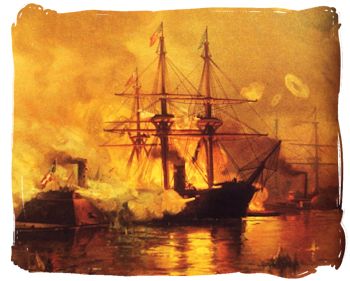
July 11th. Commences with light winds from the westward; at four forty-five A. M. got under way and steamed down the river; at nine ten went to general quarters; at nine thirty anchored off Donaldsonville; at ten fifty went to general quarters once more, and prepared for action; fired the forward Parrott rifle at the different points as we passed; fired the broadside guns at embrasures cut in the levee from which our vessels lately were fired upon by pieces of rebel flying artillery, but received no response; steaming down the river in charge of pilot; passed between the hours of twelve and four P. M., the sloop-of-war Monongahela and iron-clad Essex, gunboat, at anchor; the lads manned the rigging and cheered ship, which was vociferously returned by them; the steamers Albatross and Estrella were in company with us; about five P. M., passed the U. S. sloop-of-war Portsmouth anchored off Carrollton; from her we received another cheer which we quickly returned; she also dipped her colors as we were passing; cheer upon cheer rent the air from youngsters and grown-up persons on shore, who had seen us approaching, and flocked down to the levee to give expression to their feelings of joy at seeing the noble old ship Hartford once more, which they had begun to have a sort of veneration for on account of the great deeds she had performed, making her name to be held in dread by all traitors to their country; about six thirty passed the Pensacola, rounded to and at six thirty-five had ship cheered by Pensacola and Tennessee, which we returned; at six forty came to anchor off the city of New Orleans. Soon, the news spread of our arrival, and crowds of people flocked down to the levee to see us once more; they were informed by those in sympathy with the rebels, (loyal now because they were forced to be to save their property from confiscation, and themselves from being sent beyond our lines), that in attempting to pass the batteries at Port Hudson on the 14th of March last we had been sunk, and they, in proof of the truth of their statement, referred to the fact that when the Hartford left New Orleans last, she was painted black, and the vessel before them was of a light lead color; in fact they so talked their theory into them that they believe it to be the truth; even the statement of the Era, a daily loyal sheet, that the Hartford had arrived, was not believed, and some of our boys ashore on liberty, with the ship’s name on their hats, could not make them believe any different; in fact, they could not be made to believe it until parties had been on board who were acquainted with some of our officers, and returned, having seen them, and learned we had the power of changing our plumage wherever we might be.


