Vicksburg, Friday, July 10. Everybody busy preparing permanent quarters. Tarpaulins spread over picket rope. Water the horses in the river twice a day, passing through the center of Vicksburg. It is planted on very rough ground, very scattering with the exception of the first streets. Notwithstanding the lay of the country, it is made beautiful by shrubbery and shade trees which are liberally and beautifully planted along the street.
July 2013
July 10 — The Yankees advanced again this morning on the National Road, and we moved about two miles below Funkstown and opened fire on their advancing cavalry. We did not hold our position very long, as the enemy had too many dismounted sharpshooters crawling up on us, and their long-range rifles rendered our position untenable for artillery, and we retired.
We fell back a mile and took another position. We were then only a mile below Funkstown. The Yankees advanced on us again, and we opened fire on them, and held our ground until we fired the very last round of ammunition we had; then we moved back across the Antietam. Just at that juncture of affairs a brigade of our infantry and several batteries came to our relief, and they kept up a lively skirmishing and sharpshooting with some cannonading until night. When the firing ceased at dusk both sides held the respective positions they had when the firing commenced.
In consequence of being entirely out of ammunition we were ordered to the rear. In moving to the rear we passed through Hagerstown, the county seat of Washington County. The town is situated in a section of beautiful country, on the National Road, sixty-five miles from Baltimore and six miles from the Potomac River; it contains some five or six thousand inhabitants. The buildings are mostly of brick, close together, well built and kept in good condition; the streets straight, run at right angles, and are almost level; the sidewalks are well paved with brick.
Camped between Hagerstown and Williamsport.
July 10th.
Shall I cry, faint, scream, or go off in hysterics? Tell me which, quickly; for to doubt this news is fine and imprisonment, and if I really believe it I would certainly give way to my feelings and commit some vagaries of the kind. My resolution is formed! I will do neither; I won’t gratify the Yankees so much. I have been banging at the piano until my fingers are weary, and singing “The Secret through Life to be Happy” until my voice is cracked; I’ll stand on my head if necessary, to prove my indifference; but I’ll never believe this is true until it is confirmed by stronger authority.
Day before yesterday came tidings that Vicksburg had fallen on the 4th inst. The “Era” poured out extras, and sundry little popguns fizzled out salutes. All who doubted the truth of the report and were brave enough to say so were fined or imprisoned; it has become a penal offense to doubt what the “Era” says; so quite a number of arrests were made. This morning it was followed up by the announcement of the capture of Port Hudson. The guns are pealing for true, and the Yankees at headquarters may be seen skipping like lambs, for very joy. And I still disbelieve! Skeptic! The first thing I know that “Era” man will be coming here to convert me! But I don’t, can’t, won’t believe it! If it is true, — but I find consolation in this faith: it is either true, or not true, — if it is true, it is all for the best, and if it is not true, it is better still. Whichever it is, is for some wise purpose; so it does not matter, so we wait, pray, and believe.
5 o’clock, P.M.
I don’t believe it? What am I crying about then? It seems so hard! How the mighty are fallen! Port Hudson gone! Brother believes it. That is enough for me. God bless him! I cry hourly. He is so good and considerate. He told me, “Name your friends, and what can be done for them shall be attended to. The prisoners will be sent here. Maybe I cannot do much; but food and clothing you shall have in abundance for them when they arrive.” God bless him for his kindness!
O dear, noble men! I am afraid to meet them; I should do something foolish; best take my cry out in private now. May the Lord look down in pity on us! Port Hudson does not matter so much; but these brave, noble creatures! The “Era” says they had devoured their last mule before they surrendered.
Saturday, July 10th, 10 o’clock P.M.
I preach patience; but how about practice? I am exasperated! there is the simple fact. And is it not enough? What a scene I have just witnessed! A motley crew of thousands of low people of all colors parading the streets with flags, torches, music, and all other accompaniments, shouting, screaming, exulting over the fall of Port Hudson and Vicksburg. The “Era” will call it an enthusiastic demonstration of the loyal citizens of the city; we who saw it from upper balconies know of what rank these “citizens” were. We saw crowds of soldiers mixed up with the lowest rabble in the town, workingmen in dirty clothes, newsboys, ragged children, negroes, and even women walking in the procession, while swarms of negroes and low white women elbowed each other in a dense mass on the pavement. To see such creatures exulting over our misfortune was enough to make one scream with rage. One of their dozen transparencies was inscribed with “A dead Confederacy.” Fools! The flames are smouldering! They will burst out presently and consume you! More than half, much more, were negroes. As they passed here they raised a yell of “Down with the rebels!” that made us gnash our teeth in silence. The Devil possessed me. “O Miriam, help me pray the dear Lord that their flag may burn!” I whispered as the torches danced around it. And we did pray earnestly— so earnestly that Miriam’s eyes were tightly screwed up; but it must have been a wicked prayer, for it was not answered.
Dr. S—— has out a magnificent display of black cotton grammatically inscribed with “Port Hudson and Vicksburg is ours,” garnished with a luminous row of tapers, and, drunk on two bits’ worth of lager beer, he has been shrieking out all Union songs he can think of with his horrid children until my tympanum is perfectly cracked. Miriam wants to offer him an extra bottle of lager for the two places of which he claims the monopoly. He would sell his creed for less. Miriam is dying to ask him what he has done with the Confederate uniform he sported before the Yankees came. His son says they are all Union men over there, and will “lemonate” (illuminate) to-night. A starving seamstress opposite has stuck six tallow candles in her window; better put them in her stomach!
And I won’t believe Vicksburg has surrendered! Port Hudson I am sure has fallen. Alas, for all hopes of serving the brave creatures! the rumor is that they have been released on parole. Happily for them; but if it must go, what a blessed privilege it would have been to aid or comfort them!
July 10.—Lord Palmerston, in a speech in the House of Commons, requesting Mr. Roebuck to submit to a postponement of the debate on the question of the recognition, of the confederate States, declared anew his hostility to the policy of recognition, and the unchanged sentiments of “Her Majesty’s Government” on the subject His language was:
“It is not likely, I think, that the House would agree either to the motion of the honorable and learned member for Sheffield, or to the amendment which has been moved to it; and, indeed, I think it very disadvantageous to the public service that any such resolution should be adopted. Therefore the discussion, as far as any practicable results may have been expected by those who are in favor of the motion, would have no important effect. I can assure the House, whereas now it is plainly acknowledged by every body, that the wishes of the Emperor of the French to find a fitting opportunity for advising the reestablishment of peace in America are not changed, that, on the other hand, her Majesty’s Government do not see that that opportunity has arisen.”
—The expedition under General J. G. Blunt reached Cabin Creek, fifty-five miles from Fort Gibson.—Thirty-one battle-flags captured by the National forces at Gettysburgh, were sent to the War Department by Major-General Meade.— (Doc. 92.)
—The siege of Jackson, Miss., was commenced this day by the Union forces under General Grant. It began by skirmishing on the Clinton road with musketry and artillery; shells were thrown into the city, and several persons were killed and wounded.—Mobile Advertiser, July 18.
—As artillery and cavalry battle took place at a point on the road from Boonsboro to Hagerstown, Md., between the Union forces under Generals Buford and Kilpatrick, and the rebels belonging to the army of General Lee.—(Doc. 32.)
—Major-General Schenck, from his headquarters at Baltimore, issued an order regulating the treatment of rebel prisoners in his department—The Mayor of Lynchburgh, Va,, issued a proclamation to the citizens of that place, requesting them to suspend business on Friday afternoons, in order that the members of the different military organizations might have an opportunity of attending regularly the drills of their respective companies….
“It is high time,” said he, “that we should act, and act at once, toward putting ourselves in readiness for any emergency.”
—General Joseph E. Johnston, at Jackson, Miss., issued the following battle order to the troops of his army. It “was read along the line amid deafening shouts:”
“Fellow-soldiers: An insolent foe, flushed with hope by his recent success at Vicksburgh, confronts you, threatening the people, whose homes and liberty you are here to protect, with plunder and conquest. Their guns may even now be heard as they advance.
“The enemy it is at once the duty and the mission of you brave men to chastise and expel from the soil of Mississippi. The Commanding General confidently relies on you to sustain his pledge, which he makes in advance, and he will be with you in the good work even unto the end.
“The vice of ‘straggling’ he begs you to shun, and to frown on. If needs be, it will be checked by even the most summary remedies.
“The telegraph has already announced a glorious victory over the foe, won by your noble comrades of the Virginia army on Union soil; may he not, with redoubled hopes, count on you while defending your firesides and household gods to emulate the proud example of your brothers in the East?
“The country expects in this, the great crisis of its destiny, that every man will do his duty.”
General Johnston ordered all pillagers to be shot, the guard to shoot them wherever found.
—Martial law was declared at Louisville, Ky.—The letter of William Whiting, Solicitor to the National War Department, to the members of the Fremont League, was published.— Salem, Ind., was visited and sacked by the rebel forces under John Morgan; the railroad bridge over the Blue River was also destroyed by the same parties.—(Doc. 47.)
—The National forces under the command of General Q. A. Gillmore, at five o’clock this morning, made an attack upon the rebel fortifications on the south end of Morris Island, in the harbor of Charleston, S.C., and after an engagement of over three hours, captured all the strongholds in that part of the Island, and pushed forward their infantry to within six hundred yards of Fort Wagner. The attacking party was gallantly led by Brigadier General George C. Strong. It landed from small boats under cover of the National batteries on Folly Island, and four monitors, led by Rear-Admiral Dahlgren, which entered the main channel abreast of Morris Island, soon after the Union batteries opened. The monitors continued their fire during thp rest of the day, principally against Fort Wagner. — General Gillmore’s Report.— (Doc. 147.)
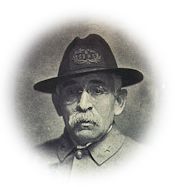
July 10—Moved four and a half miles on the other side of town. We have fortified ourselves here.
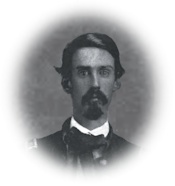
Headquarters Delaware Department,
Wilmington, Del., July 10th, 1863.
My dear Mother:
I know I ought to be thankful in my present pleasant position, but somehow or other I was not born to enjoy sinecures. Doing nothing makes me very fretful. I had a capital good time while on Maryland Heights, feeling well repaid for my trip thither, but after leaving, I have been bored to death with the ennui of city soldiering. To be sure we are feted, and take our places among the Princes of Delaware, still, my dear mother, it was not for this I left home, and I cannot, with all the idle time on my hands, avoid regretting the pleasant summer plans we had arranged in old Conn. It is six years since I have strolled about the streets of Norwich the whole summer long. Norwich was never more beautiful than now. So I suppose I feel disappointed at being so peacefully employed at the seat of war. Still here we are, General and Staff—persons of distinction—Ahem! I am on hand in case I am called for. I don’t owe my position to Gov. Buckingham, and I expect to get home to my studies in the fall. Good things, all of them! Besides this, I am raising whiskers. I am reading Kinglake’s “Crimea.” I have given up smoking. Think of that! You see, at first, when I found there was little to do, I smoked vigorously to pass away time. But when the cigar was smoked, there was an end to the amusement, so I then determined to break off smoking altogether, and, to make it exciting, I kept a handful of cigars in my pocket so that the temptation might be frequently incurred. Whenever I longed for a fragrant Havana, I would take one in fingers, and then sitting back in my chair, reason philosophically on the pernicious effects of tobacco. On reaching the point of conviction, I would return it to my pocket unlighted. This, you see, has afforded me a very excellent pastime.
Occasionally Bishop Lee’s benignant face shines upon us. Everyone worships the Bishop here, and how he deserves it, you know well.
Am very sorry for Capt. Nichols. The opposition is a mistake. However, I should as soon think of breaking my heart for a Bedlamite Hag, as for one who rejected me on the grounds of prudence. So perhaps Nichols is not so unlucky as he thinks himself. Now that I have practically abandoned military life, I have a fancy Gov. Buckingham made a mistake in persistently ignoring my claims to promotion. I fancy I would have done him more credit than some of his appointments. This may be vanity.
Written in haste
with affectionate intent,
W. T. Lusk.
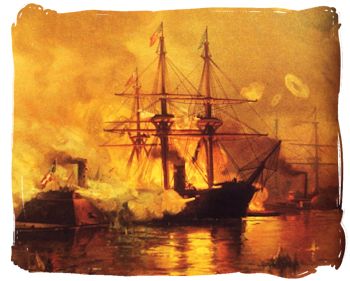
July 10th. At six o’clock this morning we hove up anchor, got under way, and steamed up to the batteries at Port Hudson, the Albatross in company with us. Came to anchor off same; hove up anchor and shifted our berth on account of eddies; some of our officers left the ship to visit the place which had lately gained so much notoriety; at eleven thirty Major-General Banks visited the ship, and at twelve forty-five left same to go ashore; the blue jackets manned the rigging and gave him three cheers, which he acknowledged by uncovering his head and politely bowing; at one o’clock got under way again and started down the river. When a short distance below Port Hudson passed and spoke the gunboat Winona coming up; she stated that she had despatches from the Admiral for Commodore Palmer and Capt. Jenkins of the U. S. steam sloop-of-war Richmond. We told her to come within hail, but since she did not seem to hear us, still keeping on her course, we sent the Albatross up after her to get the despatches for first-named party. We continued on our way down the Mississippi; at five thirty came to anchor off Baton Rouge.
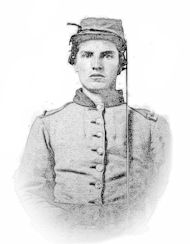
Friday, 10th.—Some better. Suppose we will start Sunday, but know nothing definite.
Whiskey Rations.
July 10. This being an isolated post and several miles from any commissary or sutler, the officers feared it would be terribly infected with malaria; having regard for the health and welfare of the men, they prevailed on our assistant surgeon, Doctor Flagg, to order whiskey rations. Up went the order and down came the whiskey, and now the order is to drink no more river water, but take a little whiskey as a preventive. This will prove a terrible hardship to the boys, but the surgeon’s orders are imperative. The boys in camp get their whiskey at night, and the pickets in the morning when they come in. After a barrel of whiskey has stood out all day in the sun and got about milk warm, it is curious to observe the boys while drinking it. Some of them with rather tender gullets will make up all manner of contortions of face trying to swallow it, but will manage to get it down and then run about fifteen rods to catch their breath. Commanders of companies deal out the whiskey to their men, consequently I deal out to mine, and when I wish to reward any of my braves for gallant and meritorious conduct, I manage to slop a little extra into their cups. That keeps them vigilant and interested and gallant. Meritorious conduct consists in bringing in watermelons, peaches and other subsistence, of which they somehow become possessed.
July 10 — Wm. Hill died last night. My friend (?) died day before yesterday. We are expecting to leave here tomorrow morning. WRC


