Following the American Civil War Sesquicentennial with day by day writings of the time, currently 1863.

Thursday, August 8, 2013

August 8.—To secure and preserve discipline, provide against disaster from the elements or attack by the enemy, an order was issued from the “War Department, compelling the organization of troops on board government transports, and regulating their transportation.—Governor Horatio Seymour, of New-York, replied to the letter of President Lincoln, relative to the draft.

—This morning, the rebel steamer Robert Habersham, which had been occupied in watching the Union advance movement up the Savannah River, was entirely destroyed by an explosion of her boiler, while lying off Scrieven’s Ferry. The entire crew were either killed or mortally injured.

—A special order was issued by Brigadier General Mercer, in command at Savannah, Ga., impressing into the rebel service, one fifth of the able-bodied male slaves in Eastern, Southern, and South-western Georgia, for the purpose of erecting additional fortifications for the defence of Savannah. “Transportation will be furnished them and wages paid at the rate of twenty-five dollars per month. The Government will be responsible for the value of such negroes as may be killed by the enemy or may in any manner fall into his hands.”

—The gunboat Sagamore captured the sloop Clara Louisa, and schooners Southern Rights, Shot, and Ann, while endeavoring to evade the blockade of Key West, Florida.

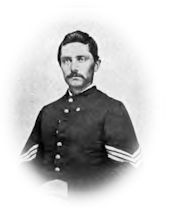
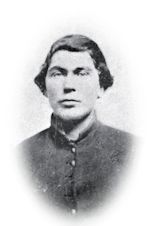
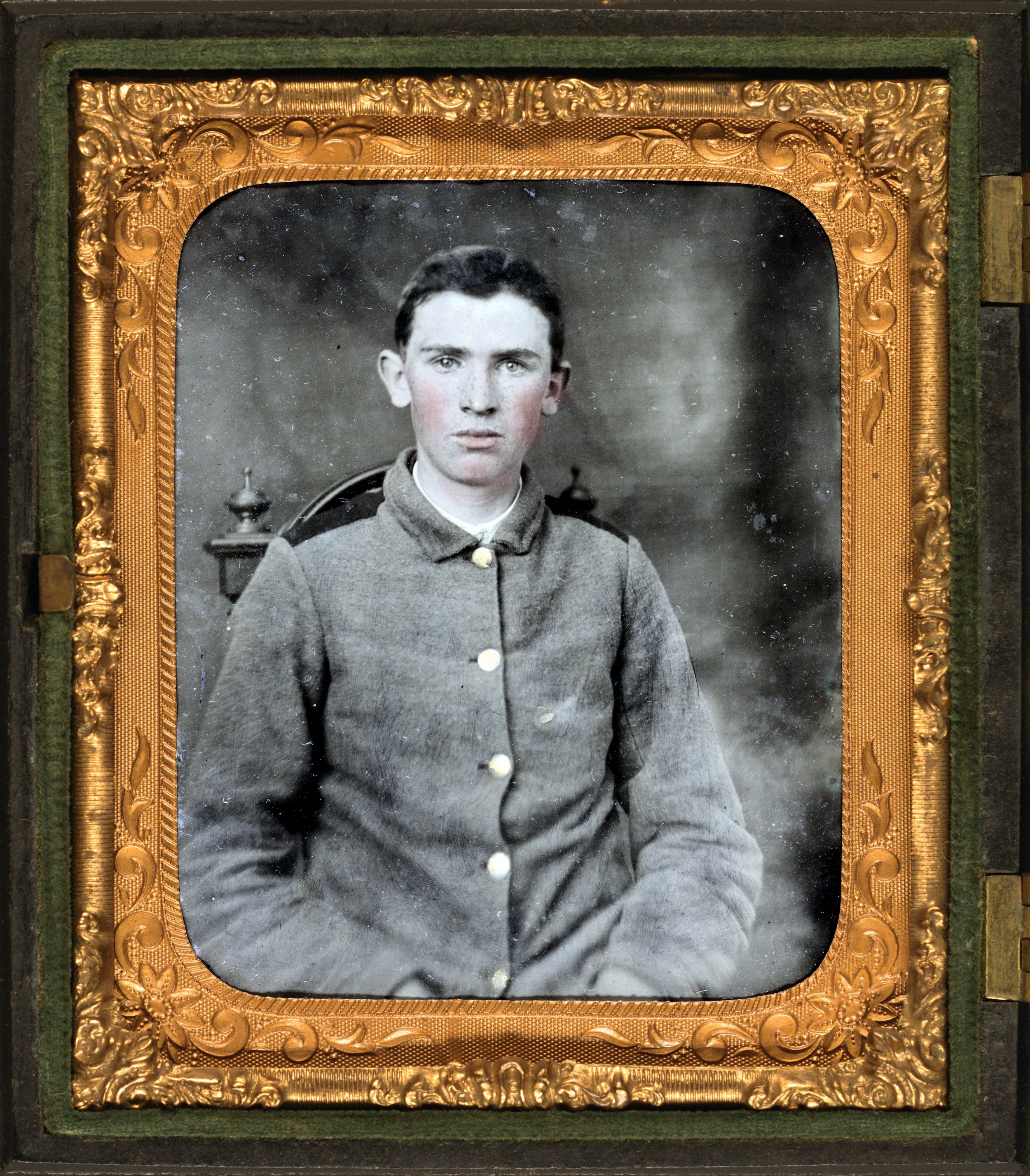
Private W.T. Harbison of Company B, 11th North Carolina Infantry Regiment in photo case


Private W.T. Harbison of Company B, 11th North Carolina Infantry Regiment.

__________

Sixth-plate tintype, hand-colored ; 9.6 x 8.4 cm (case)

Gift by Tom Liljenquist; 2010.

Liljenquist Family Collection of Civil War Photographs; Ambrotype/Tintype photograph filing series; Library of Congress Prints and Photographs Division.

Record page for image is here.

__________

digital file from original itemNote – This image has been digitally adjusted for one or more of the following:

  • fade correction,
  • color, contrast, and/or saturation enhancement
  • selected spot and/or scratch removal
  • cropped for composition and/or to accentuate subject matter
  • straighten image

Civil War Portrait 052

Charles Francis Adams, Jr., to Henry Adams

August 8, 1863. Sulphur Springs
(continuation of letter started August 2)

A little tour of picket has cut the thread of my letter. I went out early Monday morning and got in yesterday at noon. By the way, that reminds me of the conversation you mention you had with Sir Edward Cust, in which he spoke with pleasure of picket. The General’s memory does not betray him. Summer picket is the pleasantest work we have to do, and is really charming. Winter picketing is terrible, and neither he nor any man can extract any pleasure from it. I hardly had my share fall to me last winter, but I did enough. A cold, snowy day, followed by fourteen hours of night, during which miserable men, with numb fingers and freezing feet, sit motionless on jaded horses, ever listening for an enemy who will not come except when he is n’t expected, is no idea of mine of pleasure. Summer is very different. During the last week I have been picketing the Hazel River, just above its junction with the Rappahannock. The weather has been very fine, hot, but glorious for August. The enemy was just the other side of the river and just active enough to keep up one’s excitement, and my command was an independent one of about 150 men. At the fords the enemy were disposed to be very sociable, and as the river was hardly ten yards broad, nothing but orders interfered with our intercourse. Here, away from the nuisance of the infantry, we again got milk and eggs and butter, chickens, pigs and sheep, and we lived better than we have for many a day. The anxiety wears a little on one, for though one soon gets accustomed to the proximity of the enemy, the necessity of continued vigilance and perpetual preparation gets wearisome at last. Still it is very pleasant, this getting away from camps, brigades and infantry, away from orders, details and fatigue duty, out to the front with no army near, the enemy before you and all quiet along your line.

I was quite interested in what you reported General Cust as saying of the European cavalry, and it rather surprised me. I knew the Germans were good, but so I thought were the English also. We ourselves however come up to his mark of excellence in the Germans in the care of our horses; at least in our regiment, which is rather exceptional in most respects. If we are to march at sunrise we are called before the first break of day. Immediately after reveille roll-call the horses are groomed and then fed. The men then get their breakfasts. We march in columns of fours or, if the road is narrow, twos, and by squadrons. We even in spite of hard work keep up some finery. Ah, what a squadron I had on the morning of the 17th of June!! Any man might have been proud of it. First rides the chief of squadron and immediately behind him are the four bugles, mounted on their white horses and with their trumpets slung over their shoulders. Then comes the first chief of platoon, by the side of the Sergeant guide, and then the column, in closed up ranks of fours. In the rear the 2d Captain. On the march no man is allowed to fall out or straggle, without the permission of the 2d Captain, and in my squadron this rule is rigidly enforced. We rarely halt during our march and average usually three miles an hour. We have few rules of dress, simply enforcing dark hats or caps and dark blue blouses, with light blue trousers; but, I am sorry to say that in all these respects our regiment is far ahead of the average of our cavalry, which, while it straggles through a country like a cloud of locusts, looks like a mob of ruffians, and fights and forages like a horde of Cossacks. I speak now of the mass. The regulars are better and some of the volunteers, but the mass of the last would excite the special wonder and extreme mirth of European officers of the line until they met them in campaign. Nothing is known of our cavalry abroad, and it is only just now rising into a system; but some day when I have leisure I don’t know but I’ll write you a letter about them for the edification of Sir Edward and his friends in the English army. . . .

We are encamped just south of the Rappahannock at Sulphur Springs. Contrary to the hopes I expressed, all indications point to a lengthy stay. Doubtless it is, in its own good way, for the best, but I fear it insures us of more terrible battles and another autumn and winter, if not spring and summer campaigns. This delay is on the ground of rest necessary for the army in the heat of August, but I doubt whether the army absolutely needs, or at all desires this rest. My means of observation are very small, and sources of information unreliable; but I fear there is much discontent and dissatisfaction in the army with Meade and with the general management. The army, I can’t but believe, is anxious to go ahead and finish up the war. Some high officers, who have much to say in general, are not so anxious to go ahead or to see the time when their services can be dispensed with and they be reduced from Generals of Volunteers to Captains of regiments, so they do not care to see too much vigor infused into our operations. Meade, of course, is not one of these, but their councils have been felt, for he is junior to several such and a modest and naturally diffident man, who is not yet warm in his seat or thoroughly master in his own house. Hence his Councils of War and the lack of vigor in his operations after the 3d of July. The man’s very good qualities have stood in his way and in ours. He felt inexperienced and the tools felt strange in his hands. Hence much dissatisfaction with him throughout the army, in which McClellan’s name is again freely heard, and I doubt not that Meade’s resignation has, once at least, been tendered. But patience! I for one have faith in Meade; a little time works wonders. He will feel at home next time in his seat, and custom will have made his tools familiar to his hand. We know him to be honest and thoroughly brave and reliable, and he is a good judge of men, having collected already round him young men like Humphreys and Warren — the very best of our army. On the whole, with only patience and no more changes, I do not think we incur any danger by our delay here in Virginia. How it may affect the general prospect, you can tell me. For us, unless genius springs up among them, the rebel army is doomed and desperation alone won’t save them. . . .
Aug. 8th. Commences with pleasant weather; hauled down and shifted over starboard foretop-gallant studding sails, set the foretop-gallant and topmast studding sails, hauled down jib and flying jib, brailed up the main topmast stay-sail and main try-sail; at three thirty set the main fore topmast stay-sail main try-sail and spanker, bending lower studding sails; from four o’clock to eight o’clock set the port lower studding sails, jib and flying jib; at nine o’clock inspected crew at quarters; all plain sail set to royals, also all port studding sails; exercised crew at taking in, loosening, furling, and setting royals and mizzen top-gallant sails; from four to six P. M., all plain sail set to royals, and all the port fore studding sails set also; at seven thirty made Hatteras light.


August 8.—Arrived in Chattanooga last evening, and am now at the Gilmer Hospital.

On the cars coming from Kingston, a gentleman and lady came in at one of the depots. The gentleman had to stand, as the car was very much crowded. 1 offered him part of my seat, which he accepted. He then told me he was a chaplain in a hospital near Ringgold, and that they were in want of some ladies in it. I have called on Dr. Stout, and he has sent down there to make inquiries concerning it.

Last evening I went to the Episcopal Church, and a chaplain preached a most excellent sermon. His text was, “The wind bloweth where it listeth,” etc. He reminded us of how much more frequently the wind blew soft than in a storm, and so with the “still small voice:” it spoke oftener to us in the calm than in the tempest. The church was filled with soldiers. I spent part of to-day at Camp Direction Hospital, where are many of the folks from the Newsom Hospital.

The hospital is an excellent one; every thing about it is entirely new; but I can not look on those things with the same pleasure which I have heretofore, as it is impossible to feel that any thing connected with our army is permanent. The whole place is surrounded with breastworks, some of which are within a stone’s throw of the hospital.

I spent the evening at Mrs. Whitesides, and had a very pleasant time, practicing for the church. Mr. E. Stickney escorted me, to whom I am much indebted for his kindness ever since I have been here. He is from Alabama, and is much of a gentleman.

This afternoon I sent Mr. Massinger’s money by express to Mr. Bolt, in care of Captain Cupplca.

8th. Read some during the morning. At 11 went to Daguerrian Gallery and had likeness taken. New coat. Met Mr. Austin and wife, Miss Smith formerly. Helen and Aunt came. Charlie Fairchild treated boys to ice cream, lemonade, etc. Sorry can not stay in O. till after Com. too. In the evening went to N. P. St. and, shame to me, remained till nearly 11. But these farewell calls are excusable, if long, hard to say goodbye. Promised to meet the boys, but all abed. Reconsecrated my life and all to Jesus.

Saturday, 8th—Quite pleasant today. We cleaned up our clothing and accouterments for inspection. We are getting fixed up very nicely in our camp and all are feeling fine. Only a few of our boys are sick and in the hospital at present. I loaned George Toyne (Company E) $25.00 today, until next pay day.[1]


[1] Mr. Downing explained that Toyne’s family at home was in need and that it was a very common thing for a single man to loan a married comrade money to send home to his family.—Ed.

Vicksburg, Saturday, Aug. 8. A very hot monotonous day. Felt well. Lay in my tent all day reading Parton’s Life of Aaron Burr, a man of many faults but large brain. Finished it, very interesting throughout. At morning and evening, the volleys over the graves of the departed are growing more numerous. I heard four to-day, all from the infantry regiments.

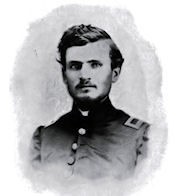
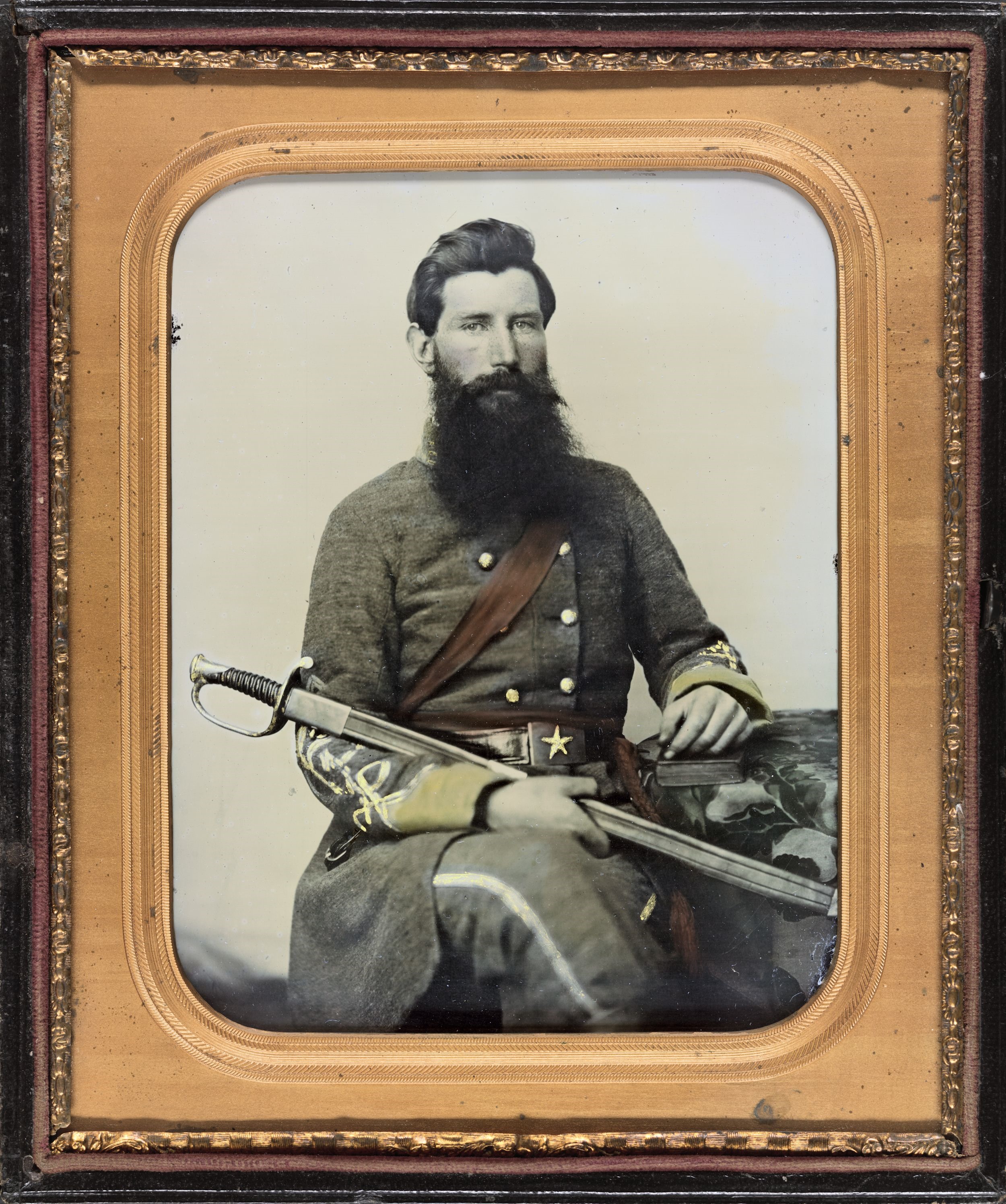
Captain George W. Hackworth of Co. F, 1st Virginia Cavalry Regiment, in uniform with sword in photo case

Captain George W. Hackworth of Co. F, 1st Virginia Cavalry Regiment, in uniform with sword.

__________

Three-quarter-plate ambrotype, hand-colored ; 18.1 x 15.2 cm (case)

Deposit by Tom Liljenquist; 2012

Liljenquist Family Collection of Civil War Photographs; Ambrotype/Tintype photograph filing series; Library of Congress Prints and Photographs Division.

Record page for image is here.

__________

digital file from original itemNote – This image has been digitally adjusted for one or more of the following:

  • fade correction,
  • color, contrast, and/or saturation enhancement
  • selected spot and/or scratch removal
  • cropped for composition and/or to accentuate subject matter
  • straighten image

Civil War Portrait 051

by John Beauchamp Jones

            AUGUST 8TH.—There is nothing new from any of the armies, except that my old friend, Gen. Rains, sent to Mississippi, stopped and stampeded Grant’s army, after Johnston retreated from Jackson, with his “subterra batteries.” It appears that hundreds of the enemy and their horses were killed and wounded by the shells planted by him beneath the surface of the earth, and which ignited under the pressure of their weight. They knew not where to go to avoid them, and so they retreated to Vicksburg. This invention may become a terror to all invading.

            A letter received some days ago from a Mr. Bible, in Georgia, proposing to contribute one-quarter of his slaves as teamsters, cooks, etc. for the army, came back from the President, to-day, approved, with directions to quartermasters to employ in such capacities all that could be procured.

            Col. Myers, the Quartermaster-General, who is charged with saying “Let them suffer,” when the soldiers wanted blankets last winter, is to go out of office at last—to be succeeded by Brig.-Gen. Lawton.

            Oak-wood is selling to-day for $35 per cord; coal, $25 per cart-load; and flour, $45 per barrel. Mr. Warwick, however, sells any family one barrel for $34. I got one from him, and the promise of another for $33—from Commissary Warner; and I hope to get two loads of coal, under the navy contract, at $20 each. There is much excitement against the speculators in food and fuel—and some harsh proceeding may ensue.

The Tribune (New York) now says no terms will be listened to so long as we are in arms. We will not yield our arms but with life—and this insures independence.