Following the American Civil War Sesquicentennial with day by day writings of the time, currently 1863.

August 2013

by John Beauchamp Jones

            AUGUST 14TH.—The enemy is not idle. He knows the importance of following up his recent advantages, and making the utmost use of his veteran troops now in the field, because his new levies, if indeed the draft be submitted to, will not be fit for use this year, probably, if ever, for they will consist of the riff-raff of the Northern population. On the other hand, he suspects we will soon have larger armies in the field than ever before, and our accessions will consist of our bravest men, who will make efficient soldiers in a month. If our armies be not broken before October, no doubt the tide of success will turn again fully in our favor.

            Major Wm. Norris, Signal Corps, reports that many transports and troops have been going down from Washington and Annapolis to Fortress Monroe during the whole week, and that 5000 men embarked at Fortress Monroe, on Monday, for (as they said themselves) Charleston. Among these was a negro regiment of 1300.

            T. C. Reynolds, confidential agent of the government in the trans-Mississippi States, sends copy of a circular letter from Lieut.-Gen. Kirby Smith to the “representative men” of Missouri, Arkansas, Louisiana, and Texas, to meet him in convention, 15th August, at Marshall, Texas. Mr. Reynolds says he and others will exert themselves to prevent the meeting from taking a dangerous political direction. Gen. Smith is popular, and opposed to the States named setting up for themselves, although he plainly says in the circular that they must now adopt self sustaining measures, as they cannot look for aid from the East. Mr. Reynolds says something, not clearly understood by me, about an equipoise among the political generals. Has he been instructed on that point in reference to Gen. Price?

            Letters from Mr. Crenshaw, in England, and the correspondence forwarded by him, might seem to implicate Major Caleb Huse, Col. J. Gorgas’s ordnance agent, in some very ugly operations. It appears that Major H. has contracted for 50,000 muskets at $4 above the current price, leaving $200,000 commission for whom? And that he really seems to be throwing obstacles in the way of Mr. C., who is endeavoring to procure commissary stores in England. Mr. C. has purchased £40,000 worth of bacon, but Major Huse, he apprehends, is endeavoring to prevent its shipment. Can this be so?

            The Charleston Mercury that came to-day contains an editorial broadside against the President, Mr. Benjamin, Mr. Mallory, and Commissary-General Northrop.

            Mr. Gilmer, lawyer, remarked to me to-day that some grave men (!) really believed Davis and Lincoln had an understanding, and were playing into each other’s hands to prolong the war, knowing that peace would be the destruction of both I think there is more danger to both in war. The blood of a brave people could not be trifled with without the utmost danger. Let peace come, even if the politicians be shorn of all their power.

August 13.—A gunboat reconnoissance from Clarendon, up the White River, Ark., was made by the steamers Lexington, Cricket, and Mariner, under the command of Captain Bodie. They returned in the evening, bringing as prizes the steamers Tom Suggs and Kaskaskia. They also destroyed two mills used by the rebel army for grinding corn, and a pontoon-bridge across the Little Red River. The casualties on the Union side were five men wounded, two of whom died.

—An expedition under the command of Lieutenant-Colonel Phillips, of the Ninth Illinois infantry, left La Grange, Tennessee, for Central Mississippi.—Major-general Burnside issued an order regulating the employment and subsistence of negro laborers.

—This night a party of rebel cavalry made a descent upon a signal station, located on Water Mountain, near Warrenton, Va., capturing every thing except the officers and one glass. Sixteen horses, several wagons, the camp equipage, together with a number of telescopes, foil into the hands of the rebels. The officers had sufficient warning to enable them to escape before the enemy reached them, but their private property was lost.—The first full regiment of colored men, raised in Pennsylvania, left Philadelphia by steamer for Morris Island, S. C., to reenforce the army under General Gillmore.

—Colonel Catherwood, commanding the Sixth Missouri cavalry, sent the following despatch to headquarters, from his camp at Pineville, Mo.:

“Colonel Coffee attacked me to-day, and was completely routed, with over thirty killed and wounded. We have a large number of prisoners, all his ammunition wagons, commissary stores, arms, horses, cattle, etc. We scattered all his force except two hundred with himself. Our force is following him closely. My horses are so worn down that they cannot move further until rested. Colonel Hirsch, just in, reports that he killed thirty-five and wounded a large number.”

August 13, Thursday Laird’s friend Howard telegraphs Fox that he has a letter of F.’s which conflicts with my letter to Sumner, and, while he does not want to go counter to the country, does not wish to be sacrificed. Faxon, who has charge of Fox’s letters and correspondence, is disturbed by this; says that Fox has been forward, and too ready with his letters substituted for those of the Secretary or chiefs of bureaus; has an idea that Fox took upon himself to correspond with Howard and perhaps L. when I turned them off.

There may be something in these surmises, not that Fox intended to go contrary to my decision, but he was perhaps anxious to do something to give himself notoriety. At times he is officious. Most men like to be, or to appear to be, men of authority, he as well as others. I have observed that when he knows my views and desires he likes to communicate them to the parties interested as his own. Orders which I frequently send to chiefs of bureaus and others through him, he often reduces to writing, signing his own name to the order. These are little weaknesses which others as well as Faxon detect, and I permit to give me no annoyance; but Faxon, who is very correct, is disturbed by them and thinks there is an ulterior purpose in this. Admiral Smith, Lenthall, and Dahlgren have been vexed by them, and not infrequently, perhaps always, come to me with these officious, formal orders signed by the Assistant Secretary, as if issued by himself. Faxon thinks Fox may have taken upon himself to correspond with Howard, and committed himself and the Department. There can, I think, have been no committal, for Fox is shrewd, and has known my policy and course from the beginning. He doubtless wrote Howard, from what the latter says, but without any authority, and he saw my letter to Sumner without a suggestion that he had given other encouragement.

Chase spent an hour with me on various subjects. Says the Administration is merely departmental, which is true; that he considers himself responsible for no other branch of the Government than the Treasury, nor for any other than financial measures. His dissent to the War management has become very decisive, though he says he is on particularly friendly terms with Stanton. In many respects, he says, Stanton has done well, though he has unfortunate failings, making intercourse with him at times exceedingly unpleasant; thinks he is earnest and energetic, though wanting in persistency, steadiness. General Halleck Chase considers perfectly useless, a heavy incumbrance, with no heart in the cause, no sympathy for those who have. These are Chase’s present views. They are not those he at one time entertained of Halleck, but we all know H. better than we did.

We had some talk on the policy that must be pursued respecting slavery and the relation of the State and Federal Governments thereto. It was, I think, his principal object in the interview, and I was glad it was introduced, for there has been on all sides a general avoidance of the question, though it is one of magnitude and has to be disposed of. His own course, Chase said, was clear and decided. No one of the Rebel States must be permitted to tolerate slavery for an instant. I asked what was to be done with Missouri, where the recent convention had decided in favor of emancipation, but that it should be prospective, — slavery should not be extinguished until 1870. He replied that the people might overrule that, but whether they did or not, Missouri is one of the excepted States, where the Proclamation did not go into effect.

“What, then,” said I, “of North Carolina, where there is beginning to be manifested a strong sentiment of returning affection for the Union? Suppose the people of that State should, within the next two or three months, deliberately resolve to disconnect themselves from the Confederacy, and by a popular vote determine that the State should resume her connection with the Union, and in doing so, they should, in view of the large slave population on hand, decide in favor of general but prospective emancipation, as Missouri has done, and enact there should be an entire abolition of slavery in 1875.” He said he would never consent to it, that it conflicted with the Proclamation, that neither in North Carolina, nor in any other State must there be any more slavery. He would not meddle with Maryland and the excepted States, but in the other States the evil was forever extinguished.

I said that no slave who had left his Rebel master could be restored, but that an immediate, universal, unconditional sweep, were the Rebellion crushed, might be injurious to both the slave and his owner, involving industrial and social relations, and promoting difficulties and disturbances; that these embarrassments required deliberate, wise thought and consideration. The Proclamation of Emancipation was justifiable as a military necessity against Rebel enemies, who were making use of these slaves to destroy our national existence; it was in self-defense and for our own preservation, the first law of nature. But were the Rebellion now suppressed, the disposition of the slavery question was, in my view, one of the most delicate and important problems to solve that had ever devolved on those who administrated the government. Were all the Slave States involved in the Rebellion, the case would be different, for then all would fare alike. The only solution which I could perceive was for the Border States to pass emancipation laws. The Federal Government could not interfere with them; it had with the rebellious States, and should morally and rightfully maintain its position. They had made war for slavery, had appealed to arms, and must abide the result. But we must be careful, in our zeal on this subject, not to destroy the great framework of our political governmental system. The States had rights which must be respected, the General Government limita­tions beyond which it must not pass.
August 13 — We remained on outpost picket until late this evening, were relieved then by the second section, and we moved back to Brandy Station on reserve. It commenced raining last night at one o’clock and rained very fast until daylight, with just enough thunder and lightning mixed with it to make it interesting.

13th. After breakfast and reading morning papers went over to City Library and read some in Quarterlies and Magazines. Mr. Brown came in. Saw Barnitz. After dinner took a stroll about the city in search of a lovely, honest, satisfied countenance, a person who seemed perfectly happy with self, world and God. A few happy children, but most of them even seemed marred, scarred and marked by contact with this world.

Beverly Ford, Va., Thursday, August 13, 1863.

Dear Mother:—

I received your letter of the 5th night before last. Yesterday it was so hot that I could not write or do anything else but lie in the shade and sweat. I don’t know where the mercury stood, but I think it must have been above 100. It was as hot as any day we had on the Peninsula except one. Last night we had a furious thunder storm. The ground was completely soaked and I had fun enough this morning to last me a week.

Yesterday Colonel Rice had a large force of men putting up booths or shades of poles and brush over the tents. This morning they all fell down one after another and smashed down the tents. The colonel’s was the first, just about daylight. He came crawling out under the edge sans everything but shirt. He came in such a hurry that he could not keep his perpendicular and went sprawling in the mud. Then Lieutenant Grannis’ tent came down and he came out in the same cool dress like a mouse from a shock of corn.

We have just been paid $52. I’m going to send $50 home. Father inquired once what I did with my money lately. I don’t remember whether I explained about that or not, but I have not wasted a great deal of it. Since I have been at headquarters, I have had to keep a good watch. The time of everything is left to me. Well, last fall I had a watch stolen from me that cost me $18, I think, and then I bought another, and both had to be paid for out of the next pay. This last watch kept time splendidly all winter, but when we forded the Rapidan, it got wet inside and stopped entirely. I sent it to Erie for Captain Austin to clean. When I went back to headquarters I bought a watch for $10 which turned out to be good for nothing. I bought another for $15 which is a good one. Last Monday my watch came back from Erie, so now I have three. That is where my money has gone to, part of it at least. I am going to keep my old watch and sell the other two.

I dare not risk sending much money in a letter, so I am going to send $10 at a time. Let Father do what he thinks best with it.

I am very glad you are having so much fruit and such a variety too. I should like it very much if I could have some too, but you are so far away and everything sent by express is so uncertain of reaching its destination that I don’t think it would be best to try to send me any. Next winter there may be a good chance. There would be now if there was any certainty of our staying here any length of time. We have laid out three “permanent camps” this side of Warrenton. This is the best place we have found yet and I think we will stay here through the hot weather. I have no correspondents in Springfield now.

Thursday, 13th—It is rumored that our brigade is to go to Natchez, Mississippi, in a few days, but we cannot tell whether it is true or not. I was on police duty today, for the first time, down in Vicksburg. There are more than a hundred men detailed each day to keep order in the city, and nobody is allowed on the streets without a pass from the provost marshal. We work on eight-hour shifts, and each man has a certain part of a street to patrol for two hours at a time, after which he is off duty for a period of four hours. I was on duty in a residence district, and while I was walking my beat, a lady came out of her home for an afternoon’s walk. I of course had to ask her to show her pass. I must have looked pretty fierce to her, with loaded gun, fixed bayonet and all accouterments on. I asked her kindly for her pass and she answered that she had none, whereupon I told her what my orders were; that she would have to return to her home and not come out on the streets again without a pass, or I would have to take her to the provost marshal’s office. She thanked me very politely as I closed her gate, saying that she wanted to obey orders and that she would send out and procure a pass before going on the street again. This lady is certainly experiencing war at her own dooryard, yet she showed the good breeding of the Southern lady.

Vicksburg, Thursday, Aug. 13. Boys in good spirits, those of them that are blessed with health. At twilight they had a general gathering in our street, and held a wild, jovial scuffle of an hour, such as none but soldiers can partake in or enjoy. An eye witness would call it foolishness, but it is well that they spend it innocently rather than in some worse game. “It is all in three years” they say. Very true.

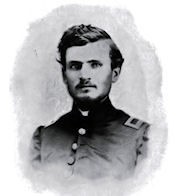
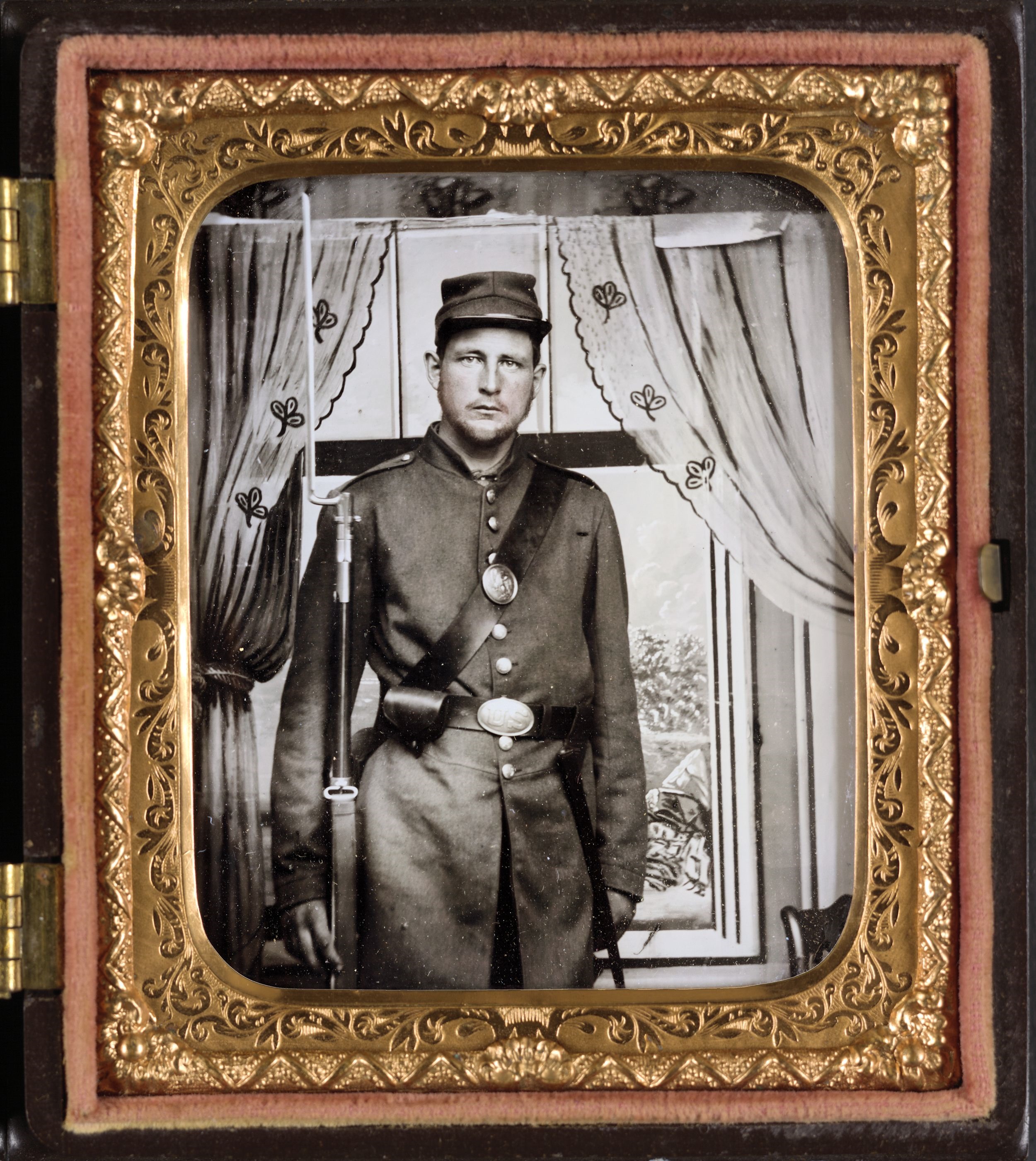
Unidentified soldier in Union uniform with bayoneted musket in front of painted backdrop showing a window with curtains in photo case


Unidentified soldier in Union uniform with bayoneted musket in front of painted backdrop showing a window with curtains.

__________

Sixth-plate ambrotype, hand-colored ; 9.4 x 8.4 cm (case)

Deposit by Tom Liljenquist; 2012

Liljenquist Family Collection of Civil War Photographs; Ambrotype/Tintype photograph filing series; Library of Congress Prints and Photographs Division.

Record page for image is here.

__________

digital file from original item Note – This image has been digitally adjusted for one or more of the following:

  • fade correction,
  • color, contrast, and/or saturation enhancement
  • selected spot and/or scratch removal
  • cropped for composition and/or to accentuate subject matter
  • straighten image

Civil War Portrait 057

by John Beauchamp Jones

            AUGUST 13TH.—No news. It turns out that Gen. Taylor got only 500 prisoners at Donaldsonville, La., instead of 4000.

            A writer in the New York Tribune says the Northern troops burnt Jackson, Miss.

            Lincoln has marked for close confinement and hostages three of our men for three free negroes taken on MorrisIsland.

            The government here has, at last, indicated blockade-goods (U. S.) which are to be seized; also sent circular letters to the generals at Wilmington, Charleston, and Mobile to impose restrictions on blockade-running steamers belonging to private parties. The government must first have such articles as its necessities require, at fair prices, before the merchandise can be offered to the public, and the vessels must be freighted out partly with government cotton. This is a good arrangement, even if it is “locking the stable after the horse is stolen.”