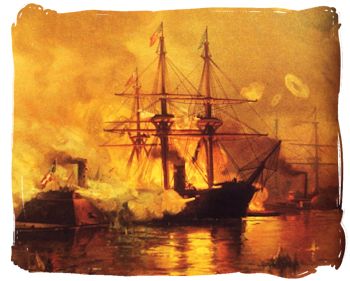
August 3d. At sea; at eleven in the morning light rain squall passed over; at eleven thirty set all fore and aft sails; at eleven forty-five took them in; at three fifteen P. M. light rain-squall passed over; at four ten made a sail to the southward, and bore down for her, called all hands make sail, and at four thirty fired a gun in direction of strange sail, which hoisted the French colors. Furled sail and hauled up to course again. Unbent and sent down foretopsail for repairs, and sent up and bent a new one. At six ten inspected crew at quarters. From eight o’clock to midnight slight wind from southward and eastward, and clear; at eleven fifty a sail reported on starboard beam.
August 2013

August 3.—I am beginning to think that we shall not be able to remain here, as Dr. A. has proved himself a real Pharaoh—expecting brick without straw. We have many sick, and much to do. Our servants are still sick, and when we ask Dr. A. for more, he tells us the government will not allow him to grant the request.
The poor government is blamed for every thing. I have many a time heard it charged with faults which I thought were owing to subordinate officers. Dr. H. was constantly telling us about orders he had received from head-quarters: allowing us so much soap and no more, and even regulating how many pieces each person must have washed. I have never been able to ascertain whether head-quarters meant General Bragg, the surgeon-general, or President Davis. I think sometimes it is only a mythical term, merely used to frighten us. If not, I think it is a pity that those worthies have not something of more importance on which to spend their time. I have often thought that they are surely not aware of the price of paper, or they would be a little more sparing of their dispatches. I wish they would send me a few blank sheets, as I find it difficult to get enough for my private use.
We have no wash-house. When I asked Dr. A. for one, he told me that his grandmother and mother never had any but the canopy of heaven for theirs, and he did not intend having any other in the hospital. I argued the case with him as best I could; I told him that a hospital was not a private house, and it was our duty to do all in our power to promote the health of the attendants as well as the patients; and that whoever washed ought to have a covering of some kind; and the clothing, whether dirty or clean, needed to be covered in case of rain. I found him inexorable.
I feel confident that the doctor has never had charge of a hospital before, and it is useless to try and teach any one who has such unbounded faith in his progenitors. I have made up my mind to let things take their course, and if I find I can not get along, will leave.
Numbers of troops are being transported down the road. No one can tell where they are going to.

3rd. Spent the forenoon at home and doing chores. Spent a little time reading. After dinner called on Fannie. Found her the same lovely creature as of old. One may well feel rich in the possession of such a friend. I do. In the evening attended Young People’s Meeting. Did me good.
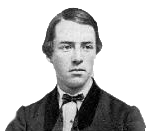
Headquarters 1st Army Corps,
Camp at Rappahannock Station, 6 P.M., Aug. 3, 1863.
Dear Father, — I have heard nothing about my commission, and nothing about coming home. I am afraid that there is some mistake about the matter. In case any telegram or document is sent me, you had better have it directed to me at these headquarters. Of course I can take no measures about coming home until I receive official notice that I am commissioned as lieutenant colonel, or until I am ordered home by the War Department. Even if I took any such measures, no attention would be paid them, unless, as I have said, I should receive official notice.
We are settled here for some time, I think. At present we have most of our corps across the river, waiting until the railroad bridge is completed. I went out to the front day before yesterday, and saw the cavalry fight. The fighting I saw took place near Brandy Station, some six miles from here.
Our headquarters are on this side of the river and about a mile from the river.
I hope I shall hear soon from some one in regard to my commission. As soon as I do hear, I shall start for home, going from here to Washington on the railroad, which is a safe route. I shall send my horses on to New York by boat.
August 3. — We received a message this morning that the enemy was advancing in force. Lieutenant Jackson rode down to the river, and found that it was a false alarm. Weather sultry and hot.
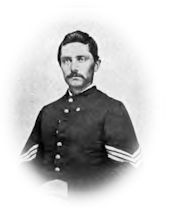
Monday, 3d—I was on camp guard today. We got our tents and pitched them today, and also, because of the intense heat, built shades in front of them by setting up forks and poles covered with brush. It is the report that we are to remain here on garrison duty. Our work is very light, however, as we have no picket duty.
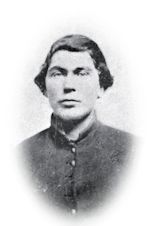
Vicksburg, Monday, Aug. 3. Had a very heavy fever all night. In the morning the fever subsided, and a cold clammy sweat followed. Reported at the sick call. The doctor prescribed three large doses of morphine and quinine, with two blue pills. Took the first dose, caused vomiting, did not take any more. Felt very sick all day. Could eat nothing. Bathed and put wet applications to head.
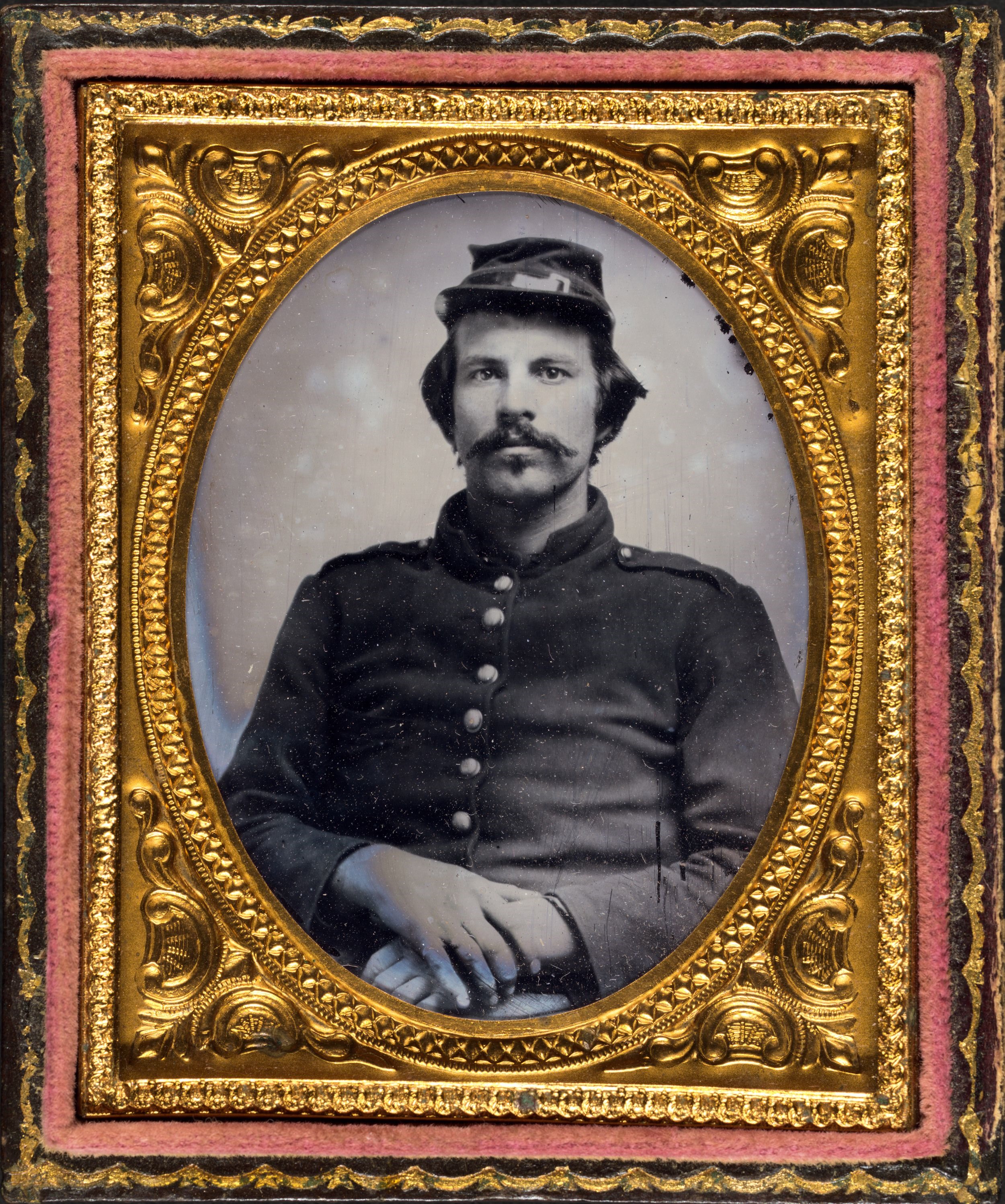
Unidentified soldier in Union uniform and forage cap.
Ninth-plate ambrotype, hand-colored ; 7.3 x 6.1 cm (case)
Gift by Tom Liljenquist; 2010
Liljenquist Family Collection of Civil War Photographs; Ambrotype/Tintype photograph filing series; Library of Congress Prints and Photographs Division.
Record page for image is here.
__________
 Note – This image has been digitally adjusted for one or more of the following:
- fade correction,
- color, contrast, and/or saturation enhancement
- selected spot and/or scratch removal
- cropped for composition and/or to accentuate subject matter
- straighten image
Civil War Portrait 046

by John Beauchamp Jones
AUGUST 3D.—The President issued a proclamation to-day, calling upon all absentees to return to the ranks without delay, etc.
Hon. D. M. Barringer writes from Raleigh, N. C., that the State is in a ferment of rage against the administration for appointing Marylanders and Virginians, if not Pennsylvanians, quartermasters, to collect the war tax within its limits, instead of native citizens.
Mr. W. H. Locke, living on the James River, at the Cement and Lime Works, writes that more than a thousand deserters from Lee’s army have crossed at that place within the last fortnight. This is awful ; and they are mainly North Carolinians.
August 2.—Five hundred rebel prisoners were taken by four companies of the “Lost Children,” New-York volunteers, on an island in the rear of Folly Island, in Charleston harbor.


