Following the American Civil War Sesquicentennial with day by day writings of the time, currently 1863.

August 2013

by John Beauchamp Jones

            AUGUST 2D.—We have warm, fair weather now ; but the momentary gloom, hanging like the pall of death over our affairs, cannot be dispelled without a decisive victory somewhere, or news of speedy foreign intervention. The letters which I read at the department this morning, contain no news whatever. I have suggested to the government to prohibit the exchange of newspapers in the flag of truce boat; but I doubt if they will act upon it. It is a manifest injury to us.

            The exchange of prisoners is practically resumed; the Federal boat delivering yesterday 750 of our sick and wounded; and we returned 600 of their sick and wounded.

August 1, [1863). — Our best scout, Corporal Jacobs, and Private Fenchard, Company F, were murdered last night at Morris’ mill on Gauley River, twelve miles above Gauley Bridge. Jacobs was an awkward, pigeon-toed youngster, cool, shrewd, brave; could walk fifty miles a day, go without food or sleep longer than most men; very fond of scouting. Poor fellow! I have long feared that he would be caught in this way. He was made one of the color-guard but was so awkward — never could keep step — that we usually let him be excused from all ordinary duty. Ordered Morris arrested, to be kept if no proof against him; hung if guilty of the murder in any way.

August 1—Resumed our march at 4 this morning, and got to Orange Court House, fourteen miles. It is a very hot day, and there were several men fell dead on the road from sunstroke. We rested here until the 4th.

August 1, Saturday. Made a selection of midshipmen for Naval School. An immense number of applicants and, of course, many disappointments. Some of the young men, and among them probably those who are deserving, feel this first disappointment grievously. It is a pleasure to bestow the favor in many instances, but not sufficient to counterbalance the pain one feels for those who are rejected. Last year there were captious and censorious Members of Congress who abused me for filling the school; the same will probably be the case this year. Were I, however, to omit filling the school, the same persons would blame me for neglect of duty, — not without cause, —and I should not be satisfied with myself for this omission.

August 1.—Jefferson Davis issued an address to the people of the States in rebellion, calling upon them to hasten to the camps of the rebel armies, all persons who had absented themselves without leave, and granting an amnesty to all who should return to duty before the expiration of twenty days. (Doc. 113.)—The English steamer Peterhoff was condemned at New York, by the United States Prize Court, for carrying contraband of war at the time of capture.—A party of rebels made an attack upon one of the new Union batteries, in course of erection on Morris Island, S. C., and were repulsed with considerable loss.

—The funeral of Brigadier-General George C. Strong, who fell in the attack on Fort Wagner, July eighteenth, took place at New-York City.— The monitor Canonicus was successfully launched from the works of Harrison Loring, at East-Boston, Mass.—The Fourth and Seventh United States army corps were discontinued by order of the Secretary of War.

—This morning General Buford’s cavalry division crossed the Rappahannock River, at the Rappahannock Station, and shortly afterward encountered a brigade of Stuart’s rebel cavalry, which they attacked. The rebels were soon reenforced by the balance of General Stuart’s command, who fought with obstinacy, but they were driven back to within one mile of Culpeper. Here a division of infantry, made its appearance, and the Union troops, finding they were in danger of being outflanked, slowly fell back, followed by the enemy’s artillery, cavalry, and infantry. General Buford soon secured an eligible position, and for some hours held the whole rebel force at bay.

The fighting was obstinate, and the loss on both sides severe. The Union troops, although greatly outnumbered, heroically held their position, and repulsed every assault of the enemy. General Buford was shortly afterward reenforced by the First corps of our army, and the combined force soon compelled the rebels to cease their attack. The loss of the Nationals was one hundred and forty, sixteen of whom were killed.

—The Richmond Sentinel published the following this day: “A lecture at the Bethel meeting-house, Union Hill, to-morrow forenoon, is announced. The subject is, ‘The Northern States of America the most likely location of the Lake of Fire and Brimstone, in which the Beast and the False Prophet will be tormented.’ The lecturer will have the prejudices of his audience on his side.”

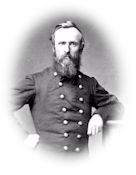
August 1 — We were on picket to-day until noon; were relieved then by the second section of our battery. We came back to camp and were there about two hours when orders came for us to move camp, as the enemy was advancing on Culpeper Court House. Soon after we received orders to move camp we heard artillery and musket firing in the direction of Brandy Station. In quick succession the boom of cannon came rolling across the fields of Culpeper, which was a clear and self-evident indication that there was a sharp conflict transpiring not far away.

We had our horses hitched to the battery and were ready to move at a moment’s notice, and were waiting with momentous anxiety for a summons to hasten to the field of action.

We did not have to wait long, for the firing grew fiercer every moment, and soon a courier came post haste for us to hurry to the fray. We started at once and moved rapidly for about four miles, then we drew in sight of the battle-field, which was already piled full of bunches of white, battle smoke. When we first arrived in sight of the field two Yankee batteries were shelling some of our infantry and a battery on our right. We were directly on the right flank of the Yankee line, and we opened a square enfilade fire on their batteries, which compelled them to abandon their position immediately after we opened. We advanced then and took another position and opened fire, and the Yanks again retired, and so we kept up a running fight for two hours, in which time we drove the enemy back about three miles. Then the shades of night were already falling fast, and the gathering darkness lulled the wavelet of war to quietude and rest. The field where the little fight occurred is a level plain about two miles long, with the Orange and Alexandria Railroad on one side and a body of woods on the other. It is identically the very same field where General Stuart held his grand reviews last June.

The engagement to-day was principally between cavalry, with some artillery mixed in on both sides.

General Hampton’s cavalry and General Jones’ brigade were in the fight on our side. For the last few days the weather has been oppressively hot, in fact, too hot for an active butcher business. However, if the bluecoats can endure it the gray jackets can do the same thing.

After the fight this evening we moved back about two miles west of Brandy Station, and camped.

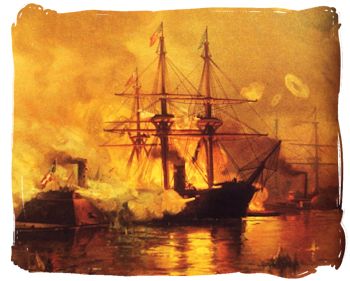
August 1st. Commences with pleasant weather. At nine thirty A. M. the U. S. gunboat Black Hawk, with Admiral D. D. Porter on board, came down the river, accompanied by the gunboat Conestoga. As they passed they fired a salute of fourteen guns, which the U. S. S. Portsmouth returned, and we cheered ship. Admiral Porter visited the ship, and was received by the marine guard. At six thirty P. M. called all hands up anchor, got under way and steamed up the river and turned round. Was cheered as we passed the fleet, which we returned. The church bells in the city also were rung. Stood down the river in charge of pilot.

August 1.—We have a number of patients very sick, and we are kept very busy, as the two girls we brought with us from Chattanooga are both ill, and I suppose will have to leave. Two of our cooks are also down. I asked Dr. A. to let some of the men come and assist in the kitchen, but he refused, saying that such work was degrading to them.

The surgeons have been compelled to find boarding-houses outside of the hospital. Dr. A. found it was against the regulations for them to board in the hospitals; so we have gone back to the plan of having our own table.

Aug. 1st. Reached Columbus about 3 A. M. Went to Niel House and rested two or three hours and breakfasted. Did business. Receipted for property. Left horse and equipments at Q. M. Burrs. All very pleasant. Left C. at 3:40. Took dinner at Mrs. Crarey’s. Pleasant time. From Wellington rode across in carriage. Colored man company. Oberlin about 10:30. Happy boys. Saw Minnie and John.

Saturday, 25th, to 1st day of August—All quiet; usual routine of camp duty. Two days since, while out on forage, I saw Miss Anna Ransom at Mrs. Garrett’s—a great pleasure to meet with them.