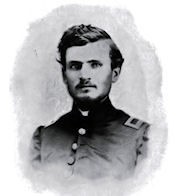
Saturday, 19th. Remained in camp till 1 P. M. Orders came to report to Corps Hdqrs. at Knoxville. Supposed to go to Rosencrans. Drew flour and beef and made ready for the march. Marched at 1 P. M. Passed through Greenville and camped at Blue Springs, 8 miles from G. A very cold night. Boys jolly. Heavy frost and cold. Many reports as to where we were to go.
September 2013
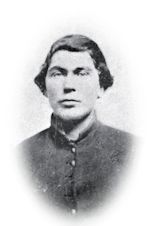
Helena, Saturday, Sept. 19. Still very chilly, the wind being raw from the river. Slept comfortable last night. The train which we were to escort moved this morning with the cavalry, so the object of our expedition is abandoned and we are lying here waiting orders. Mail arrived at tatoo. I received one enclosed in E. W. E.’s but none from home. It has been four weeks since the last I received from home. I am very uneasy. I am afraid all is not well.

September 19.—We have received news that a battle has commenced. A number of surgeons from this post have been ordered to the front. Drs. Ray and Bateman will go from our hospital. We regret losing them, as we have so many sick.
On hearing of the commencement of a battle it sends a thrill of horror through me, and especially such a one as it is said this will be. Both armies have been collecting all the forces they could muster, intending to put their strength in the conflict . It will send many a gallant spirit away to that land “from whence no traveler returns.”
I must try and dismiss this gloomy subject, as we have much to do. I feel it is a great blessing, and keeps our thoughts from wandering to the bloody drama.
We had numbers of sick come in last night. As it is impossible to attend to them all, immediately after they come in, I go around to visit them, and from having seen so many, can nearly always tell at a glance who are most in need of special care.
Mrs. Johnston went round with me this morning. I passed a fine, healthy-looking man, and I thought he was one who was out of place there, and ought to be back with the army. I had passed him without speaking, and saw a tear in his eye; so curiosity made me go back to find out who he was. He had been three years in the service, and this was his first visit to a hospital. He had been injured by the upsetting of a train. So much for judging from appearances.
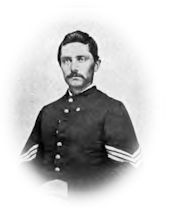
Saturday, 19th—Company E went out on the picket line today. The nights are getting cooler and the middle of the day, though warm, is not so oppressive. Since our rainstorm it begins to look like autumn; the trees are beginning to turn various colors and the sun shining over the timbered hills in the late afternoon makes a landscape grand to look upon.
September 19.—A party belonging to the command of General Buford, swam the Rapid Ann River, near Raccoon Ford, and after capturing a considerable number of prisoners, returned to their camp in safety.—The battle of Chickamauga, Ga,, between the Union forces under General Rosecrans, and the rebels under General Bragg, commenced this day.—(Docs. 43, 105, and 123.)
by John Beauchamp Jones
SEPTEMBER 19TH.—The reports from Western North Carolina indicate that much bad feeling prevails there still; and it is really something more than a military trick to obtain a command. But I think the government had better keep out of the field its assistant adjutant-generals, and especially those in the Bureau of Conscription, unless they are put in subordinate positions. Some of them have sought their present positions to keep aloof from the fatigues and dangers of the field; and they have contributed no little to the disaffection in North Carolina. Gen. Whiting suggests that one of Gen. Pickett’s brigades be sent to Weldon; and then, with Ransom’s brigade, he will soon put down the deserters and tories. The Governor approves this plan, and I hope it will be adopted.
The Northern papers say President Lincoln, by proclamation, has suspended the writ of habeas corpus throughout the United States. This is good news for the South; for the people there will strike back through the secret ballot-box.
They also say an expedition is about to sail up the Rio Grande, where it will come in collision with the French, now occupying Matamoras.
And it appears that Lord John Russell will not prevent the sailing of our monitor-rams from British ports without evidence of an intention to use them against the United States. He will do nothing on suspicion; but must have affidavits, etc.
A young lady, Miss Heiskell, applied yesterday, through the Hon. A. H. H. Stuart, for a passport to Philadelphia, to be married to a young merchant of that city. Her father was a merchant of that city, though a native of Virginia. I believe it was granted.
The country is indignant at the surrender of Cumberland Gap by Brig.-Gen. Frazier, without firing a gun, when his force was nearly as strong as Burnside’s. It was too bad! There must be some examples of generals as well as of deserting poor men, whose families, during their absence, are preyed upon by the extortioners, who contrive to purchase exemption from military service. The country did not know there was such a general until his name became famous by this ignominious surrender. Where did Gen. Cooper find him?
September 19—We are at Moulton’s Ford.
September 18, Friday. The proclamation suspending the privilege of the writ of habeas corpus has been generally well received. I have never feared the popular pulse would not beat a heathful response even to a stringent measure in these times, if the public good demanded it.
At the Cabinet-meeting Chase inquired of Seward how he and the Secretary of the Navy got on with the English ironclad rams. Seward treated the matter lightly and turned the conversation aside skillfully, I thought, for I was interested in the question. No one could do this more adroitly than he. On returning from the Cabinet I found upon my table two letters received by the noon mail, one from Consul Dudley of Liverpool of the 5th and one from Consul Cleveland at Cardiff of the 3rd, both private, but each warning me, earnestly, that the English government manifested no intention to detain these vessels, and expressing their belief that they will be allowed to leave.
I went directly to the State Department with these letters, which I read to Seward, and reminded him of our conversation in August when he quieted my apprehension so far that I left Washington to visit the navy yards, by assurances which he had received that we should not be disturbed by these formidable vessels.
He answered very pleasantly that he remembered the interview and the assurances he gave me, and seemed not the least disturbed by the information of threatened danger. On the contrary he appeared gratified and self-satisfied. After a remark or two of assumed indifference, he saw I was in earnest and not to be put off with mere words. He suddenly asked if I was a mason. I replied I was, but this was a matter of public concern. He said he wanted to tell me a secret which I must not communicate to any living person, and he should be unwilling to tell it to me on other consideration while things were in their present condition. He must enjoin upon me especially not to tell the President, nor let him know I had been informed, for he should himself probably let the President have the fact which he was about to disclose to me. “You must promise me,” said he, ” that you will neither communicate nor talk about it.”
I said that any matter thus communicated I should not be likely to repeat, but I must necessarily talk about these rams and communicate with others concerning them, —it was my business and duty to do it. I had come to him to talk about them, and I must, from the information I had, some of which I had just submitted, take action unless I had something from him to justify my abstaining to move.
He had a hesitating and inquiring look. “If,” said he, “England lets these vessels out we must let loose our privateers.”
This I had repeatedly said on previous occasions, and I now fully concurred, but I had delayed extra efforts in consequence of his assurances, and we are in no condition for these troubles. We must act, and with promptness and energy, unless he had something to say as a preventive.
“Well, they won’t come out,” said he. “The English Ministry are our friends with the exception of the chief. His course and conduct are execrable, and with his organ are damnable. I don’t know,” continued S., “what he, the premier, means. For certain reasons they gave out on the 4th of November that the government could do nothing to prevent the rams from coming out. On the 5th of November, the next day, they gave us assurances they should not come out. They will be retained in port, but you must not know this fact, nor must any one else know it. Mr. Adams is not aware of it. No one but you and the President and I must know it here, and it is best that he should not know that you know it.”
“Do you mean to say,” I asked, “that this state of facts was communicated to you last November, — nearly one year ago?” “No,” replied he, “did I say November? I meant September. I have dispatches here. I have not read all. I left the Cabinet early, as you observed.”
After some farther remarks, some additional injunctions, assurances that no member of the Cabinet knew or must be allowed to know anything on the subject, — there was a necessity that I should be informed, but yet appear to the world as if I were not informed, — some allusions to the Emma, recently captured and taken into service, our interview terminated. Before leaving, however, he expressed a wish that we had a fast steamer off Brest to capture the Florida, without recollecting that neither of our good neutral friends of England and France will allow us to coal or remain in port over twenty-four hours.
The information thus given in confidence relieves me of much labor and anxiety, yet I am not without some anxiety. I dislike this mystery, this reticence towards our colleagues in the government. Should the English fail us, or Seward find it convenient under a calamitous condition of affairs to deny what he has told me, or claim that he was misunderstood, I could not escape censure and condemnation. There is no record or writing in my possession. I have, on verbal, confidential assurances, omitted to take precautionary measures, which, without those assurances, I should have taken, and it was my duty to take, last August and now. If the rams come out and damage us, the denunciations against me will be severe, and I am without remedy but must bear the odium of neglect and inaction, for I cannot make public what has been told me.
The Emma was not a naval capture. She was taken by the Arago, an army transport, and was purchased under order of the court by the Navy. Her Majesty’s representative is pressing the question of sale to the Navy of this vessel, captured by an army transport, for a purpose.
September 18 — Rained nearly all last night, and to-day it poured down incessantly until ten o’clock, then the clouds rolled away, and for a while the sun shone from a bright midsummer-like sky; but it was too bright to last, for it soon again was curtained with dark, thick, angry-looking, piled-up thunder clouds that broke overhead in copious, drenching showers, accompanied with thunder and lightning. This evening we moved toward the Rapidan, and we are now camped on Mountain Run in Orange County, five miles from Raccoon Ford.
Vicksburg, September 18, 1863.
Left Cairo last Sabbath and arrived here this (Friday) morning. Am feeling splendidly. Better than for three months. Intended visiting you before going to my regiment, but know you’ll excuse me. Address me 4th Division 15th Army Corps.


