Following the American Civil War Sesquicentennial with day by day writings of the time, currently 1863.

September 2013

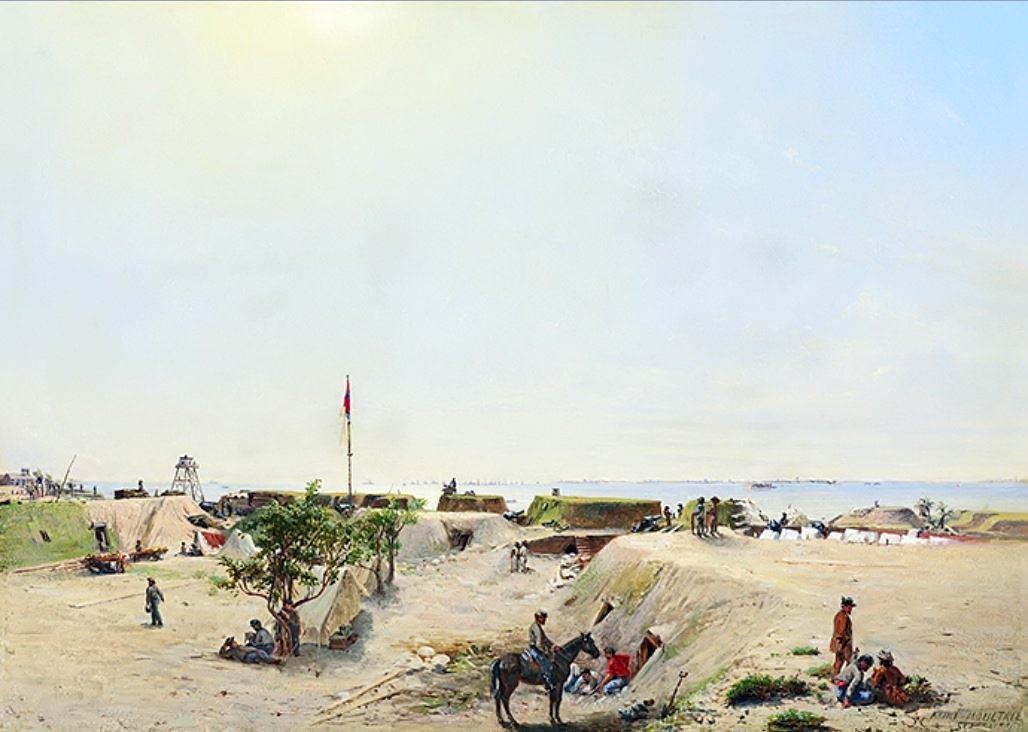
Fort Moultrie, Interior, September 16, 1863 by Conrad Wise Chapman

Painting by Conrad Wise Chapman.

“Interior view of Fort moultrie while the fortifications are being built.  Shows the old Moultrie house, Battery Beauregard, and Battery Marion.  Lieutenant Martin is on a horse belonging to Col. Tabb of the 59th Va. Regt.” – Conrad Wise Chapman, 1898

by John Beauchamp Jones

            SEPTEMBER 16TH.—The enemy advanced yesterday, and, our forces being unequal in numbers, captured Culpepper C. H. Our cavalry fell back several miles, and a battle is looked for immediately, near Orange C. H., where Gen. Lee awaits the foe in an advantageous position.

            From the Southwest also a battle is momentarily looked for. If the enemy be beaten in these battles, they will suffer more by defeat than we would.

            Gov. Vance has written a pointed letter to the President in regard to the mob violence in Raleigh. He says, when the office of the Standard was sacked, the evil was partially counterbalanced by the sacking of the Journal,—the first, moderate Union, the last, ultra-secessionist. He demands the punishment of the officers present and consenting to the assault on the Standard office, part of a Georgia brigade, and avers that another such outrage will bring back the North Carolina troops from the army for the defense of their State.

            From Morton, Miss., Gen. Hardee says, after sending reinforcements to Bragg, only three brigades of infantry remain in his department. Upon this the President made the following indorsement and sent it to the Secretary of War:

            “The danger to Atlanta has probably passed.”

            While the army of Gen. Taylor threatens the southwestern part of Louisiana, troops will not probably leave New Orleans. The movement to White River is more serious at this time than the preparations against Mobile.

            “Efforts should be made to prevent the navigation of the Mississippi by commercial steamers, and especially to sink transports.” [click to continue…]

September 16.—The rebel steamer Lizzie Davis, from Havana, for Mobile, Ala,, was captured in latitude 25° 58′ north, longitude 85° 11′ west, by the National flag-ship San Jacinto.—The rebel forces made an attempt to recross the Rapid Ann River, but were foiled by the National artillery and cavalry. They advanced in three columns, with artillery, toward the river, but being opposed by the Union troops on the north side, soon fell back.—A spirited skirmish took place at White Plains, Va., in which the rebels were dispersed in disorder.

September 16—To-day there was a man shot for desertion. Eight balls passed through him. The way this is conducted is: the brigade that he belongs to, or sometimes even the division, is drawn up in full sight of the doomed man. He is tied to a stake in front of his grave, which is already dug, and his coffin at his side. There is a squad of twelve men and one officer detailed to do the shooting. Eleven of the guns are loaded. The guns are given to them by the officer, so that no man knows which gun is loaded. The order is then given to fire. Thus ends the deserter’s life. The brigade, or division, then marches around him, so that every man can see his, the deserter’s, end.

September 15, Tuesday. The President read the paper which he had drawn up. Mr. Chase proposed as a preferable course that the President should, pursuant to the act of the 3rd of March last, suspend by proclamation the privilege of the writ of habeas corpus on military questions. This proposition, after discussion, met with favor from all, and the Council adjourned to 1 P.M. for Mr. Seward to prepare a proclamation. On meeting at one o’clock, the draft which Mr. Seward had prepared was criticized and after some modifications was ordered to be recopied and carried into effect. All came into the arrangement cordially after Stanton read the reports of sundry provost marshals and others detailing the schemes practiced for defeating the draft.

The question is raised whether the executive can suspend the privilege of the writ of habeas corpus without Congressional action. If the executive can suspend in the cases specified, which is generally admitted, the policy of falling back on the act of the 3d of March last is more than questionable, for if Congress has, as claimed, the exclusive right, can it delegate away that right? If the right is in the Executive, it is not wise nor proper to place the proclamation on the delegated grant in the law of last March which is made the basis of the proclamation. I think I am not mistaken in my impression that Mr. Chase is one of those who has claimed that the President had the constitutional right to suspend the privilege of this writ, yet he was to-day sensitive beyond all others in regard to it and proposed relying on the act of Congress instead of the constitutional Executive prerogative. He feared if the President acted on Executive authority a civil war in the Free States would be inevitable; fears popular tumult, would not offend Congress, etc. I have none of his apprehensions, and if it is the duty of the President, would not permit legislative aggression, but maintain the prerogative of the Executive.

Commander Shufeldt, an officer of ability, gives me trouble by a restless but natural desire for change and more active employment. Wishes an independent command, is dissatisfied to be in the South Atlantic Squadron. Inadmissible. It is only recently he has been reinstated in the service, on my special recommendation and by my efforts, against the remonstrance of many officers and their friends in and out of Congress. Now to give him choice of position over others who never left the service would be unjust. I cannot do it. Duty on his present station is arduous, irksome, exhausting; some one must perform it were he to leave.

Jane Stuart Woolsey to Joseph Howland

Point Lookout Hospital,
September.

Eliza’s help and all her little nice things were, and are, invaluable to us. . . . Things promise pretty fair here in every respect. The surgeon in charge is civil and ready to support us in everything necessary. The post is a queer one, hospital, military encampment, Contraband camp, rebel camp, Roman Catholic element and divided jurisdiction of Mrs. Gibbons and Miss Dix. Quite a mixture. We shall be involved in no gossip or small quarrels, but do our work as we find occasion, without partiality and without hypocrisy. . . . John, our man servant, is a nuisance. He interferes right and left, upsets everybody in a mistaken idea to serve us, and volunteers his views on all subjects. He would be in the guardhouse in a week if he didn’t go home to-night. . . .

September 15 — Still guarding the ford on the Robinson.

Tuesday, 15th.—Remained all night in depot at Acworth; left 6 A. M.; in Atlanta at 12 M. Orders to strike tents; left Atlanta 6 P. M.; at Stone Mountain 8 P. M.

15th. Reveille early and all ready to march at 5 but no orders. After remaining saddled two or three hours “Recall” blew. Ordered to be ready at noon. At 4:30 orders came and we saddled and went to town and witnessed the drumming out of a thief—whole Div.—sad sight. Pitied the man. Drunk and stole a horse. After dark marched out on Strawberry Plains road. Camped at 2 A. M. Quite tired and sleepy.

Helena, Tuesday, Sept. 15. Awakened to find the boats tied up at Helena, which point we reached at 3:30 A. M. Guards were placed to prevent the boys going ashore; notwithstanding, the boys went and came. At 2 P. M. swung out and after much trouble affected a landing where we could disembark. Got off and into park by sundown. Indications of rain. (I on guard.) Many of the boys down in the streets raising “ned”, breaking into saloons, drunk, etc.