September 15th.
We marched fifteen miles to Barboursville and encamped on the banks of the Cumberland River. Many of the men fell out by the way and came straggling into camp until after dark. I am too tired to write, and will lie me down and rest.
September 15th.
We marched fifteen miles to Barboursville and encamped on the banks of the Cumberland River. Many of the men fell out by the way and came straggling into camp until after dark. I am too tired to write, and will lie me down and rest.
Tuesday, 15th—The weather continues sultry and hot. We have our camp fixed up quite comfortably again. There are not many of the sick in the regiment now, most of them having been sent away, and others of us who were sick are getting stronger. I am on duty again, having been to see the doctor only the one time.
September 15th. The fascinations of our charming young hostess, together with the large collection of books and music, were so tempting that most of us spent the whole morning in the house; such a state of happiness for the Bold Soldier Boy was not likely to last long, of course, and we were determined to make the most of it, but at noon we were ordered into a defensive position, and fate compelled us to take a hasty leave, and so bidding good bye to our fair hostess, we reluctantly mounted our horses and rode away.
The division moved forward about three miles south of the town and formed in line of battle along the high ground. The enemy, however, did not show up, and after standing all day about the line, the troops were ordered to bivouac for the night. Broom found another house suitable for headquarters, but it was abandoned and there was no fair lady on hand to weave a web of romance and make it attractive.
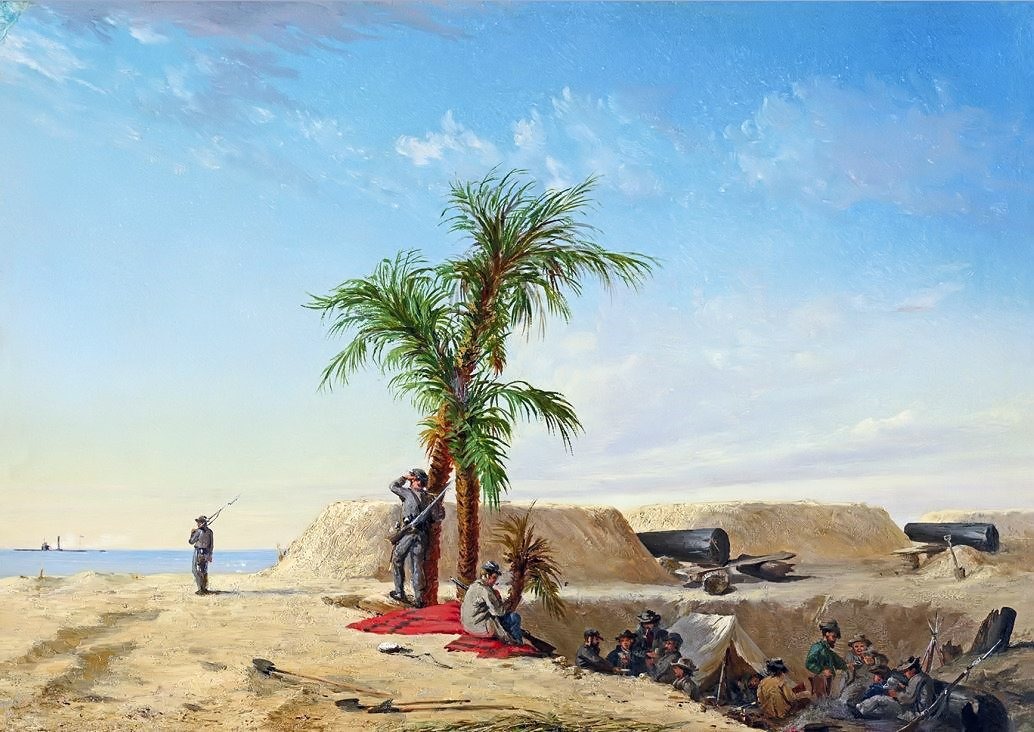
Painting by Conrad Wise Chapman.
“This is a fancy sketch by the artist, and simply designed to show the subterfuge that sometimes had to be resorted to when there was a lack of guns, or there was a delay in receiving them. The fortifications would be prepared, and ‘Quakers’ mounted until the arrival of real guns. The ‘Quaker’ were made of wood and painted black, and at a distance could not be told from the genuine article.” – Conrad Wise Chapman, 1898
September 15.—Rear-Admiral D. D. Porter, writing to the Navy Department from Cairo, Ill., under this date, says:
“The river below seems quiet. There has been but one attempt made to obstruct commerce or transportation. A party of guerrillas attacked the gunboat Champion from behind the levee while she was convoying a body of troops below. The troops passed on safely, and the Champion stopped and fought the rebels until she made them retire, losing some of their men—report says fifty-seven. They have not been heard of since, excepting that they were falling back on Alexandria, General Herron having given them a chase with his division. As I came up, I overtook a part of the Marine Brigade under Colonel Curry. He reported to me that he had just captured at Bolivar three rebel paymasters with two million two hundred thousand dollars in confederate money to pay off the soldiers at Little Rock. He also captured the escort consisting of thirty-five men. This will not improve the dissatisfaction now existing General Price’s army, and the next news we hear will be that General Steele has possession of Little Rock. The gunboats pick up deserters every day, who say the rebels do not intend to fight in Arkansas, and that with proper steps she will be in the Union again in forty days. Lieutenant Bache captured a Colonel Mattock, who was on a conscription expedition, and it gave unusual satisfaction to all the people.”
—At Richmond, Va., three Irishwomen were charged with buying a load of mush-melons in the Second Market, with intent to retail them, and were fined five dollars, and the melons were ordered to be confiscated.
It is well the attention of the efficient clerk of the Second Market has been called to these creatures. They swarm through the market every morning, and buy up the major part of the fruit brought in by the country people, and take it to their houses to retail. As they understand the world, a jug of whisky and a half-dozen melons, and a dozen hard-boiled eggs, constitute a respectable store.—Richmond Examiner.
—M. Larue Harrison, commanding a force of National troops three hundred strong, attacked the combined forces of the rebels Coffee and Brown at Seneca Station, one mile west of Enterprise, at the mouth of Buffalo Creek, Indian Territory, at ten o’clock this morning, and after an engagement of two hours, completely routed them, driving them southward in disorder. As the engagement occurred in a dense grape-vine thicket, it was impossible to estimate the loss of the rebels; five were ascertained to have been killed, among them a Captain W. R. Johnson. Colonel Harrison lost none, either in killed, wounded, or missing.—A magazine on James Island, S. C., belonging to the rebels, exploded, killing a lieutenant and six men.—President Lincoln issued a proclamation suspending the writ of habeas corpus in certain cases.—(Doc. 171.)
by John Beauchamp Jones
SEPTEMBER 15TH.—Gov. Vance writes that he has reliable information that the 30,000 troops in New York, ostensibly to enforce the draft, are intended for a descent on North Carolina, and Gen. Whiting has said repeatedly that 3000 could take Wilmington. The Governor says if North Carolina be occupied by the enemy, Virginia and the whole Confederacy will be lost, for all communication now, by rail, is through that State.
Gen. Sam. Jones writes from Abingdon, Va., that from his information he does not doubt Cumberland Gap and its garrison capitulated on the 9th inst. He calls lustily for reinforcements, and fears the loss of everything, including the salt works, if he be not reinforced. Well, he will be reinforced!
Gov. (just elected) R. L. Caruthers (of Tennessee) begs that 20,000 men from Lee’s army be sent out on Rosecrans’s left flank to save Tennessee, which alone can save the Confederacy. Well, they have been sent!
There must be a “fight or a foot-race” soon in Northern Georgia, and also in Virginia, on the Rappahannock. May God defend the right! If we deserve independence, I think we shall achieve it. If God be not for us, we must submit to His will.
Major Huse is buying and shipping 2000 tons saltpetre, besides millions of dollars worth of arms and stores. If we can keep Wilmington, we can send out cotton and bring in supplies without limit.
Note:, In the book, this entry was dated the 13th. Since there was already a 13th, and since this entry was between the 14th and 16th, I’ve dated this post the 15th.
September 15—Still some firing in front. We are in reserve. I went to see the fight. I saw the enemy very plainly, and thus I spent my New Year’s Day.
September 14, Monday. The President called a special Cabinet council this morning at eleven. The course pursued by certain judges is, he says, defeating the draft. They are discharging the drafted men rapidly under habeas corpus, and he is determined to put a stop to these factious and mischievous proceedings if he has the authority. The Secretary of State and Attorney-General have each been consulted and declare they have no doubt of his authority. Mr. Blair was satisfied the President had the legal power, but whether the measure proposed, which is an order from the President directing the provost marshals to disregard the writ, or to make return that the person to be discharged was held by authority of the President, was perhaps not the best process. Mr. Chase feared civil war would be inaugurated if the privilege of the writ of habeas corpus was suspended. Mr. Usher had doubts and uncertainties.
The President was very determined, and intimated that he would not only enforce the law, but if Judge Lowrie and others continued to interfere and interrupt the draft he would send them after Vallandigham. As considerable discussion had taken place, he was prepared to act, though willing to listen to, and, if mistaken, to defer to, others. Up to this point neither Mr. Stanton or myself had taken part in the discussion, though Stanton had undoubtedly expressed his opinion and prompted the proposed action.
I remarked that the subject was not new to me, — that I had two or three times experienced this interference by judges to release men from service, not in relation to the recent draft, but that we were and had been suffering constant annoyance. Vessels were delayed on the eve of sailing, by interference of State judges, who assumed jurisdiction and authority to discharge enlisted men in the national service in time of war, on habeas corpus. I had as high regard and reverence for that writ as any one, but it seemed to me there should be some way to prevent its abuse. A factious and evil-minded judge — and we had many such holding State appointments — could embarrass the Government, could delay the departure of a vessel on an important mission, involving perhaps war or peace, or interrupt great military movements by an abused exercise of this writ, — could stop armies on the march. I had questioned whether a local State or municipal judge should have this power to control national naval and military operations in a civil war, during the existence of hostilities, and suggested that, especially in time of war, United States judges were the only proper officers to decide in these naval and military cases affecting the law and service of the United States. Hitherto the Army had suffered less than the Navy, and I was not sorry the subject had been brought forward by others.
The President said he would prepare and submit a paper at an adjourned meeting for criticism to-morrow at 9 A.M.
Abby Howland Woolsey to H. Gilman.
Brattleboro, September.
We have had our first letters from the girls at Point Lookout, and everything promises pleasantly. The only grievance is the chaplain, whose face is “as hard as a wooden chair,” and who looks as if he had fought through life, inch by inch. He is fanatically Episcopal, though his sermons were practical and good, and he has the melodeon (paid for by general subscription) picked up and carried off and locked in his own room after every Sunday service, that it may not be used at the Methodist prayer meetings which the men choose to have! Georgy says they have grand good singing, whether or no, without it. . . . There is a little of almost every phase of the war there, except the actual fighting. They have the prisoner’s camp, the New Hampshire brigade to guard it, with their splendid drill, dress parades, officers’ wives, hops, etc. There are the hospitals for each, the General Hospital, and lastly the large Contraband camp. Jane’s first letter was long and interesting, as she was much at leisure, but we do not expect to hear at great length hereafter. . . . Charley, always at Headquarters Army of the Potomac, writes us to-night that they have sent off two corps to West Tennessee, and that he thinks the ultimate use of the balance will be within the defences of Washington. Is not Rosecrans’ crushing defeat a sad blow? . . .
Monday, 14th—Remained in camp all day.
 Follow on facebook
 RSS
RSS email
email