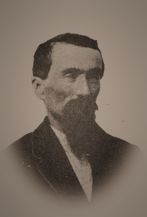
September 14 — This morning at sunrise we forded the Robinson and put our guns in battery at a commanding position on the Madison side of the river, but we saw no enemy to-day except a few scouts on the hills about three miles away, on the Culpeper side of the river. We heard artillery firing this evening down the river in the direction of Rapidan Station. Bivouacked near the Robinson.
September 2013
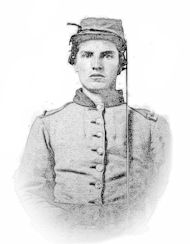
Monday, 14th.—Collision of trains near Atlanta; several soldiers killed. Reported skirmishing in Catoosa County.
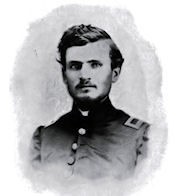
14th. Talk about marching but no orders. During day studied some and wrote two letters. Finished “Barnaby Rudge.” Gave a good many boys passes to go to town. Last night reprimanded Sergt. Beers for staying behind when we went to C. Gap. Glad to get a little rest. Went to town in evening. Provost arrested several of us. Managed to get released. Orders to march at 5 A. M. Tuesday. Wrote to Fannie and Sarah Felton.
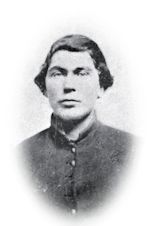
On the Mississippi, Monday, Sept. 14. ‘Tis evening, and I am seated on the guard of the boat all alone, with no noise save the heavy breathing of the steam horse. The sun has just set in the stern of the boat like a ball of fire, throwing its long rays over the waters, giving it the appearance of a golden pathway. The soldiers are all mute, gazing out on the glorious scene, save here and there a group indulging in a quiet game of cards. All day the boat has kept on its slow but steady headway, passed Napoleon at 9 A. M. and yet we are many miles from Helena. You will not wonder then that I have been day dreaming. Behind us lies the parched city of Vicksburg, for which we underwent many weeks of weary toil to capture, after which two short months of rest. And now we are off again, we know not where, but we know it is for war, marching, fatigues, battles and perhaps wounds and suffering, and that, while the anxious heart of an invalid mother, an aged father, sisters and brothers dear, are waiting my return. And I am comparatively alone, and the only happiness I derive is in the indulgence of hope of the realization of the good time coming.
September 14th, 1863.
We were aroused this morning at 3 o’clock and ordered to be ready to march at 5 o’clock. In a very few minutes hundreds of fires were brightly glowing, striving by their feeble rays to dispel the gloom of night. At the appointed hour we were up and away with hearts as light and buoyant as though privations, toil and danger were unknown. The morning was delightfully cool, and before the god of day had risen to scorch us with his burning rays, nearly half our day’s march was done. The rest of the day was made easy by frequent halts, and when, at 2 o’clock p. m., we filed into line and stacked arms, all were agreeably surprised. We had marched twelve miles. Today is the anniversary of our first battle—our baptism. The mind naturally reverts to that trying time, and all its scenes pass rapidly in review. Then, for the first time, we met face to face our country’s foe. The chivalry of the South then met the mudsills of Michigan and learned to respect them. Today we met them again, but not in battle array. As we were starting, this morning, we came upon 2,300 prisoners taken at Cumberland Gap. They were free to talk, and a more ignorant lot of semi-savages I never met. We could not convince them that Vicksburg or Port Hudson were in our possession. They were very “frank,” and indulged freely in epithets and pet names.
September 14th, 9 o’clock p. m.
Our camp is in a beautiful grove, on the banks of a “babbling brook.” A cool, delicious breeze is gently blowing from the west. The sky is cloudless, and the bright, scintillating stars shine out in unwonted brilliancy, and the pale moon is pouring down upon the earth a flood of silvery light. It is an ideal night in which to rest after a fatiguing march—an ideal night, so seem to think our boys, in which to celebrate the anniversary of our first battle. The Sutler came up about sundown with the “accessories.” The preliminaries have been gone through with, and the “celebration is in full blast.” Pandemonium reigns. This quiet glen has been transformed, for the time being, into the council hall of demons. Men fall upon each other’s necks and weep, and laugh, and drivel, and shout ” ‘Rah for Seventeenth Michigan.” It was an impressive ceremony, and one in which all allusions to the brave men who fell and sympathy for their bereaved families were considerately left out, lest they wound the tender sensibilities of the living.
Monday, 14th—Companies A and B started out with teams on a foraging expedition of three days. A detail of forty men was sent down to the wharf to unload a boat of ammunition.
September 14th. Weather dull and wet. At 8 A. M. fell in and marched to the Rappahannock, crossed the river on pontoon boats at 9 A. M. and marched directly for Culpeper, where the cavalry had been fighting all day long a sort of running fight. We passed over the principal battle ground, but saw only a few dead horses and no men. Broom, with his usual appreciation of comfort, selected a fine mansion as headquarters, and while the rest of us put the troops in position for the night, he devoted himself to getting dinner ready, taking care to plant the division flag by the gate post, to let us know where to find him. Tents were pitched in the yard under some fine old trees, and the large drawing rooms appropriated as the general rendezvous; the house belongs to a Mr. Wallach, said to be the editor of a Washington paper, and is in charge of his daughter and a half dozen female former slaves; the daughter is a bright, handsome young woman of eighteen or twenty years, and carries herself superbly, serene and undisturbed. In the parlor everything indicates wealth and culture, while the large hall is lined with books, very miscellaneous indeed, but a genuine treasure to a hungry book lover. This young lady has an eye to business, as well as the fascinations of social life, and soon induced the accommodating general to order guards over her barns, fences, and various properties, her retinue of female servants in the meantime exercising such potent fascinations over our cooks and servants that they secured the complete stocking of their larder for weeks to come from the abundance of Uncle Sam’s commissary. In the evening, after a good dinner in the front yard, we all went into the parlors, where the young lady was on hand to receive us, and spent a delightful evening. She is very fascinating, perfectly at ease, and brilliant as a dewdrop on a summer morn. She sat down to the piano and sang several songs, most of them very rebellious, with considerable skill, receiving, of course, immense flattery, but maintained her dignity and gracious behavior throughout, and an observer would have taken us for intimate friends, on a perfect footing of equality. We sang many war and college songs, and did our best to entertain her. At twelve o’clock she retired and left us to our own resources.
The cavalry fight was between General Pleasanton, commanding Bufort, Gregg and Kilpatrick’s divisions, and the rebel General Stuart; our cavalry met them near Brandy Station, and in a succession of brilliant charges drove them through the town, capturing three guns and one hundred men. Pleasanton followed them over Cedar Mountain, near the Rapidan, and then went into bivouac. Our corps was ordered here in support, in case of a reverse to the cavalry force.
September 14.—This evening three squadrons of the First Maryland cavalry, commanded by Major Russell, were ordered to the front to relieve the Sixth Ohio, then engaged with the rebels at Rapidan Station. When it reached the battleground the enemy was forming for a charge. One squadron was immediately dismounted and deployed as skirmishers, and the other two formed in line of battle. Scarcely were they formed when the enemy charged with a full regiment upon the line of skirmishers. These two squadrons promptly charged the enemy and drove him back. The enemy soon rallied and charged again; but Major Russell had his men well in hand, and met the enemy the second time and drove him back again, capturing one officer and one private. The enemy was satisfied with charging. All this time the rebels had four batteries playing at cross-fires upon the Unionists, and yet, strange to say, the only casualties in the regiment of First Maryland cavalry are Captain Joseph Cook, company D, slightly wounded; Corporal Jno. McCowhen, company G, killed; private John Otto, company F, wounded; private John Schmits, company A, wounded, and three privates missing. Never did men charge more gallantly, or behave better than did these sqadrons. They met more than double their number, and twice drove them back and held the field. Lieutenant Bankard, company A, distinguished himself by his cool and gallant conduct.
—The following circular was issued this day from the headquarters of the army of the Potomac, by command of Major-General Meade:
I. Newspaper correspondents will be admonished to hold no communication with prisoners of war, whether on their way to headquarters or temporarily detained in the custody of any guard, or to seek any information from guides, scouts, or refugees, coming from beyond the lines.
II. No newspaper correspondent or civilian, not connected with the army, will be permitted to accompany or remain with cavalry serving in the front, or on the flank of the army.
—The cavalry advance of the army of the Potomac, under the command of General Pleasanton, reached the Rapid Ann River, at Raccoon Ford, after considerable heavy skirmishing between Culpeper and that point. No rebel infantry had been met with, though a strong force of rebel cavalry had been constantly driven back by the National forces.
—This morning, at about six o’clock, a regiment of Texas Rangers, the Second Texas cavalry, two hundred and fifty strong, under command of Colonel George Madison, charged on the Union picket stationed about one mile south of the town of Vidalia, La., on the road leading along the levee, near the river. The picket—only one lieutenant and six men strong — had to fall back against such an overwhelming power. The musketry firing was distinctly heard in town, where only two companies of the Thirtieth Missouri regiment were stationed. Colonel Farrar, who happened to be present, at once ordered all his men to “fall in,” and was in a few minutes at the place of attack, having only about twenty men, who were first under arms, along with him, the whole force at Vidalia who were fit for duty consisting only of about fifty men. In the double-quick he rushed forward, and was received by a heavy fire of the enemy, who had taken possession of a pontoon train encamped in the southern part of the town, and were just preparing to burn up the wagons loaded with the pontoons. The Union skirmishers opened a brisk fire on the enemy, who was covered by a live hedge, and could not be seen by the men, though the distance was only about twenty yards. Colonel Farrar seeing that the object of the enemy’s attack was the destroying of the pontoon trains, ordered a charge at once, and with cheers his men rushed to the guard, where a lively skirmish for about fifteen minutes took place, and he succeeded in driving the enemy back. The Unionists lost two men killed and four wounded. The enemy lost six killed, eleven wounded, and two prisoners, among whom was a Lieutenant Skinner, of the Twenty-sixth Tennessee cavalry, who stated that the strength of his regiment was two hundred and fifty, and that Brigadier-General Majors, with a body-guard of thirty men from a Louisiana cavalry regiment, was near, but did not take part in the charge; that his regiment had crossed Black River near Trinity City, La., on the evening of the thirteenth, to charge on Vidalia for the purpose of burning down the pontoon train; that besides his regiment there were two Texas cavalry regiments, under command of Colonels Stone and Lane, at Black River, seventeen miles distant, and also one Louisiana and one Arkansas cavalry regiment, all under command of Brigadier-General Majors. Colonel Farrar, who had sent notice to Natchez about the attack, at once prepared to have his men mounted to follow up the enemy as quick as reenforcements came. At about eight o’clock two regiments of infantry and a few companies of cavalry had crossed the river and come to his assistance. The enemy was followed up closely and overtaken at Black River, where another skirmish took place, lasting until dark. The enemy was forced to cross the river, and the National forces returned to camp, where they arrived at eleven o’clock P.M.
by John Beauchamp Jones
SEPTEMBER 14TH.—The report from Lt.-Col. Lay of the condition of affairs in North Carolina, received some days ago, was indorsed by Judge Campbell, Assistant Secretary of War, and father-in-law of Col. Lay, that the destruction of the government was imminently menaced, does not seem to have alarmed the President; on the contrary, he sends the paper back to the Secretary, Mr. Seddon, suggesting that he had better correspond with Gov. Vance on the subject, and if military force should be required, he might call in the aid of Brig.-Gen. Hoke, thus ending hopes of a conscription officer here obtaining a command.
And so with rumors from Eastern Tennessee; the President takes matters coolly, saying the “locals,” meaning home guards, or companies for local defense, should be on the alert against raiders. If large bodies of the enemy come in, Jenkins’s brigade, and one from Pickett’s division, might be temporarily detached to punish them.
Bragg is falling back toward Atlanta, and Burnside says, officially, that he has taken Cumberland Gap, 1200 prisoners, with 14 guns, without a fight. All of Tennessee is now held by the enemy.
There has been another fight (cavalry) at Brandy Station, and our men, for want of numbers, “fell back.” When will these things cease?
September 14—Left camp this morning at 7, marched twelve miles and halted. Hear firing in front on the Rapidan, at Summerville Ford. Here all night.


