Following the American Civil War Sesquicentennial with day by day writings of the time, currently 1863.

September 2013

September 13. — Sunday a year ago was the 14th. South Mountain and its losses and glories. How the sadness for the former fades and the satisfaction with the latter grows!

General Burnside has east Tennessee. Knoxville ours; Cumberland Gap taken, and our forces on the railroad nearly to Bristol. Knoxville to Bristol one hundred and thirty miles; Bristol to depot at bridge one hundred and seven; total two hundred and thirty-seven. Charleston to bridge one hundred and sixty-six.

September 13th. Tents were struck, wagons loaded and at ten o’clock the entire corps marched for Bealton Station. The day was frightfully hot and several men were sunstruck, two or three of whom died. It is reported that Longstreet’s corps has been detached from Lee’s army and sent to assist in fighting Rosecrans and that we are to demonstrate, to entice him back, or possibly take advantage of his absence. This I think doubtful. Towards evening the sky became overcast, and a most refreshing shower cooled the air and revived the drooping men. We marched, I think, only about seven miles, then went into bivouac two miles below the station.

September 13.—A portion of rebel guerrillas belonging to the band of the Chief Biffles, amounting in number to over one hundred and ten, was surrounded by a detachment of Missouri cavalry and a company of mounted infantry from Paducah, Ky., near Paris, Tenn., and six of them killed, twenty-one wounded, and the rest captured.—The Clyde-built side-wheel steamer Jupiter, a noted blockade-runner, one hundred and eighty-four feet long, nineteen feet beam, formerly a passenger-boat on the Clyde, was captured by the United States steamer Cimarron, at half-past three o’clock this morning, in attempting to run the blockade into Savannah, by the way of Warsaw Sound. She had for passengers four officers of the Royal Navy, an agent of the Confederacy named Weaver, and a commercial agent. Also Nassau and Savannah pilots.—A cavalry fight took place near Culpeper Court-House, Va., between the Nationals, under General Kilpatrick, and the rebels, under General Lomas and Colonel Beale, of the Ninth Virginia cavalry, resulting in a complete rout of the rebels, with considerable loss in killed, wounded, and prisoners.—(Doc. 169.)

—The National troops stationed at Salem, Dent County, Mo., were attacked by four hundred rebels, who were repulsed, with a loss of twenty killed and a number wounded.—The expedition against the Sioux Indians, commanded by General H. H. Sibley, returned to Fort Snelling.—The United States steamer Genesee, and gunboats Calhoun and Jackson, shelled the rebel iron-clad Gaines near the fort at Grant’s Pass, below Mobile, and compelled her to retire behind the fort, together with another vessel belonging to the rebel fleet. After the retreat of the rebel iron-clad and the transport steamer behind the fort, the shelling was directed solely against the latter. Twenty-two shells from the Genesee alone, fell inside the fort, and the firing from the other boats was remarkably accurate. Sand, stones, logs of wood, etc., were sent flying upward in great quantities, and before the action terminated every gun was dismounted, and, it is believed, disabled. One large gun in particular was knocked completely end over end, as could be plainly seen from the vessels, and the achievement drew forth hearty cheers from the gallant tars.—An expedition composed of sailors and marines from the Navy-Yard and frigate Potomac, was organized at Pensacola, Florida, and sent up the Blackwater River to destroy a ferry and bridges used by the rebel troops in passing from Alabama into Florida, for the purpose of annoying our garrisons and stealing supplies. Lieutenant Houston, United States Marine corps, employed the captured steamer Bloomer, and accomplished his mission with a loss of two men, namely, Corporal Enderly, marine guard, killed ; private ——, Potomac guard, wounded.
by John Beauchamp Jones

            SEPTEMBER 13TH.—A letter from Gen. J. E. Johnston, Atlanta—whither he had repaired to attend a Court of Inquiry relating to Pemberton’s operations, but which has been postponed under the present peril—repels indignantly the charge which seems to have been made in a letter from the Secretary of War, that in executing the law of conscription in his command, he had acted hastily, without sufficient attention to the rights of exemption under the provisions of the act. He says the law was a dead letter when he charged Gen. Pillow with its execution; that Gen. Pillow has now just got his preparations made for its enforcement and, of course, no appeals have as yet come before him. He hopes that the Secretary will re-examine the grounds of his charge, etc. He is amazed, evidently, with the subject, and no doubt the “Bureau” here will strain every nerve to monopolize the business—providing as usual for its favorites, and having appointed to snug places a new batch of A. A. G.’s—men who ought to be conscribed themselves.

            Col. Preston, under the manipulations of Lieut.-Col. Lay, is getting on swimmingly, and to-day makes a requisition for arms and equipments of 2500 cavalry to force out conscripts, arrest deserters, etc. I think they had better popularize the army, and strive to reinspire the enthusiasm that characterized it at the beginning and the only way to do this is to restore to its ranks the wealthy and educated class, which has abandoned the field for easier employments. I doubt the policy of shooting deserters in this war—better shoot the traitors in high positions. The indegent men of the South will fight, shoulder to shoulder with the wealthy, for Southern independence but when the attempt is made to debase them to a servile condition, they will hesitate.

            Gen. Pickett’s division, just marching through the city, wears a different aspect from that exhibited last winter. Then it had 12,000 men—now 6000 and they are dirty, tattered and torn.

            The great Blakely gun has failed.

            We have reports of the evacuation of Cumberland Gap. This was to be looked for, when the Virginia and Tennessee Railroad was suffered to fall into the enemy’s hands. When will this year’s calamities end?

            Gen. Lee is at Orange Court House, and probably will not leave Virginia. He will still have an army of 50,000 men to oppose Meade and Richmond may possibly be held another winter.

            Congress will not be called, I think; and the Legislature, now in session, I am told, will accomplish no good. It will not be likely to interfere with the supreme power which resolves to “rule or ruin,” —at least this seems to be the case in the eyes of men who merely watch the current of events.

September 12, Saturday. Exceedingly busy in bringing up and disposing of matters which accumulated during my absence. Admiral Farragut and a few friends to dine with me. The more I see and know of Farragut, the better I like him. He has the qualities I supposed when he was selected. The ardor and sincerity which struck me during the Mexican War when he wished to take Vera Cruz, with the unassuming and the unpresuming gentleness of a true hero.

Saturday, 12th—I played off on an old Georgian as Captain or with Captain’s uniform, got a buggy that a private could not have reached with a twenty foot pole. I and Oly Archer rode out in it to Mr. Ransom’s. Took Mr. Jackson along with us. We took supper and sit till bedtime. Time passed delightfully. Pleasant drive back to camp.

September 12 — In camp. We had a heavy rain this afternoon, accompanied by thunder and lightning, and a severe storm which uprooted a large tree near my shelter, that came very near falling on me. It was so near that a change of a few feet in my direction would have been “Farewell to the Star Spangled Banner” for me sure enough. In gratitude for my narrow escape I went to prayer meeting this evening like a good boy.

Saturday, 12th.—Went to Mr. McMillan’s to-day; found Rev. A. Y. Lockridge there. Miss Sallie Orr came over; spent very pleasant evening. Accompanied Miss Sallie home.

12th. All ready to move at “To Horse” but had to wait for whole Brigade to move, being in the rear. Stopped about noon and fed, also got coffee. Passed through Maynardsville and Graveston. Went into camp a little after dark. Good deal of dust. Thunder storm came up too quickly for supper. To bed immediately.

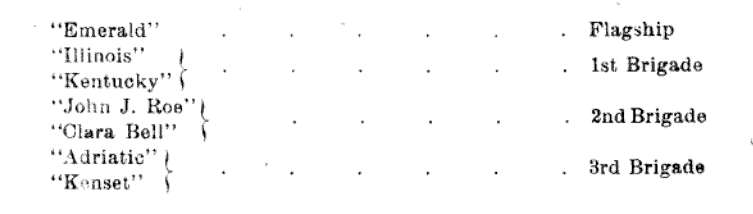
On the Mississippi, Saturday, Sept. 12. Early the “muskets” appeared on the shore and filed on board, the 18th Wisconsin, 4th Minnesota and 63rd Illinois took their quarters on this boat. At 11: 30 A. M. the fleet of the 7th Division put out, headed up stream in the following order:

image

Advanced very slowly, the river being very low. Passed Millikens Bend, deserted and grass grown in appearance, at 4 P. M. Landed at sundown on an island to take on fuel. A lot of negroes at work for government chopping cord wood. All hands got off for fun. Bathed in the river and went to bed.