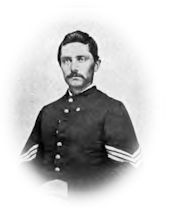
Saturday, 12th—Company E went out on picket this morning. I did not accompany them, as I had another chill yesterday and was not strong enough to go. The teams brought in our poles, lumber and planks and those of us left in camp worked all day building bunks and putting up the brush shades in front of the tents.
September 2013
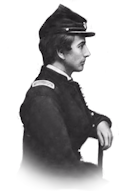
September 12th. Since the gunboat expedition in which the doctor distinguished himself so preeminently, nothing of importance has ocurred. The weather is superb and the health of the officers and men excellent.
Our headquarters are about the house of Doctor Cooper, a graduate of the University of Pennsylvania, who for some unknown reason, has not been drafted into the Confederate army although distinctly rebellious in his views. Amongst the inmates of his home are his wife and three young women, none of whom interest me, but Wilson and Hobart find a good deal of amusement with two of them, and pay them much attention, taking them out riding, etc. We sleep in our tents, but eat in the house, the doctor’s wife presiding with much dignity the mess, furnishing the food, the cooks, waiters, and many of the appointments. We feed the entire family, which is a great thing for them, as they have nothing left of their own, and Broom furnishes the mess luxuriously.
For the first time since the cavalry expedition, we heard cannonading; it was on the right and quite vigorous. About five o’clock orders were received to prepare everything for the march to-morrow morning; it seems really too bad to leave this delightful spot, but life on active service is most uncertain.
September 12.—About three o’clock to-day, a prowling band of guerrillas, some three hundred strong, supposed to be a part of the rebel Colonel Freeman’s men, at Salem, Mo., attacked the Union forces, consisting of one company of the Fifth M. S. M., under command of Captain Whyback, resulting in the greatest confusion and slaughter among the rebels. The rebels had laid their plans to surround the soldiers, and in attempting to carry out their projects—the strong wind blowing the dust in thick clouds round about—they became literally entangled among themselves, and supposing a part of their own men to be Nationals, commenced a most deadly engagement, resulting in great slaughter. In the mean time the militia were “keeping cool,” watching the sport, and at the proper time charged upon the confused foe, raking them down in every direction, putting their vastly superior number to flight, hotly pursued by the undaunted boys of the gallant Fifth, who scattered death and terror to the rebels in their hasty retreat, a distance of eighteen miles. Their loss was not less than twenty killed in the chase. There was not a man of the Fifth killed, and only three wounded. A more complete victory over guerrillas has not been accomplished in Missouri for many months.—Rollo Express, September 19.
—The blockade-runner Alabama was chased ashore on the Chandeleur Islands, Mississippi, and captured, by the United States flag-ship San Jacinto; during the afternoon the rebel steamer Fox was driven ashore by the United States steamers Genesee, Calhoun, and Jackson, and afterward burned by the rebels.—Fitz-Hugh Lee, a brigadier-general in the rebel service, relinquished the command of his brigade, having received promotion to a major-generalship.—As the second battalion of the Sixty-third Indiana regiment was returning from Terre Haute to Indianapolis, this day, an attempt was made to hang D. W. Voorhees, who was reelected to Congress from Indiana at the last election. Mr. Voorhees was travelling as a passenger in the same train with the soldiers. He was rescued by the officers, but compelled by the soldiers to leave the train at Greencastle.—The national salute was fired at noon to-day from the Fort at Sandy Hook, Fort Lafayette, Castle William, and Fort SchuyIcr, New-York, in honor of the Union victories at Morris Island, Knoxville, and Chattanooga.—The schooner Flying Scud was captured by the National steamer Princess Royal She was from Brazos, Texas, and was loaded with cotton.
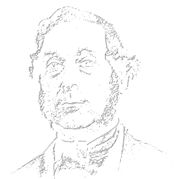
by John Beauchamp Jones
SEPTEMBER 12TH.—Lieut.-Col. Lay, “Inspector,” reports from North Carolina that some twenty counties in that State are “disaffected;” that the deserters and “recusants” are organized and brigaded; armed, and have raised the flag of the United States. This is bad enough to cause the President some loss of sleep, if any one would show it to him.
Gen. Wise, it is said, is ordered away from the defense of Richmond with his brigade. I saw him to-day (looking remarkably well), and he said he did not know where he was going—waiting orders, I suppose.
C. J. McRae, agent of the loan in Europe, writes July 24th, 1863, that the bad news of Lee’s failure in Pennsylvania and retreat across the Potomac, caused the loan to recede 3½ per cent., and unless better news soon reaches him, he can do nothing whatever with Confederate credits. He says Capt. Bullock has contracted for the building of two “iron-clads” in France, and that disbursements on account of the navy, hereafter, will be mostly in France. I fear the reports about a whole fleet of Confederate gun-boats having been built or bought in England are not well founded. Major Ferguson has also (several have done so before him) made charges against Major Huse, the agent of Col. Gorgas, Chief of Ordnance. Mr. McRae thinks the charges cannot be substantiated.
We have tidings of the bursting of the Blakely gun at Charleston. I fear this involves the fall of Charleston. Still Beauregard is there.
Gen. Pickett’s division (decimated at Gettysburg) is to remain in this vicinity—and Jenkins’s and Wise’s brigades will leave. The hour now seems a dark one. But we must conquer or die.
It is said a deserter has already gone over from our lines and given information to the enemy of the large number of troops detached from the Army of Virginia. No doubt Gen. Meade will take advantage of their absence, and advance on Richmond again. Yet I am told the very name of Richmond is a terror to the foe.
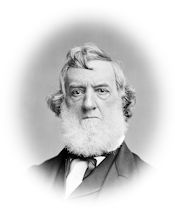
September 11, Friday. I left Washington on the 31st ult. on an official visit to the several navy yards. Have a good report of affairs during my absence. Met the members of the Cabinet with the exception of Stanton at the regular meeting. All glad to see me, —none more so than the President, who cordially and earnestly greeted me. I have been less absent than any other member and was therefore perhaps more missed.
Had a call from Admiral Farragut of a most cheerful and friendly character. Also from Commodore Pennock from Cairo.
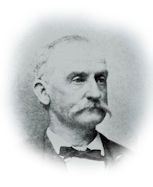
Letter No. XV.
Wilmington, North Carolina,
September11th, 1863.
My Precious Wife:
I am at this place on my way to Bragg’s army. Our division has been ordered there. Of course in a hurried letter I can give you no account of the movements of our armies. Suffice it to say that we are not whipped on this side of the river yet, and I do not believe the combined Yankee army can subjugate the Texas brigade, though they may all be killed. I have met Major Hampton Gibbs here, and have spent most of the day with him visiting the blockaders, and he has extended to me every courtesy possible, and I shall recollect my detention in Wilmington with pleasure. I have had but one letter from you since I left Texas, but feel satisfied that all is well.
Brother Charles wrote to me in August and said you were all well up to the 10th of July. Douglas De Saussure was wounded in the shoulder a few days ago at Charleston, so I expect to see him in passing through Columbia, as I have permission to go by there. This will be sent by blockader Elizabeth. Hampton Gibbs sends regards to you. Your husband, faithfully ever,
John C. West.
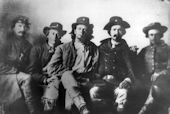
Friday, 11th—Remained in camp.
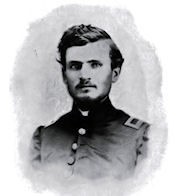
11th. Awakened at daylight and moved at sunrise. In advance. Gen. Shackleford now commands 4th Div. and Col. Carter the Brigade. Gen. Carter Prov. Mar. Gen. of Tenn. Reached Clinch River at sundown, and camped. Receipted for oats, plenty of eggs, chickens and potatoes. Camp near a little stream on Union man’s place. Bosworth sick today and in ambulance. Chicken and potatoes for supper. Apples and peaches enough today.
Richland Jail, Columbia, S. C., Sept. 11, 1864.
Dear Father, — I suppose you have heard from Captain Williams by this time that I am well. In case he is unsuccessful and has to return here, please send $100 in gold by him. If he does not come back, please forward a bill of exchange for 20 pounds sterling to Major Anderson of General Foster’s staff, and ask him to get it to me. I am very anxious to hear from you all at home. Have heard nothing since my capture, which was six weeks yesterday. Have managed to get along very comfortably since I have been here. Our rations are good and in sufficient quantity, and we have obtained money to buy extras by selling our watches.
Captain Amory is well. He received a box of clothes day before yesterday from Major Anderson. He very kindly furnished me with a shirt and pair of drawers, so that I manage to keep a clean suit of underclothes with me.
We all of us expect a general exchange of prisoners this fall. It certainly ought to be done for the sake of the enlisted men, who have no money and no means of getting any.
In our new room we have got rid of all vermin. An agreeable riddance, I can assure you.
. . . Please give me any news you. may have in regard to my regiment.
Vicksburg, Friday, Sept. 11. Reveille at the usual time, breakfast, after which proceeded to move; hitched quietly and leisurely. I was ordered to pick my team out of the Platoon and harness it as extra team, which gave me an opporunity to take my valise along with me. Griff took my butter keg and dried apples. Left my overcoat with E. W. E., knapsack in charge of G. M. Spencer and Piper, who are to stay behind. Proceeded to the levee and loaded on to the “Illinois”, a large freight boat; guns put in position on the forecastle, the horses in the stern unharnessed. All was stowed away tuck by 9 A. M. Infantry loading on teams and mules all the remainder of the day, filling up the lower deck so as to be impassable. Made our bed on the boiler deck and slept.


