Vicksburg, Thursday, Sept. 10. Very warm and quiet during the day. All ready and awaiting marching orders. J —— taken to the Provost Marshal as being concerned in yesterday’s riot. Mail arrived, brought the sad news of the death of Alice, Evie’s sister. After supper call, while eating quietly in the dusk, a hurried order came to hitch up, and was executed with more haste. Our piece was not going, and I knew not in what capacity I was to go, but it was evident there was nobody to tell me just then. And not wishing to be left, I hurriedly packed my blankets and started with the column; nearly everything lying around, such was the haste. We marched briskly until we reached the levee street, when we halted, made a counter march and returned to camp.
September 2013
Thursday, 10th—I reported to the doctor this morning for the second time in the space of two years. The doctor thought that I was in no immediate danger, for which opinion I thought he was not very well posted, but he gave me the “Blue Mass” pills, telling me to be sure to take them and not throw them away as so many of the boys do. I told him that I did not come for the purpose of getting medicine to throw away, for I had been too near dying. He assured me that I was a long way from dying.[1]
[1] The doctor’s exact words were: “Oh, you’re a long ways from dying!” Perhaps I was more frightened than sick. But when a sick man is near a regular hospital and sees from three to six dead men carried out every day to the “bone-yard,” as the boys used to say, it does not look very encouraging to him.—A. G. D.
September 10.—Major-General S. A. Hurlbut, from his headquarters at Memphis, Tcnn., issued general orders causing reprisals to be made for all rebel outrages committed within his lines, by levying assessments upon the wealthiest and most notorious sympathizers with the rebellion, adding fifty per cent to the amount of damages proven.—Last night a party of soldiers, belonging to General Benning’s rebel brigade, robbed the office of the Standard newspaper, at Raleigh, N. C., and this morning a crowd of citizens “gathered and rushed upon the office of the State Journal, in the same place, and totally destroyed the furniture and printing materials.”— (Doc. 186.)
—Little Rock, Arkansas, was captured by the National forces under the command of General Steele.— (Docs. 124 and 145.)
—Major-General James G. Blunt, from his headquarters at Fort Smith, issued the following address to the people of Arkansas:
“The flag that two and a half years ago was struck, when a weak garrison of United States troops were compelled to abandon this post, before a superior number of maddened and infuriated men, who had resolved upon the overthrow of the best Government upon earth, now floats in triumph over Fort Smith. In reply to the many inquiries ‘made, “Is the occupation of this post by Federal troops to be permanent?” I answer yes. The flag that floats from yonder staff, shall continue to wave its folds to the breeze, never again to be desecrated by treason’s foul pollution. The whole of the Indian Territories and Western Arkansas are now in my possession, and under my control. All the rebel hordes, except a few guerrillas, have been driven beyond the Red River. The most obnoxious of the rebel citizens have followed the army with their families to seek the ‘last, ditch.’ It is for you, who have chosen to remain at your homes, to elect whether you will have peace or war.
“From the unfeigned joy manifested by thousands of your citizens upon the occupation of this city and the neighboring city of Van Buren— from the reports of delegations who have visited me from over one hundred miles in the interior, south of the Arkansas River, as also from the fact that hundreds of true men have come from the mountains to swell the Union ranks in the last few days, and still continue to come from whither they have been driven and hunted like beasts of prey by confederate soldiers—gives assurance that the love and attachment for the Union is not yet extinct in Western Arkansas. Moreover, the bleached and crumbling bones of hundreds of Arkansians who, in this locality, have recently been hung upon the gibbet, by a fiendish and merciless crew of confederate murderers, for no other reason than that they loved the old flag, and would not bow their necks to the behests of treason, is evidence that they were true and devoted heroes, worthy a better fate.
“Many applications have been made by citizens for safeguards. None will be issued. The best safeguard you can have is the American flag suspended over your premises, and to deport yourselves as becomes good and loyal citizens. Your conduct must be your safeguard. If it shall be your desire to disenthral yourselves from the tyranny and oppression to which you have been subjected, and organize a civil government, under the auspices of the United States authority, every facility will be afforded you to accomplish this purpose. I leave the matter with you, trusting that wise counsels may prevail.”
—The Eleventh regiment of Kentucky mounted infantry, commanded by Colonel Love, in pursuit of the rebel guerrillas under Colonel O. P. Hamilton, overtook them at Brimstone Creek, Tenn., where a brisk skirmish occurred, the guerrillas mounting their horses and making off. Hamilton, who was recognized, rode boldly up to within one hundred and fifty yards of the Union advance, and delivered his fire, then turned and dashed into the bush. He was followed by a volley and retreated to the hills. The morning report of their Adjutant was captured, showing four hundred and eighty men for duty. Four of the guerrillas were killed and found in the brush. Two prisoners were taken, who acknowledged that seven were wounded. The rebels, who had bushwhackers in the hills assisting them, so completely blockaded the road by felling trees, that it was found impossible to pursue them. Colonel Love withdrew, and under orders from Colonel Barney, halted at Ray’s Cross Roads.
The following proclamation was found posted on a tree at Tonipkinsville, given literally :
Head Qrs Hamilton Battalion
Tomkinsville Ky.
Sept 7 1863
I Now Give Notice to Citizens and Soldiers to all Concerned that the principle of Burning and Pilaging must be Stopt as I am ordered to retaliate in Every respect. Let us fight and not make war on the Women and Children. I am Roundly opposed to Burning and Plundering But I am Compelled to Retaliate tharefore I am Desireous that the Burning and Pilaging may be stopt if it Does not stop I will Certainly Retaliate I will Certainly Regard Citizens if the Citizens of the South is Regarded. I am your Humble Servt
O. P. Hamilton
Col. Comdg
The Cavalry!
—Mathew F. Maury addressed a letter to the London Times, on the reports and war-plans of the National Government.—A fight occurred at Ringgold, Ga., between the National forces under Colonel Wilder and General Van Cleve, and a portion of the rebel army which was retreating from Chattanooga, resulting in the expulsion of the latter from the town, with a loss of three killed and eighteen taken prisoners. The Union loss was three men wounded of the Ninety-third Illinois regiment.—Major-General Rosecrans entered Chattanooga.
—-B. H. Richardson and his son, Frank A. Richardson, and Stephen J. Joyce, proprietors of the Baltimore, Md., Republican, were to-day arrested by order of General Schenck, for publishing in their paper of yesterday evening a piece of poetry entitled the “Southern Cross.” The three were sent across our lines this morning. The proprietors of the Republican were frequently warned by the authorities against the publication of disloyal sentiments in their paper.

by John Beauchamp Jones
SEPTEMBER 10TH. —A Mr. J. C. Jones has addressed a letter to the President asking permission to run the blockade to confer with Mr. Bates, of President Lincoln’s cabinet, on terms of peace, with, I believe, authority to assure him that none of the Northwestern States, or any other free States, will be admitted into the Confederacy. Mr. J. says he has been on intimate terms with Mr. B., and has conceived the idea that the United States would cease the war, and acknowledge the independence of the South, if it were not for the apprehension of the Northwestern States seceding from the Union. If his request be not granted, he intends to enter the army immediately. He is a refugee from Missouri. He assures the President he is his friend, and that a “concentration of power” in his hands is essential, etc. The President refers this paper, with a gracious indorsement, to the Secretary of War, recommending him either to see Mr. Jones, or else to institute inquiries, etc.
S. Wyatt, Augusta, Ga., writes in favor of appeals to the patriotism of the people to counteract what Mr. Toombs has done. What has he done? But he advises the President, to whom he professes to be very friendly, to order a discontinuance of seizures, etc.
A. Cohen (Jew name), purser of the blockade-running steamer “Arabia” at Wilmington, has submitted a notable scheme to Gen. Winder, who submits it to the Secretary of War, establishing a police agency at Nassau. Gen. W. to send some of his detectives thither to examine persons coming into the Confederate States, and if found “all right,” to give them passports. It was only yesterday that a letter was received from Gen. Whiting, asking authority to send out a secret agent on the “Arabia,” to see what disposition would be made of her cargo, having strong suspicions of the loyalty of the owners and officers of that vessel. [click to continue…]
September 9, 1863.—Arrived at Newnan, Georgia, this morning about 8 o’clock.
We left Dalton yesterday morning, reaching Atlanta at 6 o’clock P. M. On our arrival we saw numbers of families around the depot, in tents and old cars—refugees, who had been driven from their homes by the enemy. Some of them had left home on the advance of our army, as wherever it is there is a scarcity of provisions.
We put up at the Atlanta Hotel. Dr. Young, whom the shells at Chattanooga had put under the necessity of changing his abode, and Major Proctor, spent the evening with us. Major P. was very low-spirited, as he thought his chance of getting to his home in Kentucky less than ever. General Bragg, as a rule, is not a favorite with Kentuckians, as they think he had no good reason for leaving Kentucky when he did; but he was little spoken about that evening.
Dr. Y.’s indignation was so great against the extortioners and speculators, that he had none left for any one else. He was bitter in the extreme, which it is not much to be wondered at, when we think of how he and others have given up homes, friends, and every thing dear to them for the cause, and find such Shylocks preying on the very heart-blood of our country; and it is enough to make even the “stones cry out.” Dr. Y. told us that our money was more depreciated in Atlanta than in any place in the Confederacy. He said that for himself, “if the Confederacy fell, he would think it an honor to sink with it and its money in his pocket, rather than to have made his thousands.
We found Atlanta full of the “gilt-lace gentry;” a sure sign, they say, “there will be a battle soon.” If General Bragg is a strict disciplinarian, why is it that nearly every place we go to is filled with officers; apparently in good health, and doing nothing?
We left our sick at different posts on the road.
Newnan seems to be a very nice little town; it is the capital of Coweta County, and is forty miles south-west of Atlanta, on the West Point road. We are at the Coweta Hotel, a very pleasant one, kept by Colonel Colyer of Tennessee, a member of congress. He has been driven from his home, and, for want of something better to do, has turned hotel-keeper. The fare is very good, but we had no wheat-bread for breakfast, and I am not southern enough to like corn-bread.
The first thing we were told on our arrival was, that the citizens did not like the idea of the hospitals coming here. This seems strange; it can not be that these people have no relatives in the army, as we know how nobly Georgia has come forward at every call for troops; and have we not heard of their bravery on every battle-field in Virginia?
Well, if they have relatives in the army, do they not expect they stand a chance of being sick or wounded, and that, unless hospitals are provided for them, these same relatives would be in a terrible state, and denounce the government and everybody connected with it?
I do not doubt but that they would be very much displeased if they were to hear that the people in some of the towns in Virginia, where most of the Georgia troops are, were opposed to having hospitals among them for the benefit of those troops. True, a hospital is not the most pleasant place in the world, where we have stern war, stripped of all its glory, and nothing but the sad realities presented—fell disease, with all its noxious vapors, and the poor, emaciated frames—men who went forth to the army, flushed with health and strength, but now, by wounds and disease, made nearly as helpless as infants. But what are we to do? Let the men suffer?
I sincerely trust that it is mere idle talk we have heard, and that the people here have not forgotten, “Do unto others as you would have them do unto you.”
The next thing we were told was, that there is great hostility shown to the refugees in this place. Can this really be the case? But if the former is true, then the latter may be. If the enemy are culpable, who have driven those people from their homes, and forced them to seek others among strangers, how much more so are those persons who are now living, surrounded with all the comforts of home. True, in a measure, all are suffering now; but sympathy costs nothing, and, as Burns says,
“A man may tak a neebor’s part,
Yut hao nao cash to spare him.”
If these people would only think of what may be their own fate; for if we are to judge from the signs of the times, the war is far from being over, and if for no other reason than that they may need the same kindness shown to themselves, they ought to show all they can to the strangers.
“Thou thinkst sweet, when friend with friend,
Beneath one roof in prayer may blend;
Then doth the stranger’s eye grow dim—
Far, far are those who prayed with him;
Thy hearth, thy home, thy vintage land;
The voices of thy kindred band;
O, midst them all, when blest thou art,
Deal gently with the stranger’s heart!”
Dr. Gamble and his surgeons have been out all day in search of hospital accommodations, and have succeeded in getting room for one thousand patients. They have taken nearly all the large buildings and stores. It astonishes me to see how cheerfully our men go to work again to fix up more hospitals.
I observed the people on the cars coming down, and that every body seemed to take their trials as a matter of course. Suffering has made them strong. It is said, the only grumblers we have are those who stay at home and have had no reason to feel the war.
Wednesday; 9th—Quiet to-day.
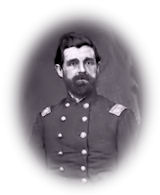
During this time Colonel Lyon had a leave of absence and went home for a visit of two or three weeks. Lieutenant-Colonel Chapman had command of the regiment during his absence, and Colonel Smith, of the 83d Illinois, had command of the post. During his absence the regiment was ordered to Columbia.
Wednesday, 9th.—Command left Dalton 8 A. M.; at Atlanta, 6 P. M.
9th. Moved on at daylight without breakfasting. Reached Mr. Patterson’s where the brigade was camped and fed and got breakfast. Col. P. and Major went to gap with flag of truce. Still refuse to surrender. Drew and issued rations. Burnside arrived, and we at noon received orders to proceed to Baptist Gap and clear the blockade. 8 miles we marched and then dismounted and climbed the high and rough mountain, cutting out the timber as we went. It was a hard job for me, came near bleeding. Thought at first we were to have a fight. Gap surrendered at 4 P. M. Camped at foot of the mountain.
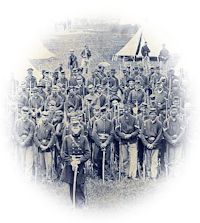
Crab Orchard, Ky., September 9th.
Again has the note of preparation sounded in our camp, and all hands are busy getting ready for another campaign. In all probability we will soon be on our winding way among the Cumberland Mountains, en route for East Tennessee to assist in driving treason from that unhappy State. Orders have not been issued, but our artillery and ambulances have come, clothing has been issued, knapsacks, haversacks, canteens and tents have been distributed, and, more ominous still, forty rounds of cartridges have been dealt out to every man—in fact, we are ready to take the field at a minute’s notice, and only await the order.
“Be ready to march tomorrow morning at 8 o’clock,” is the order that greets me as I write. It is one hundred forty miles to Knoxville, our objective point, and will take us fourteen days if unopposed.


