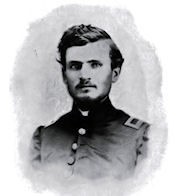
6th. Up early and on the march at 6:30 towards Knoxville. Passed through a very pretty country along the railroad. Passed Dr. Baker’s, killed by Trescott, Co. C on raid, bushwhacker. Many rich people, many well dressed darkies. Reached K. at 3 and lay in dust for two hours. Major Seward—disgusted—marched us through town when Col. P. overtook us and ordered us back through town and to camp north of river. Very pretty town, 6,000 or 7,000 inhabitants once, many vacant houses now. Hartsuff’s Headquarters. Depots, cars and barracks. Boys showed me old fighting ground.
September 2013

Sunday, August 6. [September]—Since writing in this journal a sad change has come over the spirit of my dreams. What but a few hours ago was a scene of order and comfort, has disappeared, and in its place vacancy.
When the afternoon service was over, starting to visit the sick, I met Dr. Ray going to give orders to pack up immediately, as a raid was momentarily expected, and we would have to leave. The first thing done was to send off the sick, and to see that they were properly cared for; and then it seemed like magic the way every tent was leveled with the ground.
It is not more than a few hours since the order came, and we are nearly all packed, and many of the hospital things sent to the depot, which is some two miles distant. I suppose the cooks will be up all night, preparing rations. We will have to spread comforts on the floor to rest on for the night, as our bedding has been carried off. We do not expect to leave before morning. If the enemy do not capture us I shall be thankful.
We have three very sick men—Lieutenant Payne, Dr. Mitchell, and a Mr. Green. The last we shall be compelled to leave, as he is in a dying state. The nurse who has had him in charge is very much alarmed that he will be compelled to remain with hint. Ho does not like the idea of being captured, having been a prisoner before, and has had as much as he cares for of prison life. Dr. Bemiss thinks he will be able to get some one in the place to take care of the sick man.
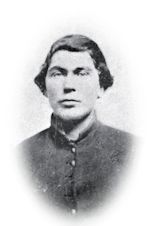
Vicksburg, Sunday, Sept. 6. Warm and monotonous during the day. Felt unwell. Mail arrived in the evening. None for me.
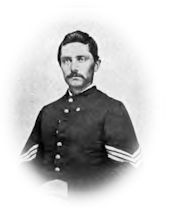
Sunday, 6th—The sick in our regiment were sent away this morning, thirty-one in all. Those who could stand the trip North were given a thirty-day furlough, and the very sick were taken to the general hospital here in Vicksburg. The men whose thirty-day furloughs have expired are returning to their regiments.

Md. Heights, Sept. 6, 1863.
Dear Family:
Yours rec’d and contents noted. Glad to hear of your good health. Lieut. F. said you were looking well. Rec’d shirts by corp’l Frye. I wore them three days and was obliged to take them off or pass for a black man. The black came off in profusion. It took nearly half a day to wash it off my body. I would really like to hear that piano. I presume it would sound very unnatural, as I never heard one in the old house, and I believe I have not heard one since I have been out here. I often think does the poor old pear tree bear well this year? I used to think it was the nicest fruit on the farm.
I got a pass Friday, for the purpose of obtaining all the information I could in regard to growing tobacco, as that was your desire. After about an hours work in getting through the chopped down trees (to stop the rebs) I at length reached the valley. I asked one of the assistants about it and he referred me to an old negro, who had grown tons of it in his day; but by his looks, should think he had done about all the work he could do. And now, if the reader will give me his entire attention for a few moments I will explain all. (How does that sound?) A side hill or slope where the sun shines most of the day is preferable, new ground is the best; burn bush over the ground, in order to kill the weeds; then grub up the ground, working in ashes, “the more the better;” rake the ground up fine and then sow the tobacco, raking it well. After raking and cross raking and rolling (as you do most of your land), I suppose that the tobacco would grow well. It neither needs wet not dry soil, but about the common soil. It greatly depends on the season, about the last of march is the time for planting in this section; it is sown the same as grass seed, only not so thick. It is not necessary to use manure.
The heavens are assuming a dark and cloudy aspect, and the low thunder rumbling in the distance, from the Alleganies, gives tokens of a refreshing shower. It is a beautiful sight to see from this point the wind and rain come rushing down the valley, seeming to the looker on as if he were above them all. Since we have been here I have seen a thunder shower below me in the valley.
Hoping this will find you all well, I remain &c.
Lev.
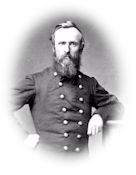
Camp White, September 6, 1863.
Dearest: — How will it suit you to come out here as soon as you have visited Fremont, say in two or three weeks? I would like to have you here before the weather gets too bad. You can leave the boys with their grandmother somewhere and after it is known where we are to winter, I can send for Grandmother and the boys to come also. If we stay here, I will want to keep house for “you all” this winter. If we go too far into the bowels of the land for you to follow, you can return to Grandma and the boys after a suitable visit here.
As things are now it would be very agreeable for you here. I prefer not to have the boys come out until it is quite certain they can stay. If you only staid a week or two, it would be worth while to come. If any change occurs to make it not desirable for you to come, I will write you. In the meantime I hope you will be able to cut your visits short so as to get here by the last week in this month, or sooner if convenient.
I send you enclosed a letter from Mrs. Delany as one of the memorials to be kept with slips from the Catholic Telegraph.
I shall direct this to Columbus hoping however you have started for Fremont. — Love to all.
Affectionately, your
R.
Mrs. Hayes,
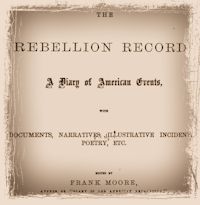
September 6.—A fight took place at Brandy Station, Va., in which the rebel cavalry, under General Stuart, were driven back four miles beyond Culpeper Court-House, on the road to Richmond, and two pieces of horse artillery were captured from the rebels by the Union forces, under the command, in person, of General Custar, who was slightly wounded.
—The bombardment of Forts Wagner and Gregg, in Charleston harbor, was continued during the day. Last night battery Gregg was assaulted by the National forces, who were repulsed.
—Forts Wagner and battery Gregg were evacuated by the rebels in accordance with the orders of General Beauregard, and seventy-five men and twenty-one guns were left in the hands of the National forces.—(See Supplement.)

by John Beauchamp Jones
SEPTEMBER 6TH.—Northern papers received yesterday evening contain a letter from Mr. Lincoln to the Illinois Convention of Republicans, in which I am told (I have not seen it yet) he says if the Southern people will first lay down their arms, he will then listen to what they may have to say. Evidently he has been reading of the submission of Jack Cade’s followers, who were required to signify their submission with ropes about their necks.
This morning I saw dispatches from Atlanta, Ga., stating that in one of the northern counties the deserters and tories had defeated the Home Guard which attempted to arrest them. In Tennessee, North Carolina, Mississippi, and Georgia, we have accounts of much and growing defection, and the embodying of large numbers of deserters. Indeed, all our armies seem to be melting away by desertion faster than they are enlarged by conscription.. They will return when there is fighting to do.
A letter from Col. Lay, dated North Carolina, to the Chief of the Bureau of Conscription, recommends the promotion of a lieutenant to a captaincy. The colonel is great in operations of this nature; and Col. Preston is sufficiently good natured to recommend the recommendation to the Secretary of War, who, good easy man, will not inquire into his age, etc.
Gold is worth from 1000 to 1500 per cent. premium; and yet one who has gold can buy supplies of anything, by first converting it into Confederate notes at low prices. For instance, coal at $30 is really bought for $3 per load. A fine horse at $1000 for $100. Bacon, at $2 per pound is only 20 cents; boots at 100 is only $10, and so on.
Thank Heaven! the little furniture, etc. we now have is our own —costing less to buy it than the rent we paid for that belonging to others up to the beginning of the month. A history of the household goods we possess would, no doubt, if it could be written, be interesting to haberdashers. I think we have articles belonging in their time to twenty families. [click to continue…]
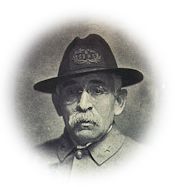
September 6—Our captain, Harvey White, returned to camp yesterday from a furlough.
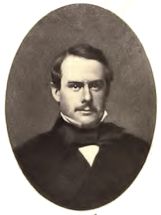
Charles Francis Adams, Jr., to his father
Camp of the 1st Mass. Cav’y
Warrenton, Va.,
September 5, 1863
I write today simply to keep up my sequence of letters, for I have no more to say than I had last week. Again we have moved camp and we now find ourselves in our old place near Warrenton. Our week of outlying picket was very uneventful so far as this regiment was concerned, although one day the enemy did catch a patrol of some fifty of the 6th Ohio and play the very devil with them, running them down to our very pickets and killing, wounding or capturing two-thirds of their number. They hurried us out to attend to matters and we pelted up to the scene of action, but the enemy were gone long before we got there, though we didn’t spare horse-flesh, and it only remained for us to pick up the pieces and come in. The rebs did the thing very neatly — the old story, an ambush, a large party in reserve, an unexpected sally, headlong flight and vigorous pursuit, the whole closing with an unmolested retreat in possession of plunder, horses and prisoners. In going out I had charge of the advance and, as we pushed rapidly along by dead horses and wounded men, I was glad to see one thing I never saw before — women caring for our wounded. They were Virginians, and only the week before our regiment searched their house for one of their two brothers in the confederate Army; but now we found the old father and four daughters, two miles this side of their home, near which the surprise took place, doing what they could for one of our Sergeants who had fallen by the road-side. The man died next morning. Only one man had been killed outright at the first fire, and he was neatly laid out by the side of the road, stripped to his underclothes in most approved fashion. We picked up the dead and wounded and returned to camp. . . .
You seem to feel great fears of the low countries for campaigning, but the summer is passed and few collections of men four hundred strong could have enjoyed better health than this regiment. The Virginia climate has now nothing new for us, as our campaigns began now some days more than a year ago. For myself I am free to say I consider Virginia as possessing in natural attributes more that would belong to an earthly Eden than any region I ever set foot in. The climate is wonderfully fine, the soil naturally fertile, the rivers are beautiful to a degree, the mountains fine and the valleys almost perfection. So much of it man has not been able to destroy or to disguise. This war, if we remain one country, has blasted and is going to redeem Virginia. It has effectually destroyed a pernicious system of labor and a new one must supply its place. Then, some day, it may be as prosperous as New England, and, if it ever is, it will be a land of milk and honey.
As to unhealthiness I see nothing of it. The unhealthiness of armies arises not from climate but from filth. I see that the new correspondent of the Times begins with the wonderful filth of our soldiers. I can only suppose that he compares foreign armies in garrison with ours in campaign, for I do not believe that foreign soldiers are cleaner than ours in the field. Statistics of mortality from camp disease in the Crimea as compared with any episodes of our war I think will not show such to be the case. Is the Crimea or Turkey so much more unhealthy than Morris Island, New Orleans and Vicksburg? Still an army, any army, does poison the air. It is a city without sewerage, and policing only makes piles of offal to be buried or burned. Animals die as they do not die in cities and, if buried, are apt to be insufficiently so. Then animals are slaughtered for beef and so, what with fragments of food and scraps of decaying substances, all festering under a mid-summer sun, an army soon breeds a malaria which engenders the most fatal of fevers. . . .


