Saturday, 5th—Reached Alpine, left one wagon to the Regiment, and with the rest the dismounted men started for Rome. Came eight miles and camped.
September 2013
Saturday, 5th.—Badly disappointed to-day. Cousins Mag and Hattie Lowry came to train, to come home with me; but the authorities would not, or could not, be persuaded to let them get on the train, and so I had to say good-bye.

Saturday, 5th. Awakened at 4. Breakfasted at 5. Kind people, intelligent woman. Most intelligent and pretty girls in Tenn., two. Had some music last night. Marched at 6. Rear guard. Passed through Unitia, all Union. Illuminated houses last night. All fared first rate, good time. Two meetings today and tomorrow. Forded the river. Reached camp at 10 A. M. Ben got an early dinner. Did some business and took a nap. Had a good bath and change of clothes. Some flour baked. Gave Ben $10 to pay for it! Thought it $1 and got 50 cents back.
Vicksburg, Saturday, Sept. 5. Fine day. Health very good. Feel first rate today. We have fine times of it. We bought lots of potatoes and onions with butter, sauce, etc. and we live good for soldiers. Headquarters serenaded in the evening by 3rd Brigade band—Avery leader.

Saturday, 5th—No news of importance. The weather continues hot and sultry. Many more of the sick are being sent home on furloughs or taken to hospitals. Although half of our number are sick with the chills and fever, yet a kind Providence has certainly favored the soldiers of the Union armies in this region; for though in past years it was a common thing for the people here to have a siege of cholera or yellow fever, we have thus far been spared such a scourge.
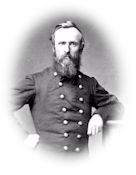
Headquarters 1st Brigade, 3d Division, 8th Army
Corps, Camp White, West Virginia,
September 5, 1863.
Editor Catholic Telegraph: — In the Catholic Telegraph of August 26, I am mentioned as the commander of the expedition to Wytheville in which Captain Delany lost his life. This is an error. The expedition was planned by General Scammon and was under the command of Colonel Toland until he was killed early in the action at Wytheville, when (Colonel Powell, the next officer in rank, having been disabled by a severe wound) the command devolved upon Lieutenant-Colonel Franklin of the Thirty-fourth Regiment, O. V. This daring enterprise was so ably conducted, not only in the advance and attack, but also in the retreat, that it is due both to the living and the dead that this correction should be made. Captain Delany was in the brigade under my command until temporarily detached for this dangerous service. Upon hearing of his death I sent the melancholy intelligence of the loss of this most gallant and meritorious officer to his friends in Cincinnati. It was no doubt in consequence of this that the mistake of the Telegraph as to the leadership of the Wytheville expedition occurred.
Respectfully,
R. B. Hayes,
Colonel Commanding.
September 5, 1863. 8 P. M. — Lieutenant Abbott, Sergeant Clark, Sergeant Stoner, and seventeen other Twenty-third men go into Dixie to destroy iron-works, bridges, etc., etc. A perilous task. Great hardships and exposures to be encountered. Good luck to them!
September 5.—Major E. W. Stephens, with a portion of the First West-Virginia volunteer infantry, was surprised in his camp at Moorefleld, Va., by a party of rebels under the command of Imboden and Jones.—(Doc. 141.)
—Forts Wagner and Gregg, in Charleston harbor, were furiously bombarded by the National fleet and land batteries, under the command of Admiral Dahlgren and General Gillmore. The firing began at daylight and continued until dark. —{See Supplement.)
—The Charleston Mercury of this date contained the following:
“Although carefully covered over with the mantle of secresy by Congress, enough has been disclosed by stern realities to show the total incompetency of President Davis to govern the affairs of the Confederacy. He has lost the confidence of both the army and the people; and if an election to-morrow was to come off for the Presidency, we believe that he would not get the vote of a single State in the Confederacy. Yet, if the Provisional Congress had done its duty — if the present Congress would do its duty—President Davis could readily be driven into a course of efficiency. He is President of the confederate States for six years. The constitution has not been proved to be inadequate to rectify his imbecilities. He can be controlled and directed, as the King of Great Britain is. That government is a constitutional monarchy, having coordinate branches. In Great Britain, no policy of the government, no cabinet advisers, can stand against the expressed opinion of the House of Commons. Are the people less potent in the confederate States through their representatives in Congress, than the people of Great Britain in Parliament? We do not believe it. Parliament has no power, like that of Congress, to pass a law in spite of the King’s veto; yet no King, since 1688, has dared to veto a bill passed by Parliament. No King has dared to defy public opinion in the appointment of the national counsellors and the commanders of the armies, setting up personal favoritism and partisanship above efficiency.
“. . . . The legislative power which Congress possesses, as to measures and men, can control the government and force efficiency into the administration whether in the appointment of cabinet officers, commanders of armies and bureau officers, or in the management of our diplomacy, our finances, our military operations, our naval preparations, and the efficiency of our bureaus of conscription, commissary stores and quartermaster stores. But this can never be done by those who look upon President Davis as ‘our Moses.’ Congress must assume its duties under the constitution, as an independent element of power. It must abandon the idea that it is only a secret body for registering the will of the President. It must be the people, standing forth in the light of day, clothed with the whole legislative power of the government, and with their agent, the President, instrumental for their deliverance. That our cause will ultimately triumph we do not doubt, in spite of the incompetency of President Davis and his silly and most disastrous policy, by which the confederate States have been deluged with blood, and covered over with suffering and misery. His inefficiency and Yankee efficiency will both be overcome.
“But if President Davis is to be treated as ‘our Moses’ we really do not see the use of Congress. If the people, through their representatives in Congress, are to exercise no power but at the bidding of the executive, Congress is a nonentity. It is worse; it is a tool of the executive, by which the constitution is practically overthrown and a military dictatorship established in its stead; characterized by a base assumption of power on the part of the executive, and a baser betrayal of trust on the part of Congress.”
—The United States troops encamped within the city of New-York for the preservation of order during the draft, were removed by order of Brigadier-General Canby.—R. R. Belshaw, in a letter to Earl Russell, sets forth a series of outrages committed upon himself and other British subjects, by the rebel government in the States of Alabama and Tennessee, and asks for redress.—Six privates and one of the telegraph operators, belonging to the army of General Rosecrans, were captured at Running Water Bridge, near Chattanooga.—A fight occurred in Dacotah Territory, near the battle-ground of White Stone Hill, between a party of hostile Indians and the Second regiment of Nebraska volunteers, belonging to the command of General Sully.—(Doc. 161.)

by John Beauchamp Jones
SEPTEMBER 5TH.—It is believed that Lee, with a large portion of his army, will proceed immediately to Tennessee against Rosecrans; and it is ascertained that Meade is sending reinforcements thither. But I fear for Virginia when Lee is away! Meade must have a large army left behind, else he would not send reinforcements to Rosecrans. This move will excite the fear of the extortionate farmers, at all events, and make them willing to sell their surplus produce. But if Richmond should fall, and the State be overrun, it is possible it would secede from the Confederacy, which would be a virtual dissolution of it. She would then form alliances with other Southern States on a new basis, and create a new provisional government, and postpone the formation of a permanent one until independence be achieved. However, I am incredulous about the abandonment of Virginia.
Meantime, I hope France will intervene, and that Mexico will recognize the independence of the Southern Government.
Another letter from Hon. Mr. Miles, of Charleston, in reply, as it seems, to a pretty severe rebuke by the Secretary of War, for asking Jenkins’s brigade of South Carolinians for the defense of South Carolina, was received to-day. Knowing the honorable gentleman’s intimate relations with Beauregard, the Secretary criticises the conduct of the general in permitting the enemy to establish himself on the lower end of MorrisIsland—allowing a grove to remain, concealing the erection of batteries, etc. etc. Mr. Miles in reply asserts the fact that Gen. B. did the utmost that could be accomplished with the force and means left at his disposal by the government ; and that the grove would have been felled, if he had been authorized to impress labor, etc. It is sad to read these criminations and recriminations at such a time as this; but every Secretary of War is apt to come in conflict with Beauregard.
Gen. Whiting asks, as second in command, Brig.-Gen. Herbert, and reiterates his demand for troops, else Wilmington will be lost. This letter came open—having been broken on the way. If a spy did it, which is probable, the army will soon learn what an easy conquest awaits them.
Mr. C. C. Thayer, clerk in the Treasury Department, leaves on the 9th, with $15,000,000 for the trans-Mississippi Department; another clerk has already gone with $10,000,000.
After all, I am inclined to think our papers have been lying about the barbarous conduct of the enemy. A letter was received to-day from C. N. Hubbard, a respectable farmer of JamesCityCounty, stating that when Gen. Keyes came up the Peninsula about the 1st of July, he sent guards for the protection of the property of the people living along the line of march; and they remained, faithfully performing that duty, until the army retired. Mr. H. complains that these guards were made prisoners by our troops, and, if exchanges be demanded for them, he fears the next time the hostile army approaches Richmond, their request for a guard will be refused. What answer the Secretary will make to this, I have no means of conjecturing; but Mr. Hubbard recommends him to come to some understanding with the enemy for the mutual protection of the persons and property of non-combating civilians; and he desires an answer directed to the care of Col. Shingler, who, indeed, captured the guard. The Secretary consented to the exchange.
September 5—Left here at 7, got to brigade at 10 in the morning, and from the 24th of last month up to date I certainly have seen the best time since the war.


