Following the American Civil War Sesquicentennial with day by day writings of the time, currently 1863.

December 2013

image

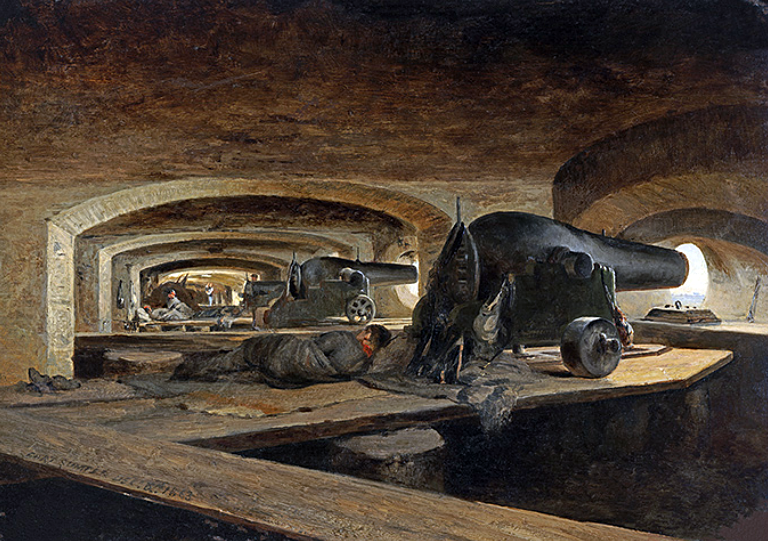
“The three large guns shown in this picture commanded the only point in the harbor that was out of reach from Fort Moultrie on one side, and Fort Johnson on the other.  The Yankees were entirely unaware of the existence of these three guns, and when the United States ship ‘Keokuk’ attempted to pass through that part of the channel which could not be reached by the guns from the forts above mentioned, she was sunk by the shots from these three guns.” – Conrad Wise Chapman, 1898

by John Beauchamp Jones

            DECEMBER 8TH.—The President’s message was sent to Congress to-day. I was not present, but my son Custis, who heard it read, says the President dwells largely on the conduct of foreign powers. To diminish the currency, he recommends compulsory funding and large taxation, and some process of diminishing the volume of Treasury notes. In other words, a suspension of such clauses of the Constitution as stand in the way of a successful prosecution of the war. He suggests the repeal of the Substitute law, and a modification of the Exemption act, etc. To-morrow I shall read it myself.

December 8. — A brisk cannonade between Fort Moultrie and Battery Gregg, in Charleston harbor, was carried on this day. The firing on Fort Sumter was moderated.—In a speech before the rebel Congress, this day, Mr. Foote expressed great indignation at the course pursued by President Davis. “When Pemberton dishonorably surrendered Vicksburgh to the enemy, the President made him his companion, and carried him to General Bragg’s army, when, as he rode along, soldiers were heard to say: ‘There goes the traitor who delivered us over at Vicksburgh.’ The President never visited the army without doing it injury; never yet that it was not followed by disaster. He was instrumental in the Gettysburgh affair. He instructed Bragg at Murfreesboro. He has opened Georgia to one hundred thousand of the enemy’s troops, and laid South-Carolina liable to destruction. I charge him with having almost ruined the country, and will meet his champion anywhere to discuss it. Would to God he would never visit the army again!” . . .

Mr. Foote also referred to abuses in the commissory department. A certain commissary-general, who was a curse to our country, is invested with authority to control the matter of subsistence. This monster, Northrop, has stealthily placed our government in the attitude charged by the enemy, and has attempted to starve the prisoners in our hands!

Meats were furnished the prisoners very irregularly, and in a meagre manner. For twelve days the supply was inadequate, and for eight days they had none at all!

“The commissary-general,” says Mr. Foote, “was a pepper-doctor down in Charleston, and looked like a vegetarian, and actually made an elaborate report to the Secretary of War, showing that for the subsistence of a human Yankee carcass vegetable diet was the most proper! For the honor of the country, this Northrop should be ejected at once.”

—President Lincoln, in his Message to Congress, appended his Proclamation of Amnesty.— (Doc. 32.)

—The following is an account of an affair that took place to-day, near Great Western Furnace, Stuart County, Tenn., about twelve miles from Canton, Ky.: “The guerrilla, Colonel Martin, who lately robbed the citizens in that section of nearly all they possessed, passed through Golden Pond, Tenn., with his gang, taking horses, and plundering indiscriminately. The citizens of the neighborhood organized a squad of fifteen men, composed principally of the late Eighth Kentucky cavalry, headed by John Martin and F. M. Oakley, and started in pursuit of the guerrillas. They came upon them about midnight, in camp, eating a supper furnished them by one Dawsy Griffin. The citizens demanded a surrender, which was refused by the rebel leader, and the order was given by Martin to charge upon them, which was done in a handsome manner, resulting in a complete rout, and the capture of all their arms, horses, clothing, camp equipage, and two contrabands. Three of the rebels were killed on the spot”—The National House of Representatives unanimously passed a vote of thanks to General U. S. Grant and his army, and ordered that a medal be struck in his honor, in the name of the people of the United States.

—President Lincoln sent the subjoined congratulatory despatch to Major-General Grant: “Understanding that your lodgment at Chattanooga and Knoxville is now secure, I wish to tender you, and all under your command, my more than thanks—my profoundest gratitude for the skill, courage, and perseverance with which you and they, over so great difficulties, have effected that important object. God bless you all!” This was immediately published to the armies under the command of General Grant.
Tuesday, 8th—Came on to Mr. Bright’s and staid all night; rained all day.

December came in quite pleasant. Weather permitting, drilling is kept up.

December 8th. Marching orders received. Must prepare three days’ rations in haversacks. Ordered to Charlestown for duty. We are informed the cavalry under General Averill are to raid upon the enemy’s country. The General is a dashing cavalry officer. He is all right.

Bridgeport, Monday, Dec. 7. Changed, washed, etc. in the forenoon. Wrote home in afternoon. All quiet in and around camp. Various rumors afloat as to our final destination for the winter. Generally supposed we are to open the road to Corinth. Fine weather for this time of the year.

7th. Awakened by firing over Clinch Mountain. Sent back details and teams for rations. Clear beautiful day. Moved at 9 A. M. up the valley. About 3 P. M. arrived at Bunch’s Trail, a pass through Clinch Mountain. Rebel pickets here and drove them. Col. Acker dismounted 9th Mich. and dislodged them from the Gap. After dark fell back to same place started from in the morning. Very cold night, huddled down by fire with saddle blanket.

Monday, 7th—I was relieved from patrol this morning. Thus far we have not succeeded in locating any of the reported spies. This patrol duty is quite hard, since when we have a few moments for rest the only place is a vacant room over a store, without fire; furthermore, lying down on the floor is not very inviting because of the graybacks running over the floor.

December 7 — As we have very few tents, nearly the whole company was engaged in the peaceful avocation of building quarters to-day.

December 7.—I received a letter from my brother to-day. He is well, and has lost every thing except the clothes which he has on. I intend sending him some.

The weather is intensely cold, and our men must be suffering very much, for they are only half clad, and half shod. I often wonder how the enemy dare to taunt us about our rags and poverty. Are they really so blind to true principle as not to know that men who fight as ours do, and as they are kept, must have something high and holy to enable them to do it? There is more glory in their rags than all the glitter and gilt lace that the Federals have in their possession.

Our army is at Dalton, and I expect will remain there all winter. My brother blames the infantry for our defeat on Missionary Ridge; but I expect it is all for the best, and that we shall do better next time.