
December 6.—I this morning attended the funeral of Mr. John Seddon, brother of the Secretary of War. It was a most solemn occasion; he was a man of fine talents and high character. The Rev. Dr. Moore, of the Presbyterian Church, preached a most beautiful sermon.
December 2013
Sunday, 6th.—Five hundred men from our brigade, working on road.
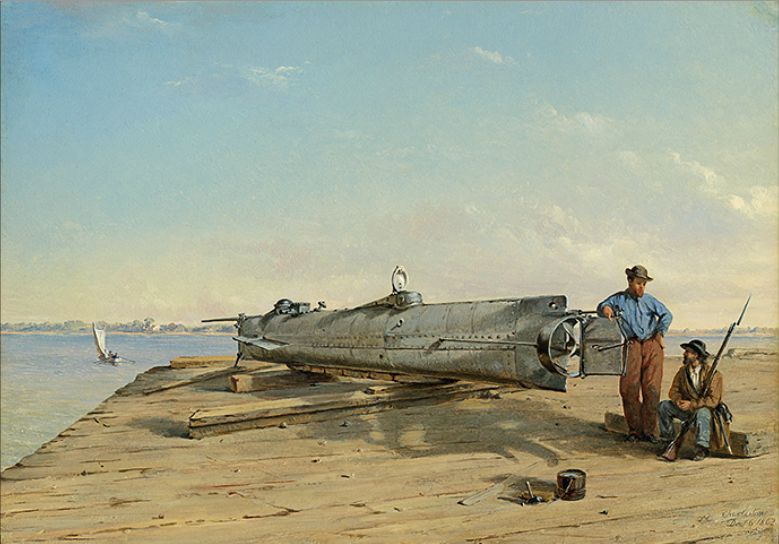
Painting by Conrad Wise Chapman.
“The inventor of this boat, a man named Hunley, can be seen; also a sentinel. This boat, it was first thought would be very effective; twice it went out on its mission of destruction, but on both occasions returned with all the crew dead. After this happened the second time, someone painted on it the word ‘Coffin.’ There was just room enough in it for eight men, one in front of the other, with no possibility of anyone sitting straight. The third time it started out, it never came back, nor was anything ever heard from it, but as one of the United States men-of-war in the harbor (USS Housatonic) was sunk at about the same time, the supposition was that they both went to the bottom together. Other objects to be seen in the picture are, Sullivans Island, and a Dispatch boat.” Conrad Wise Chapman, 1898

by John Beauchamp Jones
DECEMBER 6TH.—It is clear and cold again. Custis came home last evening, after a week’s sojourn at Chaffin’s Bluff, where, however, there were tents. Some 1500 local troops, or “National Guards,” had been sent there to relieve Pickett’s division, recalled by Lee; but when Meade recrossed the Rapidan, there was no longer any necessity for the “Guards” to remain on duty. A brigade of regulars goes down to-day. Custis says it was the third day before ammunition was issued! Yesterday he heard shelling down the river, by the enemy’s gun-boats.
I had a conversation with Col. Northrop, Commissary-General, to-day. He anticipates a collision between the Confederate and State authorities on the impressment question. He says the law was intended to secure subsistence for both the people and the army; but there is not sufficient grain in the States. Therefore the army must have what there is, and the people must go without. I differed with him, and maintained if a proper distribution were made there would be enough for all.
To-morrow Congress assembles. It is to be apprehended that a conflict with the Executive will ensue—instead of unanimity against the common enemy—and no one living can foretell the issue, because no one knows the extent of capacity and courage on either side.
The President has made his cabinet a unit.
December 6.—Major-General W. T. Sherman and staff, accompanied by Brigadier-General Wilson, arrived at General Burnside’s headquarters, at Knoxville, Tenn., at noon to-day.—A most successful reconnoissance was made to Madison Court-House, Va., by four squadrons of the First New-York Dragoons, under Major Scott, demonstrating that no rebel force existed in that quarter. At James City a few rebels, who fled on the approach of the Nationals, were seen. On Thoroughfare Mountain, the rebel signal-station was found in the possession of some thirty or more cavalry, who at once beat a hasty retreat. They were pursued some distance by Major Scott’s men, but without capture. It was found to be a good position for its past uses, as well as in turn to be used against them, as from it the position of nearly the whole rebel army can be seen. The destruction was made as complete as possible.—The National iron-clad Weehawken, during a terrific storm, sunk at her anchorage at the entrance of Charleston harbor, S. C, carrying down with her four engineers and twenty-six of her crew.—The merchant steamer Chesapeake, commanded by Captain Willets, was seized by a party of rebels, who had taken passage in her, while on her way from New-York to Portland, Maine. The pirates assaulted the crew, killed the engineer, and wounded two other officers, and, after landing the passengers at Partridge Island, ran away with the vessel.
Sunday, 6th—We started for Holloway’s with two of the Boys. We got there. Dick would go no further. Mint and Drew and Meroney all turned back. I, Hugh Singleton and Briscow started for L. Came out to Old Major Pugh’s and found the Yanks had prowled him of beehives and everything. Then came on cross Motley Ferry road and through a camp they had just left. Some Yankees on the ground laying up fences with the negroes. We came on cross Morgantown Road, found all the roads traveled by them. Came on to Capt. Dyer’s, fed our horses and got supper and on to within one mile of Louisville. Stopped at Old Man Dyer’s; found the Yanks in large force near him. Stopped, and fed and walked down to within three hundred yards of their camp fires. Could not get to the Planters Hotel. Came back; six of our boys were laying out in the woods near Mr. D’s. We fed and slept in the barn till nearly day. Old Man woke us up, found two of the men were Carlton and Patton of Company P; others were Morgan Men. All came out to a thicket and spent the day.
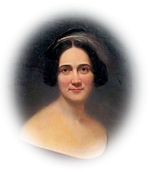
December 5th.—Wigfall was here last night. He began by wanting to hang Jeff Davis. My husband managed him beautifully. He soon ceased to talk virulent nonsense, and calmed down to his usual strong common sense. I knew it was quite late, but I had no idea of the hour. My husband beckoned me out. “It is all your fault,” said he. “What?” “Why will you persist in looking so interested in all Wigfall is saying? Don’t let him catch your eye. Look into the fire. Did you not hear it strike two?”
This attack was so sudden, so violent, so unlooked for, I could only laugh hysterically. However, as an obedient wife, I went back, gravely took my seat and looked into the fire. I did not even dare raise my eyes to see what my husband was doing—if he, too, looked into the fire. Wigfall soon tired of so tame an audience and took his departure.
General Lawton was here. He was one of Stonewall’s generals. So I listened with all my ears when he said: ”Stonewall could not sleep. So, every two or three nights you were waked up by orders to have your brigade in marching order before daylight and report in person to the Commander. Then you were marched a few miles out and then a few miles in again. All this was to make us ready, ever on the alert. And the end of it was this: Jackson’s men would go half a day’s march before Peter Longstreet waked and breakfasted. I think there is a popular delusion about the amount of praying he did. He certainly preferred a fight on Sunday to a sermon. Failing to manage a fight, he loved best a long Presbyterian sermon, Calvinistic to the core.
“He had shown small sympathy with human infirmity. He was a one-idea-ed man. He looked upon broken-down men and stragglers as the same thing. He classed all who were weak and weary, who fainted by the wayside, as men wanting in patriotism. If a man’s face was as white as cotton and his pulse so low you scarce could feel it, he looked upon him merely as an inefficient soldier and rode off impatiently. He was the true type of all great soldiers. Like the successful warriors of the world, he did not value human life where he had an object to accomplish. He could order men to their death as a matter of course. His soldiers obeyed him to the death. Faith they had in him stronger than death. Their respect he commanded. I doubt if he had so much of their love as is talked about while he was alive. Now, that they see a few more years of Stonewall would have freed them from the Yankees, they deify him. Any man is proud to have been one of the famous Stonewall brigade. But, be sure, it was bitter hard work to keep up with him as all know who ever served under him. He gave his orders rapidly and distinctly and rode away, never allowing answer or remonstrance. It was, ‘Look there—see that place—take it!’ When you failed you were apt to be put under arrest. When you reported the place taken, he only said, ‘Good!’”
Spent seventy-five dollars to-day for a little tea and sugar, and have five hundred left. My husband’s pay never has paid for the rent of our lodgings. He came in with dreadful news just now. I have wept so often for things that never happened, I will withhold my tears now for a certainty. To-day, a poor woman threw herself on her dead husband’s coffin and kissed it. She was weeping bitterly. So did I in sympathy.
My husband, as I told him to-day, could see me and everything that he loved hanged, drawn, and quartered without moving a muscle, if a crowd were looking on; he could have the same gentle operation performed on himself and make no sign. To all of which violent insinuation he answered in unmoved tones: “So would any civilized man. Savages, however—Indians, at least—are more dignified in that particular than we are. Noisy, fidgety grief never moves me at all; it annoys me. Self-control is what we all need. You are a miracle of sensibility; self-control is what you need.” “So you are civilized!” I said. ”Some day I mean to be.”
5th. A damp cloudy day. Sent out for meat and wheat. All failed save the butchers. Some talk of moving. Played checkers with Ordnance Sergt. Got badly beaten. Went to bed early with orders to be ready to march at 7 A. M. the next morning. All quiet.
Bridgeport, Saturday, Dec. 5. Had a fine night’s rest, also a fine breakfast of fried crackers and coffee. Evie borrowed the pan, I begged the salt, Dan the coffee, after which went up town, gathered waste grain and fed the famished horses. Ate a pie and water. 10 A. M. the batteries came in, having been obliged to leave their ammunition chest behind, and hard work to come at that. Eight of our horses died on the road. The road is lined on all sides with the dead horses and mules, having died of starvation. Went into camp east of town. Tents came in 3 P. M. Full rations for man and beast. Night found us comfortably quartered and “happy as lambs”, infantry singing “Rally, boys, rally” etc. They have just passed through a hard trip, no tents, got scant rations, and were half famished by the time they got here, but there was no grumbling or lagging, each marching cheerfully, parching his corn in the ashes, as corn is stuff to keep up strength; but such boys are invincible while on the field, as on the march, alike jolly and contented.
Saturday, 5th—The re-enlisting of the men for three years is proceeding rapidly. Most of the boys are in favor of seeing the war brought to a close before they quit the job, while others say that they have seen enough of war, declaring that they have done their duty.


