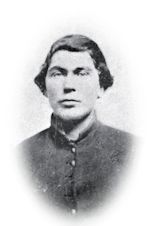
Huntsville, Monday, Jan. 18. An idle day in camp. Nothing of interest. Griff and myself went to town on pass, made a few purchases. Camp policed. Lieutenant Simpson went to Stevenson. Weather cold. No news or no mail.
January 2014
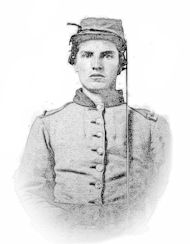
Monday, 18th.—Cold and wet. Met in room built for church and debating society, and adopted rules to govern debating society. Went round to Company A, with some others and sang for Mrs. Yancey and Mrs. Fields. Still in winter quarters. It would not be interesting to give every little detail of camp life, but just to show how soldiers employed some of their time, the following is given:
[Note: The next entry is February 15 and describes some of the antics in winter quarters.]
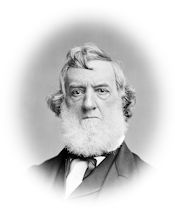
January 18, Monday. A batch of letters has been sent us from the provost marshal, disclosing a mass of fraud and intrigue on the part of a set of assuming men that is as amusing as reckless. General Haupt, Naval Constructor Griffiths, Gwyn[?] of the Treasury, Hamilton Norris, and others figure in the affair. About a year since General H. published a series of questions for the improvement and progress of the Navy Department, which he and his associates appeared inclined to take into their keeping. This correspondence brings to light the secret intrigues of these scoundrels.
by John Beauchamp Jones
JANUARY 18TH.—A flag of truce boat came up, but no one on board was authorized to negotiate for an exchange of prisoners but Gen. Butler, outlawed. It returns without anything being effected. Congress has passed a bill for the reduction of the currency, in secret session. We know not yet what are its main features. The Senate bill increasing the compensation of civil officers has not yet been acted on in the House, and many families are suffering for food.
Anne writes us that Lieut. Minor has returned from his Canada expedition, which failed, in consequence of the gratuitous action of Lord Lyons, the British Minister at Washington, who has been secured in the interest of the Federal Government, it is said, by bribes. Lieut. M. brought his family a dozen cups and saucers, dresses, shoes, etc., almost unattainable here.
The President receives company every Tuesday evening.
Among the letters referred by the Commissary-General to the Secretary of War to-day for instructions, was one from our honest commissary in North Carolina, stating that there were several million pounds of bacon and pork in Chowan and one or two other counties, liable to the incursions of the enemy, which the people were anxious to sell the government, but were afraid to bring out themselves, lest the enemy should ravage their farms, etc., and suggesting that a military force be sent thither with wagons. The Commissary-General stated none of these facts in his indorsement; but I did, so that the Secretary must be cognizant of the nature of the paper.
The enemy made a brief raid in Westmoreland and Richmond counties a few days ago, and destroyed 60,000 pounds of meat in one of the Commissary-General’s depots! A gentleman writing from that section, says it is a pity the President’s heart is not in his head; for then he would not ruin the country by retaining his friend, Col. Northrop, the Commissary-General, in office.
It appears that Gen. Meade has changed the Federal policy in the Northern Neck, by securing our people within his lines from molestation; and even by allowing them to buy food, clothing, etc. from Northern traders, on a pledge of strict neutrality. The object is to prevent the people from conveying intelligence to Moseby, who has harassed his flanks and exposed detachments very much. It is a more dangerous policy for us than the old habit of scourging the non-combatants that fall in their power.
January 18.—At Flint Hill, Va., a party of fifteen rebels attacked the National pickets, but were driven off after a brief engagement.—The rebel conscription law created great consternation and excitement in the western districts of North-Carolina, and public meetings were held to take into consideration a repudiation of the confederate government and a return to the Union. The Raleigh Standard openly defied the execution of the measures proposed, and said, if they prevail, “the people of North-Carolina will take their own affairs into their own hands, and will proceed, in Convention assembled, to vindicate their liberties and privileges.”—In the rebel Senate at Richmond, Va., a resolution was passed approving the action of the government with regard to the outlawry of General Butler, and the determination of the rebel authorities to hold no communication with him.— A party of rebel guerrillas made their appearance on the bank of the river opposite Memphis, Tenn., but were driven off by a gunboat, without effecting any damage. — Lieutenant-Colonel Fuller, of the Third Arkansas cavalry, received the following from the major of his regiment, at Lewisburgh:
“Captain Hamilton has had a fight with a portion of Wells’s command, and killed six, and wounded as many more. Hamilton lost six, and but one or two killed; the balance missing. The command opposing him were under Captain Thompson, numbering nearly one hundred. Hamilton killed Thompson, and brought his horse, equipments, revolvers, and papers in with him. The rebels were dressed in Federal uniforms. Hamilton is here with me.”—Newmarket, Tenn., was occupied by the rebels belonging to the forces under the command of General Longstreet.—The rebel blockade-runner, A. D. Vance, was run ashore, under the guns of Fort Caswell, in attempting to enter the port of Wilmington, N. C.—The steamer Laura, blockade-runner, was captured in St. Mark’s Bay, Florida, by the United States steamer Stars and Stripes.
January 10th-17th. Weather fine. Weather permitting, company drill in the forenoon, battalion drill in the afternoon, also dress parade. No matter what the weather conditions were guard and picket duty must be done. Mild weather brings on the sticky Virginia mud, disagreeable. My greatest trouble at this time is an ingrowing toe nail, causing me much trouble. Doctor trying to cure it. At times forced to wear an old shoe. Wrote and received many letters, also reading everything that we can get in the way of reading matter. Everything being quiet along the lines, furloughs are granted for a short visit home. Two to four are allowed at a time, for an absence of ten days, from each company.
Jan. 17. The balance of the re-enlisted men left for home today, several of the officers going with them. We have now got our ultimatum, either enlist or go into exile. An order was received intimating that as enlistments seemed about through in this regiment, we would be more useful at Yorktown than here, and for us to be ready to march in heavy marching order at any time; but enlistments still drag.
Sunday, 17th—We had an all day rain. Company inspection early this morning. The Eleventh Iowa received their muster rolls and the boys are anxious to be sworn into the service and start for home on their thirty-day furloughs.
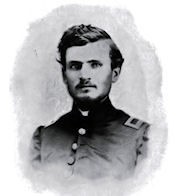
17th. Found a dugout at noon. Rol and I went ahead and engaged dinner. Pulled on in P. M. Ab and I in canoe. Stayed over night at a Union man’s. Courtship scene. None of Tenn., her women, institutions and privileges for me.
16th. Went down with Smith and Bob for dinner. Failed. Good supper at the hotel. Started down the river at dark—in pontoon. Smith, Sheldon, Stopper, Rol. Morgan, Ab Cole, Nash, Geo. Hart, etc. Went down three miles and put up at log barn—fire.


