
15th. On soon after daylight. Meal and coffee for breakfast. Raised a little blood. Hard work. Meat and salt. No prospect of boat. I am played out.
January 2014
Huntsville, Friday, Jan. 15. Little rain last night and looks like more. Quite muddy and disagreeable. Another large mail received, among which was one for me from my aged father in his own handwriting and language; gave me much pleasure to peruse. Cousin Griffith quitted the officers’ mess this afternoon, and came in with us.
January 15, Friday. A little ill for a day or two. Edgar and the Miss F. s from Harrisburg left. At the Cabinet. Little done. Friends in Connecticut are some of them acting very inconsiderately. They feel outraged by the conduct of Dixon and others in procuring the nomination of Henry Hammond for marshal, a nomination eminently unfit to be made. The President was deceived into that matter. He was told that Hammond and the clique were his true supporters and friends, and that those opposed were his enemies. This falsehood the disappointed ones seem determined to verify by making themselves opponents.

January 15.—The weather has cleared off, and all seem glad of the change.
Mr. Bradley has had his arm amputated; he came here with a slight wound on his elbow, made by an ax. Gangrene got into it, and could not be arrested. It eat so rapidly that the joint was nearly destroyed.
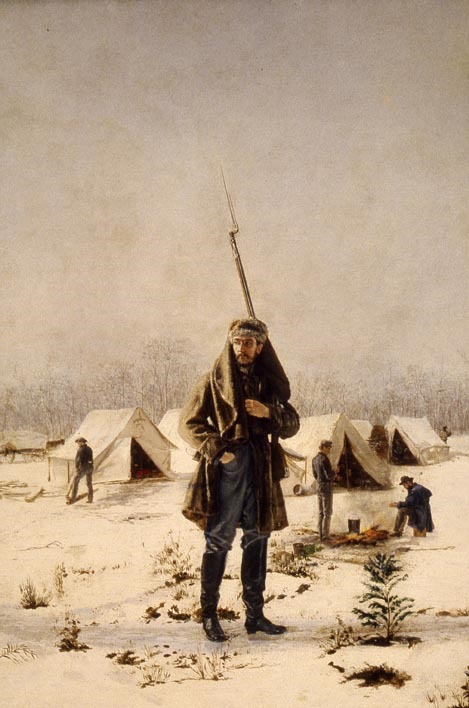
Painting by Conrad Wise Chapman, oil painting 1874; Confederate soldier, in fur hat, beard, brown winter coat, blue trousers and black boots holding a bayonet in his left arm, looks off to right; white snow-covered ground with few plants; in background are white tents, to right are two men with fire, to left is man chopping wood, beyond tents are barren trees and gray sky.

by John Beauchamp Jones
JANUARY 15TH.—We have no news. But there is a feverish anxiety in the city on the question of subsistence, and there is fear of an outbreak. Congress is in secret session on the subject of the currency, and the new Conscription bill. The press generally is opposed to calling out all men of fighting age, which they say would interfere with the freedom of the press, and would be unconstitutional.
January 15.—The United States schooner Beauregard captured, near Mosquito Inlet, the British schooner Minnie, of and from Nassau.
—”The utmost nerve,” said the Richmond Whig, “the firmest front, the most undaunted courage, will be required during the coming twelve months from all who are charged with the management of affairs in our country, or whose position gives them any influence in forming or guiding public sentiment.” “Moral courage,” says the Wilmington Journal, “the power to resist the approaches of despondency, and the faculty of communicating this power to others, will need greatly to be called into exercise; for we have reached that point in our revolution which is inevitably reached in all revolutions, when gloom and depression take the place of hope and enthusiasm—when despair is fatal and despondency is even more to be dreaded than defeat. In such a time we can understand the profound wisdom of the Roman Senate, in giving thanks to the general who had suffered the greatest disaster that ever overtook the Roman arms, ‘because he had not despaired of the Republic’ There is a feeling, however, abroad in the land, that the great crisis of the war—the turning-point in our fate—is fast approaching. Whether a crisis be upon us or not, there can be in the mind of no man, who looks at the map of Georgia, and considers her geographical relations to the rest of the Confederacy, a single doubt that much of our future is involved in the result of the next spring campaign in Upper Georgia.”
—The Fifty-second regiment of Illinois volunteers, under the command of Colonel J. S. Wilcox, reenlisted for the war, returned to Chicago. —The blockade-runner Isabel arrived at Havana. She ran the blockade at Mobile, and had a cargo of four hundred and eighty bales of cotton, and threw overboard one hundred and twenty-four bales off Tortugas, in a gale of wind.
January 14th.—Gave Mrs. White twenty-three dollars for a turkey. Came home wondering all the way why she did not ask twenty-five; two more dollars could not have made me balk at the bargain, and twenty-three sounds odd.
Jan. 14. Up to this date about 200 of our men have reenlisted, and today the first detachment left for home on their thirty days’ furlough. They were accompanied by three of the officers, one of whom was Lieut. McCarter of company B. I hope they will have a good time and enjoy themselves. Orders keep coming from headquarters, at the fort to hurry up enlistments and some of them are of a rather threatening character.

Thursday, 14th—There is a rumor that our army has taken Charleston, South Carolina. Some of our guard early this morning stole a big fish from a fisherman who was taking a load to market. It weighed forty pounds and was divided among the boys. I took a piece to my tent and cooked it, but I might as well have eaten a piece of crow, for it was tasteless and tough. It proved to be a channel cat.


