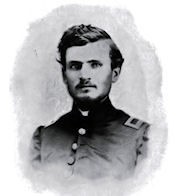
14th. Little to do. No boat. Marched at 2 P. M. for Kingston—6 miles—and camped. Dr. Noble and I bunked together.
January 2014
Diary And Memoranda, 1864
Jan. 14th. Gillmore is still knocking at the gates of Charleston. Jere went to the city today. The first lot of Vet. Vol. on furlough have returned today; most all have seen father and say he is looking well.

Huntsville, Thursday, Jan. 14. Calm and quite warm. Spent the day in writing and reading novelettes, an effective way of killing time, but very profitless. On duty in the forenoon to haul bricks for section mess shanty.

by John Beauchamp Jones
JANUARY 14TH.—Mr. A. ____, editor of the ______, recommends the Secretary of War to get Congress to pass, in secret session, a resolution looking to a reconstruction of the Union on the old basis, and send Commissioners to the Northern Governors. Meantime, let the government organize an army of invasion, and march into Pennsylvania. The object being to sow dissension among the parties of the North.
A letter from a Mr. Stephens, Columbia, S. C., to the President, says it is in his power to remove one of the evils which is bringing the administration into disrepute, and causing universal indignation—Gen. Winder. The writer says Winder drinks excessively, is brutish to all but Marylanders, and habitually receives bribes, etc. The President indorsed on it that he did not know the writer, and the absence of specifications usually rendered action unnecessary. But perhaps the Secretary may find Mr. S.’s character such as to deserve attention.
Captain Warner says it is believed there will be a riot, perhaps, when Col. Northrop, the Commissary-General, may be immolated by the mob. Flour sold to-day at $200 per barrel; butter, $8 per pound; and meat from $2 to $4. This cannot continue long without a remedy.
The President has another reception to-night.
“A YANKEE ACCOUNT OF THE TREATMENT OF CONFEDERATE PRISONERS —The Chicago Times gives the account which follows of the treatment of our soldiers at CampDouglas.
“It is said that about four weeks ago one of the prisoners was kindling his fire, which act he had a right to perform, when one of the guard accosted him with, ‘Here, what are you doing there?’ The prisoner replied, ‘That is not your business,’ when the guard instantly drew his musket and shot the fellow dead. It is said also that a mulatto boy, a servant of one of the Confederate captains, and, of course, a prisoner of war, who was well known to have a pass to go anywhere within the lines, was walking inside the guard limits about a day after the above occurrence, when the guard commanded him to halt. He did not stop, and was instantly killed by a bullet.
“It is also charged that, at the time the discovery was made of an attempt on the part of some of the prisoners to escape, a party of three or four hundred was huddled together and surrounded by a guard; that one of them was pushed by a comrade and fell to the ground, and that instantly the unfortunate man was shot, and that three or four others were wounded. It is further stated that it is no uncommon thing for a soldier to fire on the barracks without any provocation whatever, and that two men were thus shot while sleeping in their bunks a week or two ago, no inquiry being made into the matter. No court-martial has been held, no arrest has been made, though within the past month ten or twelve of the prisoners have been thus put out of the way. Another instance need only be given: one of the prisoners asked the guard for a chew of tobacco, and he received the bayonet in his breast without a word.”
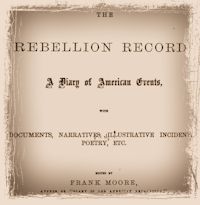
January 14.—Major-General R. B. Vance, made a raid toward Terrisville, Tenn., and captured a train of twenty-three wagons. He was pursued by Colonel Palmer, who recaptured the wagons, and took one ambulance, loaded with medicines, one hundred and fifty saddle-horses and one hundred stand of arms. General Vance and his assistant adjutant-general and inspector-general are among the prisoners captured. — General Grant’s Report—(Doc. 52.)
—A force of about two hundred rebels made an attack on a party of National cavalry, stationed at Three Miles Station, near Bealton, Va., but were repulsed and driven off, after several desperate charges, leaving three dead and twelve wounded. The National casualties were two wounded, one severely.—The official correspondence between the agents of exchange of prisoners of war, together with the report of Mr. Ould was made public.—The body of a Union soldier was found hanging at Smith Mills, Va., with the following words placarded upon it: “Here hangs private Samuel Jones, of the Fifth Ohio regiment, hung by order of Major-General Pickett, in retaliation for private David Bright, of the Sixty-second Georgia regiment, hung December eighteenth, by order of Brigadier-General Wild.”
—The Richmond Examiner held the following language: “Surely British-protection patriots of the Emerald Isle here, have, we are credibly informed, recently shouldered their shillalahs, and cut stick for the land of Lincoln. Sundry others, too, born this side of the Potomac, have wended their way in the same direction,—all leaving their families behind them to sell rum or make breeches and other garments for the clothing bureau. When mothers and sisters, sweethearts and wives, thus intentionally, and by a cunning arrangement, left behind, present themselves at the clothing bureau for a job, they represent, with the most innocent faces imaginable, that their male protectors are in General Lee’s army, and thus enlist sympathy, and sponge on the Confederacy. To poor females every kindness and aid should be extended as long as they and those belonging to them are true to us; but it is past enduring that able-bodied fellows should go North, and leave as a charge here people whom we are under no obligations to support, and who, by false representations, shut out the wives and other female relatives of gallant fellows, who are confronting our ruthless enemies.”
—Lieutenant Gates, with a party of the Third Arkansas cavalry, made a reconnoissance near Clinton, Ark., and succeeded in capturing twelve prisoners, whom he surprised at Cadson’s Cave. —The blockade-runner schooner Union, with a cargo of cotton from the coast of Florida, arrived at Havana. She was chased by the United States gunboat De Soto.
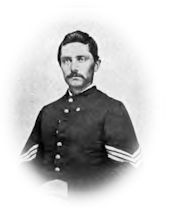
Wednesday, 13th—I was on patrol down town. Things are quiet there, but the streets are quite muddy. The patrols have strict orders to arrest all soldiers found down town without passes, as well as citizens who are caught on the streets without passes. It is not a very pleasant duty, this thing of stopping everyone on the street and requiring him to give an account of himself.1
13th. Rations of flour. Up early. Many officers at Chamberlain’s. Off on the cars at 9:30. Gen. Foster on board—don’t like his style. Loudon at 2 P. M. Went to barracks. (30 days’ “veteran furlough” for those of the 2nd O. V. C. who re-enlisted.)
Huntsville, Wednesday, Jan. 13. Wrote letter home. Mail arrived. None for me. Sadly disappointed. Camp is comparatively still. Quarters nearly complete and look well. The boys’ tents in one line of sight; tents with non-commissioned officers in rear. Kitchens erected on the left for company cooks. Remainder of men and things came up from the river to-day on railroad cars hauled by mules. Dixon’s Company setting up their tent, but we will live alone.
January 13.—The rebel Congress, having passed a joint resolution of thanks to General Robert E. Lee, and his officers, Adjutant-General Cooper issued an order announcing the fact, with the following preface: “The President, having approved the following joint resolution of Congress, directs its announcement in general orders, expressive of his gratification at the tribute awarded the patriot officers and soldiers to whom it is addressed.
“For the military laggard, or him, who, in the pursuits of selfish and inglorious ease, forgets his country’s need, no note of approbation is sounded. His infamy is his only security from oblivion. But the heroic devotion of those, who, in defence of liberty and honor, have perilled all, while it confers in an approved conscience the best and highest reward, will also be cherished in perpetual remembrance by a grateful nation. Let this assurance stimulate the armies of the Confederacy everywhere to greater exertion and more resolute endurance, till, under the guidance of Heaven, the blessings of peace and freedom shall finally crown their efforts. Let all press forward in the road to independence, and for the security of the rights sealed to us in the blood of the first revolution. Honor and glory attend our success. Slavery and shame will attend our defeat.”
—The schooner Two Sisters, a tender to the United States flag-ship San Jacinto, captured, while trying to enter the Suwanee River, the British schooner William, from Nassau.—General Butler addressed a characteristic letter to the Perfectionists of the city of Norfolk, Va.— The following report was made by Colonel James A. Mulligan, from his headquarters at New-Creek, Va.: “A soldier of ours, James A. Walker, company H, Second Maryland regiment, captured in the attack upon the train at the Moorfield and Alleghany Junction, on the third instant, by the enemy under General Fitz-Hugh Lee, escaped when near Brocks’s Gap, on the fifth instant, and reported to me this morning. He informs me that thirteen of the enemy were killed and twenty wounded, in the skirmish. He also states that there was present under the command of General Fitz-Hugh Lee, three companies of negro troops, cavalry, armed with carbines. They were not engaged in the attack, but stationed with the reserve. The guards, he reports, openly admitted to the prisoners that they were accompanied by negro soldiers, stating, however, that the North had shown the example.”
by John Beauchamp Jones
JANUARY 13TH.—There was firing yesterday near Georgetown, S. C., the nature and result of which is not yet known.
Yesterday the Senate passed a bill allowing increased pay to civil officers in the departments; but Senator Brown, of Miss., proposed a proviso, which was adopted, allowing the increased compensation only to those who are not liable to perform military duty, and unable to bear arms.
The auctions are crowded—the people seeming anxious to get rid of their money by paying the most extravagant prices for all articles exposed for sale. An old pair of boots, with large holes in them, sold to-day for $7.00—it costs $125 to foot a pair of boots.


