Mrs. Lyon’s Diary.
January 2, 1864.—Still very cold, six degrees below zero. The houses here are not built for warmth, but to keep cool in summer.
Mrs. Lyon’s Diary.
January 2, 1864.—Still very cold, six degrees below zero. The houses here are not built for warmth, but to keep cool in summer.
Saturday, 2d—I was detailed for picket again this morning, and the post I drew stationed me on the bottom land. It began to rain late in the afternoon and continued into the night and I was soon standing in water. I tell you, it is poor comfort on picket. The commanding officer banished three women from our lines today. The case against them grew out of a meeting on last Thanksgiving Day. They attended the meeting held in the Presbyterian church and when the minister prayed for the President of the United States, for the success of our arms, and for the Stars and Stripes, saying, “May they continue to float over the land of the free and the home of the brave,” the three women got up and indignantly walked out. They were banished for disloyal conduct.
2nd. Still cold as Greenland. Spent most of the day at the white house. What a splendid day to attack the enemy were our infantry on hand. Wrote letters home, to Fannie and Ella.
Larkinsville, Saturday, Jan. 2. Continued very cold and freezing. Good fires and comfortable quarters, very essential to keep warm. Captain Dillon arrived from Nashville, reports battery [of new guns] on the way. Enlistment yet the talk. I have serious thoughts upon it. I am confident that it is the best thing for us recruits. Griff, Dan and others in the same way; if one goes, all go. A dance held down town by “Alabam” gals and Yankee soldiers. Running rumor afloat that we are to leave our quarters soon for Huntsville. Don’t like it.
1864—January:
Saturday, 2d.—Very cold. Gave John Bartly $5.00 to go on guard in my place. General routine of camp life. Prayer meetings, preaching, and debates on such subjects as “Which has the greater claim, mother or wife?” Which is the greater evil, intemperance or civil war?” As to the first decision, argument was about equal; later, war won.
January 2, Saturday. Double duty for yesterday’s holiday. Senator Sumner called on Saturday as usual. After disposing of some little matters of business, he spoke of the President and the election. He says the President is moving for a reelection, and has, he knows, spoken to several persons on the subject very explicitly. I told him the President had exchanged no word with me on the subject, but that I had taken for granted he would be a candidate, that I thought all Presidents had entertained dreams of that nature, and that my impressions are that a pretty strong current is setting in his favor. To this Sumner made no response, affirmatively or negatively. I think his present thoughts are in another direction, but not very decidedly so. Neither of us cared to press the other. Whether he had in view to sound me I was uncertain, and am still.
In many very essential respects Sumner is deficient as a party leader, though he has talents, acquirements, sincerity, and patriotism, with much true and false philanthropy. He is theoretical rather than practical. Is egotistical, credulous to weakness with those who are his friends; is susceptible to flattery from any quarter, and has not the suspicions and jealousies that are too common with men in position. There is want of breadth, enlarged comprehension, in his statesmanship. He is not a Constitutionalist, has no organizing and constructive powers, and treats the great fundamental principles of the organic law much as he would the resolutions of the last national party convention. Towards the slaveholders he is implacable, and is ready to go to extremes to break up not only the system of bondage, but the political, industrial, and social system in all the rebellious States. His theorizing propensities and the resentments that follow from deep personal injuries work together in his warfare against that domineering oligarchy which has inflicted great calamities on our country and wrongs on himself. He would not only free the slaves but elevate them above their former masters, yet, with all his studied philanthropy and love for the negroes in the abstract, is unwilling to fellowship with them, though he thinks he is. It is, however, ideal, book philanthropy.
As Chairman of the Committee on Foreign Relations, his services at this time are invaluable. He is, fortunately, in many respects the opposite of Seward, has higher culture and, on international law and the science of government, is vastly better informed and greatly the superior of the Secretary of State. But the latter has greater tact, more practicality, and better knowledge of parties and men, greater versatility of genius and unsurpassed pliability, so that he can more readily adapt himself to whatever may seem expedient. Sumner acts not always from fixed principles but earnest though prejudiced convictions, investigating questions in which he is interested elaborately, and brings learning and authorities to his support. Seward is earnest for his party, but has no great deference for political principles of any kind; his convictions or opinions are weak and change without hesitation if deemed expedient or if his party can be benefited. To such a Secretary an adviser like Sumner is valuable, yet Seward does not appreciate it. There is mutual want of confidence.
My impressions are that Sumner’s present leanings are, after vague and indefinite dreams of himself, for Chase, who has ultra notions, but Chase has to some extent modified his opinions since our conversation last summer, when we took a long evening’s ride. The subject of reconstruction was just then beginning to be earnestly discussed.
Sumner has not the arts that are the chief stock in trade, to use a mercantile phrase, of some tolerably successful politicians, and he is so credulous as to be often the victim of cunning fellows of greatly inferior capacity who flatter and use him. When Senator Dixon of Connecticut desired, and was intriguing for, a reelection to the Senate, he contrived to get a quasi indorsement from Sumner in a general letter, which was used effectually to defeat Sumner’s best friends in Connecticut and injure the cause nearest his heart. Dixon understood his weakness and made skillful application of it to dupe and deceive Sumner. Too late Sumner regrets his error, but will repeat it when a shrewd and cunning mind shall need to practice the deception. He can, right or wrong, stand firm and immovable on great questions, but is swayed by little social appeals to his kindness. His knowledge of men is imperfect and unreliable, and hence, while he will always have position with his party and influence its movements he will never be the trusted leader.
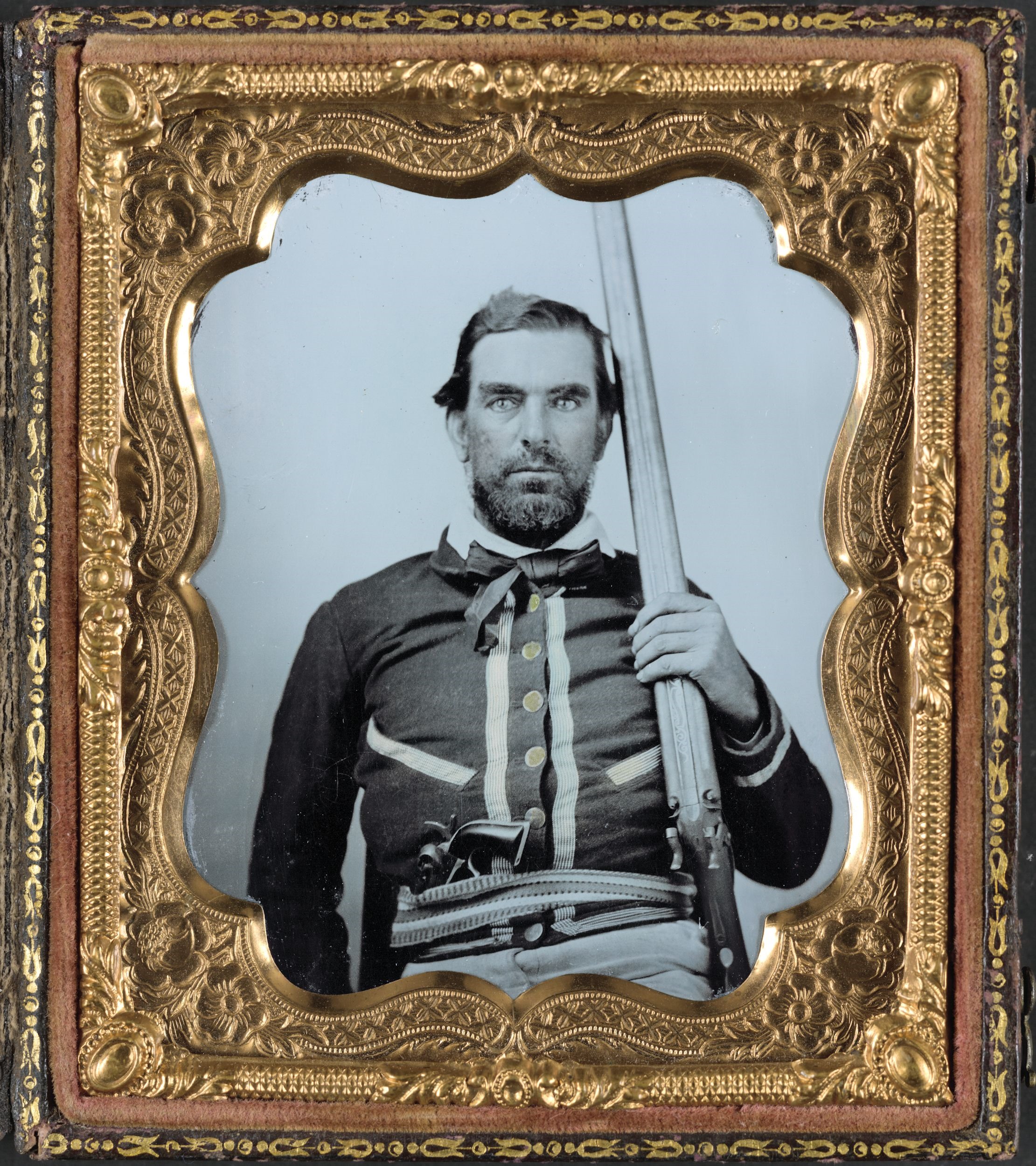
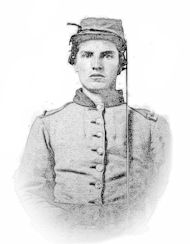
Unidentified soldier in Confederate quantrillian battleshirt with double barrel percussion shotgun and cocked Colt Navy revolver.
__________
Close-up crop:
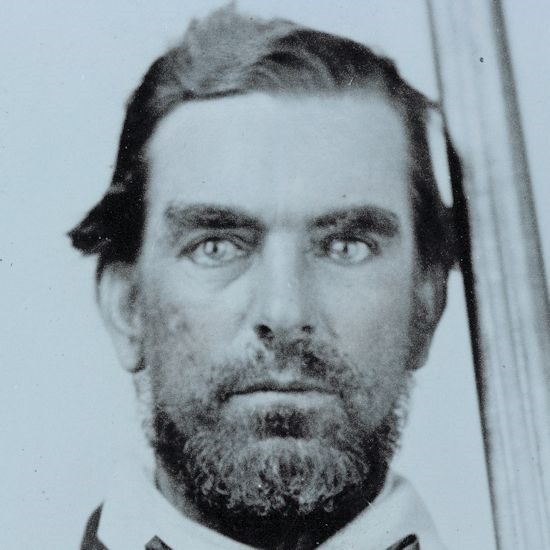
__________
sixth-plate ambrotype; 9.0 x 8.0 cm (case)
Liljenquist Family Collection of Civil War Photographs; Ambrotype/Tintype photograph filing series; Library of Congress Prints and Photographs Division.
Record page for image is here.
__________
 Note – This image has been digitally adjusted for one or more of the following:
Civil War Portrait 112
by John Beauchamp Jones
JANUARY 2D.—Gen. Longstreet writes that it will be well to winter in East Tennessee (Rogersville), unless there should be a pressing necessity for him elsewhere. But his corps ought to be at least 20,000. He says provisions may be got in that section; and if they be collected, the enemy may be forced to leave.
The Secretary of the Navy has requested the Secretary of War to open the obstructions at Drewry’s Bluff, so that the iron-clads, Richmond and Fredericksburg, may pass out. This he deems necessary for the defense of Richmond, as our iron-clads may prevent the enemy from coming up the river and landing near the city.
The Lynchburg Virginian has come out for a dictator, and names Gen. Lee.
The Raleigh (N. C.) Progress says we must have peace on any terms, or starvation. I think we can put some 200,000 additional men in the field next year, and they can be fed also.
January 1, 1864.—A melancholy pause in my diary. After returning from church on the night of the 13th, a telegram was handed me from Professor Minor, of the University of Virginia, saying, “Come at once, Colonel Colston is extremely ill.” After the first shock was over, I wrote an explanatory note to Major Brewer, why I could not be at the office next day, packed my trunk, and was in the cars by seven in the morning. That evening I reached the University, and found dear R. desperately ill with pneumonia, which so often follows, as in the case of General Jackson, the amputation of limbs. Surgeons Davis and Cabell were in attendance, and R’s uncle, Dr. Brockenbrough, arrived the next day. After ten days of watching and nursing, amid alternate hopes and fears, we saw our friend Dr. Maupin close our darling’s eyes, on the morning of the 23d; and on Christmas-day a military escort laid him among many brother soldiers in the Cemetery of the University of Virginia. He died in the faith of Christ, and with the glorious hope of immortality. His poor mother is heart-stricken, but she, together with his sisters, and one dearer still, had the blessed, and what is now the rare privilege, of soothing and nursing him in his last hours. To them, and to us all, his life seemed as a part of our own. His superior judgment and affectionate temper made him the guide of his whole family. To them his loss can never be supplied. His country has lost one of its earliest and best soldiers. Having been educated at the Virginia Military Institute, he raised and drilled a company in his native County of Berkeley, at the time of the John Brown raid. In 1861 he again led that company to Harper’s Ferry. From that time he was never absent more than a week or ten days from his command, and even when wounded at Gaines’s Mills, he absented himself but three days, and was again at his post during the several last days of those desperate fights. His fatal wound was received in his nineteenth general engagement, in none of which had he his superior in bravery and devotion to the cause. He was proud of belonging to the glorious Stonewall Brigade, and I have been told by those who knew the circumstances, that he was confided in and trusted by General Jackson to a remarkable degree.
Thus we bury, one by one, the dearest, the brightest, the best of our domestic circles. Now, in our excitement, while we are scattered, and many of us homeless, these separations are poignant, nay, overwhelming; but how can we estimate the sadness of heart which will pervade the South when the war is over, and we are again gathered together around our family hearths and altars, and find the circles broken? One and another gone. Sometimes the father and husband, the beloved head of the household, in whom was centred all that made life dear. Again the eldest son and brother of the widowed home, to whom all looked for guidance and direction; or, perhaps, that bright youth, on whom we had not ceased to look as still a child, whose fair, beardless cheek we had but now been in the habit of smoothing with our hands in fondness—one to whom mother and sisters would always give the good-night kiss, as his peculiar due, and repress the sigh that would arise at the thought that college or business days had almost come to take him from us. And then we will remember the mixed feeling of hope and pride when we first saw this household pet don his jacket of gray and shoulder his musket for the field; how we would be bright and cheerful before him, and turn to our chambers to weep oceans of tears when he is fairly gone. And does he, too, sleep his last sleep? Does our precious one fill a hero’s grave? O God! help us, for the wail is in the whole land! “Rachel weeping for her children, and will not be comforted, because they are not.” In all the broad South there will be scarcely a fold without its missing lamb, a fireside without its vacant chair. And yet we must go on. It is our duty to rid our land of invaders; we must destroy the snake which is endeavouring to entwine us in its coils, though it drain our heart’s blood. We know that we are right in the sight of God, and that we must
“With patient mind our course of duty run.
God nothing does, or suffers to be done,
But we would do ourselves, if we could see
The end of all events as well as He.”
The Lord reigneth, be the earth never so unquiet.
January 1st. New Year. Last night on second relief, going on post at eleven o’clock. Remained until one o’clock. Saw the old year out and the new in. This morning before daylight the outposts were attacked. A sharp, hot firing. All the forces around town were ordered out, double-quick time. All under arms. Later it was learned there was a large force of rebel cavalry near North Mountain, about five miles out. Reported to be under Generals Imboden and McCausland. The rebel scouts and our pickets caused the sudden firing. The cold rain turned to snow, and was bitter cold, causing much suffering while waiting in line of battle. According to reports from prisoners, they suffered worse than we did. Standing in line all day, ready for action. The boys are anxious to give the enemy a hot welcome. Double picket line ordered.
 Follow on facebook
 RSS
RSS email
email