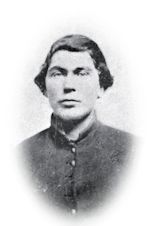
Huntsville, Thursday, Jan. 28. Up bright and early as usual. Breakfast, swept, brushed, washed, combed, etc. ready for the routine of duty, when I was notified that I was on detail to go with the forage train, which was then waiting.. Fell in with a long train under quartermaster of 18th Wisconsin. Went on the turnpike to the west, travelled about eight miles through a somewhat winding road, but beautiful country. It was rolling enough to make it varied, with good timber where not cultivated. Old fields containing 50 to 600 acres lying idle, apparently for three years or more, which was running wild into prairie. The general appearance of the country was much like extensive farming regions. North of them were wealthy Southern plantations, much more attention being paid to grain raising than to cotton. Numerous stacks of wheat were stacked unthreshed, and broad fields of corn unhusked, the land under a medium state of cultivation. I could but think with Northern enterprise and intelligence, with free and willing hands to do the work, what lovely and fruitful farms could be built in such a delightful climate. Obtained plenty of corn on a large plantation which all the whites had left, leaving a large flock of negro women and children unprovided for, and seemed delighted to see us until some of the boys took unallowed privileges of the chicken coop, which they earnestly protested against. Returned to camp at sundown well pleased with my ride of sixteen miles and my observations therein, having also escaped the drill, etc. Camp had again been swept up, ammunition packed in gun limbers. Lieutenant Clark gone to Nashville after horses. Lieutenant Jenawein in command of Battery and appeared to-day with shoulder straps on for the first time. Looks fine and soldier-like.
January 2014

Diary And Memoranda, 1864
Jan. 28th. Have been preparing all day for inspection which comes off tomorrow. Played four games of chess for the first time.
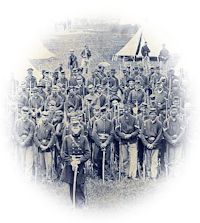
January 28th, 1864.
The all-absorbing topic with the Ninth Corps continues to be the probability of our speedy departure. No one doubts our going, but where and when? Is it strange that we would leave this place, and that right speedily? It is the possibility, should we go north, of seeing our loved ones once more, if only for a brief period. Rumor says, and Dr. Bonine, Division Surgeon, corroborates it, the different regiments are going to their respective states to recruit. Who can blame us for cherishing the fond delusion, for such it will, doubtless, prove.
Mr. Collier has just arrived from camp. He makes his presence doubly welcome by bringing me a letter from my dear wife bearing date December 30th. How precious to me are these favors, permitted by kind heaven, to keep me from despair. I do not become accustomed to the separation. I long more and more for the society of my wife and children.
Governor Blair and Dr. Tunnicliffe are entitled to the gratitude of soldiers and their friends for their persevering efforts in our behalf. Some Northern papers speak disparagingly of the high bounties offered by Government. What, then, is to be done? We must have men, and “it is beneath the dignity of freemen to submit to conscription.” So says Governor Seymour. Perhaps it may be cheaper to buy volunteers, even at one thousand dollars a head, than to enforce the Conscription Act. Our currency is a marvel to the world. It will bear the strain; and then, soldiers will vote next fall.
January 28.—The National forces under the command of Colonel Phillips drove the rebel General Roddy to the south side of the Tennessee River and captured all his trains, consisting of over twenty mule teams, two hundred head of cattle, six hundred head of sheep, and about one hundred head of horses and mules, and destroyed a factory and mill which had largely supplied the Southern armies.—General Dodge’s Report.
—This morning, two forage-wagons and some men of the Eighty-first Ohio, near Sam’s Mills, a distance of about nine miles from Pulaski, Tenn., were captured by a party of rebels. The wagons were going for forage with a small guard, and when they reached a brick church on the Shelbyville pike, two or three miles from the mills, they were attacked by thirty confederate cavalry, and captured. The two wagons were burned, the mules, arms, and equipments and the men were hurried off. A mounted force from Major Evans’s command was sent in pursuit, but without overtaking them. Private Mills, of company G, was wounded and left by the rebels. Five men of company G and three of company K were captured.
—The British steamer Rosetta, from Havana for Mobile, was captured at a point west of the Tortugas, by the steamer Metropolis.—Scottsville, Ky., was entered and plundered by a body of rebels under the command of Colonel Hamilton. —Brig.-Gen. J. C. Sullivan, from his headquarters at Harper’s Ferry, Va., issued the following general orders: “It appearing that the leaders of the rebellion against the Government of the United States have passed laws conscripting all males between certain ages, and have appointed agents to enforce such conscript laws; and such agents having made their appearance in the counties of Berkeley, Jefferson, Clarke, and Loudon, counties not occupied by or under the control of insurgent troops; and believing that a large portion of the citizens of these counties are anxious to remain at home, and to preserve their faith and allegiance to the Federal Government, and to receive the protection which is due them; and knowing that the poorer class of citizens of these counties have been hostile to the usurpation of the rebel authorities, and have been compelled by them to shoulder the musket, while the rich man’s sons have worn the sword, notice is hereby given to the inhabitants of said counties: That, upon representation being made to these headquarters by any person of the conscripting and forcing into the rebel ranks of father, husband, brothers, or sons, the nearest and most prominent secessionist will be arrested and imprisoned and held until the return of such conscript.”
by John Beauchamp Jones
JANUARY 28TH.—The beautiful, pleasant weather continues.
It is said Congress passed, last night, in secret session, the bill allowing increased compensation to civil officers and employees.
Mr. Davidson, of fifty years of age, resigned, to-day, his clerkship in the War Department, having been offered $5000 by one of the incorporated companies to travel and buy supplies for it.
Mr. Hubbard, of Alabama, suggests to the Secretary to buy 500,000 slaves, and give one to every soldier enlisting from beyond our present lines, at the end of the war. He thinks many from the border free States would enlist on our side. The Secretary does not favor the project.
Gen. Whiting writes for an order for two locomotive boilers, at Montgomery, Ala., for his torpedo-boats, now nearly completed. He says he intends to attack the blockading squadron off Wilmington.
The weather is still warm and beautiful. The buds are swelling.
Visitors.
Jan. 27. We had been here only two days when our common sense and judgment were still further imposed upon by three of our former officers from the News, soliciting enlistments. They probably thought that a fifty mile march and being in a strange city had perhaps taken the stiffening out of us somewhat, but they were not long in finding out that that was a delusion. Capt. Parkhurst laughed at them, telling them they had come to the wrong market to peddle their wares; the boys crowded around them, giving them scarcely breathing room, and jokingly told them they had picked some chickens the night before, but had got no tar, but perhaps molasses would answer for a substitute. Finding they had come on a fool’s errand, they then wanted Surgeon Hoyt to put as many of us on the sick list as possible, thereby increasing the working force at the News. The surgeon told them that men who could make a fifty mile march, carrying heavy knapsacks, were not supposed to be very seriously indisposed. Finding the leopard hadn’t changed his spots, they left, taking with them two captives.
Wednesday, 27th—We have battalion drill now every afternoon, and today our regiment was reviewed by General Chambers. A division of the Sixteenth Army Corps from Chattanooga landed here last night.
Huntsville, Wednesday, Jan. 27. Reveille sounded at 5:30 A. M. Roll call at 6 A. M. Blankets to be hung out for airing, quarters swept out and surroundings. Clothes to be brushed off and blankets to be doubled up and laid at the head of the bed in time for camp inspection at 9 A. M. by officer of the day, which to-day is Lieutenant Amsden, 12th Battery. Guard mounted at 8 A. M. in front of headquarters by Lieutenant Simpson, acting adjutant for the Battalion. 9 A. M. fell in for drill. Drilled for two hours in company by General * * * The grounds are getting smoothed off and hard as a floor. 12 M. roll call. Dinner from the section cooks. 2 P. M. another two hours’ drill in squads under the chief of pieces.
5 P. M. Formed in for dress parade in rear of the tents, in front of Captain’s tent, our Battery on the right, Cogswell’s on the left, and 12th in the center. After it was formed by Simpson, Captain took us through battalion drill for half an hour, very strict. When we broke ranks I was quite tired and almost footsore from drilling. Indeed, it gives us little time to ourselves. Cars came in this afternoon for the first time, the whistle of the engine responded to by a hundred cheers by the boys. Cavalry came in, reported the rebels repulsed.
January 27, Wednesday. The proposed race is likely to fall through. I do not regret this, and since it has this termination I do not regret that the test was proffered. The grumblers and defamers have their mouths closed for a time on that topic.
Stover, the contractor, came to-day to the Department in the full belief he had been acquitted by the court martial. I sent for the provost marshal to arrest him, and while the papers were being made out he came into my room. He denounced Missroon, Jacobs, and others as swindlers and corrupt. Said M. had cleared fifty thousand dollars, was building a magnificent house and dealing in stocks. I told him M. had not that reputation, but that my impressions of him were favorable. He said he had made money out of the government, but not through the Navy Department, that he, S., had lost more than forty thousand dollars by the Navy Department. When he left my room Provost Marshal Baker arrested him in the hall. He was excessively alarmed, I am told, and declined to ride with the provost marshal until told he must do so.
The Eutaw made a trip down the river that was satisfactory in its results, showing good speed. Another trip is to be made on Saturday, for the naval committees.
by John Beauchamp Jones
JANUARY 27TH.—Last night, the weather being very pleasant, the President’s house was pretty well filled with gentlemen and ladies. I cannot imagine how they continue to dress so magnificently, unless it be their old finery, which looks well amid the general aspect of shabby mendicity. But the statures of the men, and the beauty and grace of the ladies, surpass any I have seen elsewhere, in America or Europe. There is high character in almost every face, and fixed resolve in every eye.
The President was very courteous, saying to each, “I am glad to meet you here to-night ” He questioned me so much in regard to my health, that I told him I was not very well; and if his lady (to whom he introduced us all) had not been so close (at his elbow), I might have assigned the cause. When we parted, he said, “We have met before.” Mrs. Davis was in black—for her father. And many of the ladies were in mourning for those slain in battle.
Gen. Lee has published the following to his army:
“HEADQUARTERS ARMY OF NORTHERN VIRGINIA,
“January 22d, 1864.
“GENERAL ORDERS No 7.
“The Commanding General considers it due to the army to state that the temporary reduction of rations has been caused by circumstances beyond the control of those charged with its support. Its welfare and comfort are the objects of his constant and earnest solicitude; and no effort has been spared to provide for its wants. It is hoped that the exertions now being made will render the necessity but of short duration: but the history of the army has shown that the country can require no sacrifice too great for its patriotic devotion.
“Soldiers! you tread, with no unequal steps, the road by which your fathers marched through suffering, privation, and blood to independence!
“Continue to emulate in the future, as you have in the past, their valor in arms, their patient endurance of hardships, their high resolve to be free, which no trial could shake, no bribe seduce, no danger appal: and be assured that the just God, who crowned their efforts with success, will, in His own good time, send down His blessings upon yours.
“(Signed) R. E. LEE, General.“
An eloquent and stirring appeal!
It is rumored that the writ of habeas corpus has been suspended —as the President has been allowed to suspend it—by Congress, in secret session. But Congress passed a resolution, yesterday, that after it adjourns on the 18th February, it will assemble again on the first Monday in May.
Mr. Lyons, chairman of the Committee on Increased Compensation to the civil officers, had an interview with the Secretary of War yesterday. The Secretary told him, it is said, that unless Congress voted the increase, he would take the responsibility of ordering them rations, etc. etc. And Mr. Smith, of North Carolina, told me, to-day, that something would be done. He it was who moved to lay the bill on the table. He said it would have been defeated, if the vote had been taken on the bill.
Gov. Smith sent to the Legislature a message, yesterday, rebuking the members for doing so little, and urging the passage of a bill putting into the State service all between the ages of sixteen and eighteen and over forty-five. The Legislature considered his lecture an insult, and the House of Delegates contemptuously laid it on the table by an almost unanimous vote. So he has war with the Legislature, while the President is in conflict with the Confederate States Senate.


