Monday, 8th—We left bivouac at 8 o’clock and covered seventeen miles today. There was some skirmishing in front. The roads were good and but few bridges to cross. All is quiet in the rear. This section of the country is heavily timbered, mostly pine, and the soil is quite sandy. It is thinly settled through here.
February 2014
8th. Saw several committees in C. About 11 made arrangements for rest of company in Polk Township, Cranford County. $100 bounty. Several of us went to town and to theatre. Restaurant first for supper.
Huntsville, Monday, Feb. 8. Fine sunny day. Signed payroll in the morning, which was a pleasant duty as the “locker” is getting light. Several articles were stolen from camp lately and a guard was detailed to watch the quarters after night. 3 P. M. assembly sounded and all men forbidden entering their tents, while Lieutenant Jenawein, Sergeant Hauxhurst, and Corporal Neefe searched the quarters. One revolver was recovered in the Battery; 12th Wisconsin Battery, under the same process. Dillon very angry.
[Diary] February 8.
A busy day baking. I find our flour so miserable that the cakes, etc., were a failure. Sat up very late writing home. Walked out in the afternoon and bought an old lounge at the Smallpox Hospital. We gathered jonquils and saw the lovely view from the end of the village point — the wide St. Helena Sound, Morgan Island and Otter Island in the distance, and the Kingfisher[1] lying there.
We have very little fodder for our horses and do not know where to look for more. That is going to be a difficult question here. We hear that our poor, starving Jimsebub was shot by some of the people for trespass on the corn-patches. To-night Mr. Lynch came and we had a talk over Mr. Phillips, who has out-generaled everybody. He has come up here to see about the Baptist parsonage.
[1] The blockader.
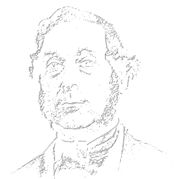
by John Beauchamp Jones
FEBRUARY 8TH.—The air is filled with rumors—none reliable.
It is said Gen. Lee is much provoked at the alarm and excitement in the city, which thwarted a plan of his to capture the enemy on the Peninsula; and the militia and the Department Battalions were kept yesterday and to-day under arms standing in the cold, the officers blowing their nails, and “waiting orders,” which came not. Perhaps they were looking for the “conspirators;” a new hoax to get “martial law.”
A Union meeting has been held in Greensborough, N. C. An intelligent writer to the department says the burden of the speakers, mostly lawyers, was the terrorism of Gen. Winder and his corps of rogues and cut-throats, Marylanders, whose operations, it seems, have spread into most of the States. Mr. Sloan, the writer, says, however, a vast majority of the people are loyal.
It is said Congress is finally about to authorize martial law.
My cabbages are coming up in my little hot-bed—half barrel.
Gen. Maury writes from Mobile that he cannot be able to obtain any information leading to the belief of an intention on the part of the enemy to attack Mobile. He says it would require 40,000 men, after three months’ preparation, to take it.
Gov. Brown, of Georgia, says the Confederate States Government has kept bad faith with the Georgia six months’ men; and hence they cannot be relied on to relieve Gen. Beauregard, etc. (It is said the enemy are about to raise the siege of Charleston.) Gov. B. says the State Guard are already disbanded. He says, moreover, that the government here, if it understood its duty, would not seize and put producers in the field, but would stop details, and order the many thousand young officers everywhere swelling in the cars and hotels, and basking idly in every village, to the ranks. He is disgusted with the policy here. What are we coming to?
Everywhere our troops in the field, whose terms of three years will expire this spring, are re-enlisting for the war. This is an effect produced by President Lincoln’s proclamation; that to be permitted to return to the Union, all men must first take an oath to abolish slavery!
February 8.—The expedition sent by General Butler, with the object of making a sudden dash into Richmond, Va., and releasing the Union prisoners confined there, returned, having been unsuccessful. The following are the facts of the affair: On Saturday morning, February sixth, General Butler’s forces, under command of Brigadier-General Wistar, marched from Yorktown by the way of New-Kent Court-House. The cavalry arrived at half-past two o’clock yesterday morning at Bottom’s Bridge, across the Chickahominy, ten miles from Richmond, for the purpose of making a raid into Richmond, and endeavoring, by a surprise, to liberate the prisoners there.
The cavalry reached the bridge at the time appointed, marching, in sixteen hours and a half, forty-seven miles. A force of infantry followed in their rear, for the purpose of supporting them. It was expected to surprise the enemy at Bottom’s Bridge, who had had for some time only a small picket there. The surprise failed, because, as the Richmond Examiner of to-day says, “a Yankee deserter gave information in Richmond of the intended movement.” The enemy had felled a large amount of timber, so as to block up and obstruct the roads and make it impossible for our cavalry to pass. After remaining at the bridge from two o’clock until twelve, General Wistar joined them with his infantry, and the whole object of the surprise having been defeated, they all returned to Williamsburgh. On his march back to New-Kent Court-House, his rear was attacked by the enemy, but they were repulsed without loss. A march by the Union infantry, three regiments of whom were colored, of more than eighty miles, was made in fifty-six hours. The cavalry marched over one hundred miles in fifty hours.
—The office of the newspaper Constitution and Union, at Fairfield, Iowa, edited by David Sheward, was visited by company E, Second Iowa, to-day. The type and paper were thrown out of the windows, and subscription-books destroyed.
—General Foster telegraphed from Knoxville, under date of yesterday, that an expedition sent against Thomas and his band of Indians and whites, at Quallatown, N. C, had returned completely successful. They surprised the town, killed and wounded two hundred and fifteen, took fifty prisoners, and dispersed the remainder of the gang in the mountains. The Union loss was two killed and six wounded.—General Grant’s Despatch.
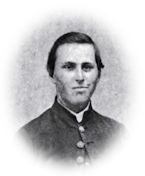
February 7th. Arrived in Baltimore at 7 A. M. Had breakfast, then made our way across the city to the Philadelphia R. R. Station. There learned that we could not get a train out of the city until 9 P. M. A great disappointment. When leaving camp thought we could connect right through to New York. As we had a long time to wait, we put up at the Union House. Made a few calls, as we had acquaintances in the city. Called at the Stuart Mansion Hospital, where I was during my long illness, early in 1863. I found the nurses still on duty. All were pleased to see me. One woman and two men, in charge of ward 4. At this time it was known as the Jarvis Hospital, west end of Baltimore. The day passed very pleasantly.
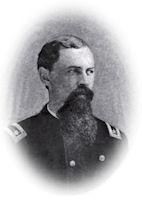
Scottsboro, Ala., February 7, 1864.
This has indeed been a day of rest. More like a home Sabbath, than the Lord’s day often seems, here in the “show business.” None of my company have been on duty, and as the day has been bright and warm, the men have been nearly all out in front of the quarters; all looking natty and clean and healthy, sunning themselves real country-Sunday fashion. Seems to me that I grow prouder every day of being captain over these men. If I could only get 30 good, healthy recruits, I expect I’d have to be “hooped.” The boys brought a fiddle in with them yesterday from our Lebanon march, and as nearly all of them play, “more or less,” it has seen but little rest to-day. Every man I have present (42) is for duty, and if there are any soldiers in the army who can outmarch them, or do duty better, “I want them for Babcockses,” as the boys say. Frank Post was in my tent to-day, and informed me that in her last letter, Laura told him that some horrible stories of my cruelty to women and children while in command of the mounted detachment, were in circulation at home. He wanted me to trace the author of them, but I respectfully begged to be excused. The person who told such stuff, falsifies; for I never killed a fly, or stepped on a worm, or kicked a dog, or threw a stone at a cat, and know I wouldn’t treat a woman or child worse, if they were Rebels. I do take a little private satisfaction in knowing that I have never said a word, except respectfully, to any woman in the Confederacy, that I have ever touched a cent’s worth of private property for my own use. We, with 600 more of our brigade, had to take horses and rations from a poor set of people, but that was no more our fault than the war is. Those pretty crystals I sent you by Lieutenant Dorrance, are “Iceland Spar,” which is, I believe, the only stone which possesses the power of double refraction. If you put a thin piece of it over a black mark on paper, and look closely, you will see two marks; try this piece which I enclose. I took a lesson in chess last night, played a couple of games. Don’t think I would ever make a player. Colonel Dickerman is at present commanding the brigade, and Major Willison the regiment, Lieutenant Colonel Wright being on detached service as a division inspector general. Mattison is in his quartermaster department almost constantly, and Dorrance’s absence leaves me quite alone. Dorrance was in a way, good company. Always in a good humor and talking. Real accommodating, too, if carefully handled.
I went to the nearest house to camp to-day, to beg a little piece of tallow to soften a pair of marching boots. I sat down by a fire, in company with three young women, all cleanly dressed and powdered to death. Their ages were from 18 to 24. Each of them had a quid of tobacco in her cheek about the size of my stone inkstand, and if they didn’t make the extract fly worse than I ever saw it in a country grocery, shoot me. These women here have so disgusted me with the use of tobacco that I have determined to abandon it. Well, we are again under orders to march at a moment’s notice. Received them about noon to-day, and expect to start in the morning. It is intimated that we go to Chattanooga, first, and then either to Dalton, Knoxville, or garrison Chattanooga, and let its present occupants go. I was much pleased to get the orders, for above all things, do hate a permanent camp. I enjoy the tramping, the mud, the cold, and being tired, and everything mean there is about soldiering, except being hungry. That beats me to a fraction. If I could only go without eating three or four days at a time I would pass as a soldier, but bless me, missing a meal is worse than drawing a tooth. I never tried it as long as I have been in the army, but it seems to me that putting me on quarter rations would be equivalent to putting me in a hospital bed.
Hurrah for the march. No such place for real fun elsewhere. We have our regular races, and tough ones they are, too, sometimes. Each regiment takes its turn in having the advance, one day at a time. Say, to-day we have the lead, then to-morrow we will march behind all the rest, and the next day the regiment which succeeded us in the lead will fall behind us, etc. It is a great deal easier to march in front than in the rear, because in passing defile, or crossing streams on single logs, all of the time that is lost falls, finally, on the rearmost regiment, and after it crosses it sometimes has to double-quick it a mile or more to catch up again. A common time step or 90 to the minute, in front with a brigade of 1,500 over the average of these roads, makes the rear in order to keep up, take more than quick time, or over 112 steps to the minute, during their marching time. So you can imagine our races, though fun to the advance, make the rear work—no laughing matter. The point of the race is for the advance regiment to move so fast that the others will break up, tired out, and straggle. Yesterday the 97th Indiana coming in had the lead and undertook to run us. We had the rear, but by not waiting to cross on logs, but wading through creeks up to our knees or middles kept at their heels for 8 miles without a rest. ‘Twas raining all the time and the roads were awful slippery. Our brigade tried hard to run us down at first, but now none of them doubt our ability to march with any regiment. When the men are resting along the road they have a great fashion of making remarks about any strange soldier or citizen who passes. As we were resting on the 5th inst., a bare-footed, sick-looking soldier came hobbling through. One man said, “He’s sick, don’t say anything to him;” another said, “No, he’s shod a little too rough;” another, “Yes, and he interferes;” another, “Keep still he’s slipping upon something;” another, “He’s showing us how Fanny Elssler went over a looking glass;” another, “Come here and I’ll take the pegs out of your shoes,” etc. Wouldn’t that be interesting to the passerby?
Sunday, 7th—We started early this morning and after reaching Brandon, about thirteen miles east of Jackson, went into bivouac about a mile from the town. There was no skirmishing in the front today, the rebels rapidly falling back. Our men set fire to the town this evening and burned almost the whole town. Most of the citizens had fled from the place before our forces entered. We captured a great quantity of tobacco here.
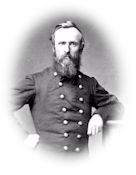
Camp White, February 7, 1864.
Dear Uncle: — The capture of General Scammon and two of his staff, will postpone my coming a few days, only a few days, I hope. I must be cautious what I say, but to you I can write that his capture is the greatest joke of the war. It was sheer carelessness, bad luck, and accident. It took a good many chances, all lost, to bring it about. Everybody laughs when he is alone, and very intimate friends laugh in concert when together. General Scammon’s great point was his caution. He bored us all terribly with his extreme vigilance. The greatest military crime in his eyes was a surprise. Here he is caught in the greenest and most inexcusable way.
We shall come, I think, in a week or so via Cleveland.
Sincerely yours,
R. B. Hayes.
S. Birchard.


