Following the American Civil War Sesquicentennial with day by day writings of the time, currently 1863.

February 2014

February 3, Wednesday. Had a brief talk to-day with Chase on financial matters. He seems embarrassed how to proceed, but, being fertile in resources, listening to others still more fertile, and having resorted to expedients in one instance, he will probably experience little difficulty in finding another. There will, however, come a day of reckoning, and the nation will have to pay for all these expedients. In departing from the specie standard and making irredeemable paper its equivalent, I think a great error was committed. By inflating the currency, loans have been more easily taken, but the artificial prices are ruinous. I do not gather from Chase that he has any system or fixed principles to govern him in his management of the Treasury. He craves even beyond most others a victory, for the success of our arms inspires capitalists with confidence. He inquired about Charleston; regretted that Farragut had not been ordered there. I asked what F. could do beyond Dahlgren at that point. Well, he said, he knew not that he could do more, but he was brave and had a name which inspired confidence. I admitted he had a reputation which Dahlgren had not, but no one had questioned D.’s courage or capacity and the President favored him. The moral effect of taking Charleston was not to be questioned; beyond that I knew not anything could be gained. The port was closed.

The conversation turned upon army and naval operations. He lamented the President’s want of energy and force, which he said paralyzed everything. His weakness was crushing us. I did not respond to this distinct feeler, and the conversation changed.

Almost daily we have some indications of Presidential aspirations and incipient operations for the campaign. The President does not conceal the interest he takes, and yet I perceive nothing unfair or intrusive. He is sometimes, but not often, deceived by heartless intriguers who impose upon him. Some appointments have been secured by mischievous men, which would never have been made had he known the facts. In some respects he is a singular man and not fully understood. He has great sagacity and shrewdness, but sometimes his assertion or management is astray. When he relies on his own right intentions and good common sense, he is strongest. So in regard to friends whom he distrusts, and mercenary opponents, in some of whom he confides. A great and almost inexcusable error for a man in his position.
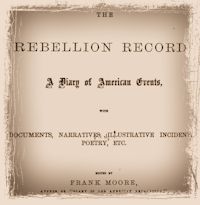
by John Beauchamp Jones

            FEBRUARY 3D.—The following dispatch indicates the prestige of success for the year 1864, and it is probable it will be followed by a succession of successes, for the administration at Washington will find, this year, constant antagonisms everywhere, in the North as well as in the South, and in the army there will be opposing parties—Republicans and Democrats. On the part of the South, we have experienced the great agony of 1863, and have become so familiar with horrors that we shall fight with a fearful desperation. But the dispatch:

            “Glorious news! The whole Yankee force, about 150, are our prisoners, and their gun-boat ‘ Smith Briggs,’ destroyed.

            “No one hurt on our side. Four Yankees killed and two or three wounded.

            “The prisoners are now at Broad Water. Send down a train for them to-morrow.”

            We learn that this Yankee force was commissioned to destroy a large factory at Smithfield, in Isle of WightCounty. We do not know the size or composition of our command which achieved the results noticed above, but understand that it contained two companies of the Thirty-first North Carolina Regiment.

            Congress has not yet finally acted on the Tax bill, nor on the new Conscription bill.

            The Secretary of War said to-day that he would not allow the increased pay to any of his civil officers who were young and able to bear arms—and this after urging Congress to increase their compensation. It will be very hard on some who are refugees, having families dependent on them. Others, who board, must be forced into the army (the design), for their expenses per month will be some fifty per cent. more than their income.

            The weather is clear but colder.

February 3.—Major-General W. T. Sherman, with the Sixteenth army corps, under the command of Major-General Hurlbut, and the Seventeenth army corps, commanded by General McPherson, left Vicksburgh upon an expedition through Mississippi.—(Doc. 122.)

—The guard of one company of infantry posted at Patterson Creek Bridge, eight miles east of Cumberland, Va., was attacked at half-past one P.M. yesterday, by five hundred rebel cavalry, under General Rosser, and after a spirited resistance, in which two were killed and ten wounded, the greater part of the company were captured. This accomplished, the rebels set fire to the bridge, and leaving it to destruction, started off with their prisoners in the direction of Romney. The employés of the railroad succeeded in staying the fire, and saved the bridge, with only slight damage. General Averill, with his command of nearly two thousand cavalry, and who had been sent out from Martinsburgh by General Kelley, this morning overtook the rebels near Springfield, and a severe engagement ensued. The rebels were driven through Springfield, and thence to and south of Burlington. Many of the rebels were killed and wounded, and the Union captures were large, including the recovery of the men yesterday taken at Patterson’s Creek, and many horses. The enemy retreated rapidly to the back country, hotly pursued by the cavalry.— A fight took place at Sartatia, Miss., between a body of rebels numbering about three thousand, under General Ross, and the National gunboats, on an expedition up the Yazoo River to cooperate with General Sherman.—(Docs. 122 and 124.)

Tuesday, 2d—Our pickets were relieved last night about 10 o’clock preparatory to going on the expedition, but we did not get off this morning because the quartermaster failed to get the rations loaded yesterday, so we have to remain in camp for another day. I went on camp guard this morning. Our orders are to leave all equipage in camp, taking only our blankets and one hundred rounds of ammunition. The convalescents are to remain here to guard the camp.

Huntsville, Tuesday, Feb. 2. Monotony of camp was broken to-day by cheering down on our left at 12 M. and soon General Smith and staff rode through camp, who was joined by Captain Dillon, and immediately orders were given to march a gun detachment to the guns immediately and fire a salute in honor of the 59th and 48th Indiana, who were about to start for home as veterans. The three Batteries were soon ready, “cocked and primed”. Captain Dillon as usual in quite a flurry. Ordered Lieutenant Simpson to his quarters in a passion, then told us the salute was to be commenced on the right, each gun to fire in succession, at the raising of the flag for a signal, ”and boys, I want you to give three of the d——st cheers you ever gave between each gun”. After a little waiting the heroes marched along in the valley below, headed by the Brigade band. Up goes the flag and a volume of dense white smoke is emitted from the gun on the right, accompanied with the thunder, then another and another, and all have fired in rapid succession, fourteen in all. Our guns were fired for the first time, giving a crack which almost demolished my “tympanum”. Act No. 2, cheer after cheer arose from the homeward bound veterans, and by the Batteries hat waving, etc. “Well do they deserve the honor, and gladly was it given. Together we have struggled on every field of strife and won. They have the wishes and gratitude of the comrades they leave behind. May they have a happy time of it at home with relations and sweethearts. Retired to parade ground on double quick, and broke ranks full of sunlight. H. S. Keene, chief of artillery clerk, is going with them on furlough. A fortunate man. A shoulder strap for a friend.

[Diary] February 2.

Our little house looks really pretty — as such a barn of a place can. Rina brings out from her store one pretty thing after another to furnish the table and house. She will not sell these things, but lends them. To-night Hastings brought our rations. Such a to-do to get them put away. It is so pleasant to have the river just before us reflecting the stars, and to-night reflecting the lightning which is incessant, and to hear the bell, and the singing in church.

February 2, Tuesday. Senator Grimes made a very good speech to-day in the Senate on naval affairs, in which he introduced a letter from Donald McKay, the eminent shipbuilder of Boston, complimenting our naval vessels and doing justice to the Bureau of Construction and Engineering, which have been of late so much abused. Truth will vindicate itself, though slowly. The persistent assault on the Navy Department is not without a purpose. There is design in it. The contractors, the claim agents, the corrupt portion of newspaper correspondents, and unprincipled Members of Congress are all engaged in this business. I am not mistaken in the fact that there is villainy in the scheme, for villains are combining in it. There is a conviction in my mind, although I cannot cite a tangible or certain fact to establish it, that the War Department had secretly instigated these attacks. I am, however, impressed with an earnest belief that there is a mischievous design to divert attention from the acts and doings of the military branch of the service by starting off with a hue and cry against the Navy.

But little of importance was done at the Cabinet-meeting. Several subjects discussed. Seward was embarrassed about the Dominican question. To move either way threatened difficulty. On one side Spain, on the other side the negro. The President remarked that the dilemma reminded him of the interview between two negroes, one of whom was a preacher endeavoring to admonish and enlighten the other. ‘There are,” said Josh, the preacher, “two roads for you, Joe. Be careful which you take. One ob dem leads straight to hell, de odder go right to damnation.” Joe opened his eyes under the impressive eloquence and awful future and exclaimed, “Josh, take which road you please; I go troo de wood.” “I am not disposed to take any new trouble,” said the President, “just at this time, and shall neither go for Spain nor the negro in this matter, but shall take to the woods.”

February 2—While hard at work in the woods,, hauling stocks for the mill, my furlough came, for eighteen days. So I was relieved. On the 3d I left camp and got home on the morning of the 6th. It took me several days to get accustomed to living as a civilian, as I have been in camp for two years at a stretch. I had a very good time, and will always be grateful for the kindness shown me by every one while at home.

by John Beauchamp Jones

            FEBRUARY 2D—So lax has become Gen. Winder’s rule, or deficient, or worse, the vigilance of his detectives,—the rogues and cut-throats,—one of them keeps a mistress in a house the rent of which is more than his salary, that five Jews, the other day, cleared out in a schooner laden with tobacco, professedly for Petersburg, but sailed directly to the enemy. They had with them some $10,000 in gold; and as they absconded to avoid military service in the Confederate States, no doubt they imparted all the information they could to the enemy.

            Mr. Benjamin, Secretary of State, asked the Secretary of War to-day to make such arrangements as would supply the State Department with regular files of Northern papers. They sometimes have in them important diplomatic correspondence, and the perusal of this is about all the Secretary of State has to do.

            It is rumored that the Hon. Robert Toombs has been arrested in Georgia for treason. I cannot believe it, but I know he is inimical to the President.

            The British papers again seem to sympathise with us.

            Senator Orr writes to the Secretary that a resolution of the Senate, asking for copies of Gen. Beauregard’s orders in 1862 for the fortification of Vicksburg (he was the first to plan the works which made such a glorious defense), and also a resolution calling for a copy of Gen. B.’s charges against Col.____, had not been responded to by the President. He asks that these matters may be brought to the President’s attention.

            The weather is beautiful and spring-like again, and we may soon have some news both from Tennessee and North Carolina. From the latter I hope we shall get some of the meat endangered by the proximity of the enemy.

February 2.—The United States steamer Underwriter, lying at anchor in the Neuse, River, N. C, was surprised and destroyed by a party of rebels, who belonged to the forces on the expedition against Newbern.—Admiral Lee’s Report.

—One hundred and twenty-nine deserters from the rebel army under the command of General Johnston, who had effected their escape during his late movement, entered the provost-marshal’s office at Chattanooga, and took the oath of allegiance to the United States.—This morning eleven prisoners and ten horses, belonging principally to the Sixth Virginia cavalry, were captured near Blue Ridge, in the vicinity of Thornton’s Gap, Va.—The British steamer Presto, in attempting to run into Charleston Harbor, ran ashore off Sullivan’s Island, where she was destroyed by the National fleet.