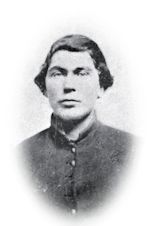
Huntsville, Thursday, Feb. 4. Cold night but pleasant day. Nothing of importance to mar the general routine of camp life. Had to put in our regular drill under Sergeant Hood. Camp was inspected P. M. by the medical director of the 15th Corps, seeing after the sanitary condition of the troops. A short drill at parade and got through without incurring the displeasure of the commanding officer. Broke ranks to receive an unusually large mail, which was soon dealt out to the eager soldier boys. Some went away light-hearted, others sorely disappointed.
February 2014
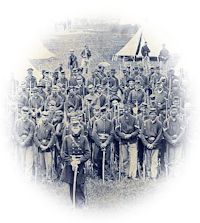
February 4th, 1864.
Fred Byron has given up the fight and sought repose in the bosom of his Mother Earth. His wound was not considered dangerous at first, but the shock was too great for his delicate constitution. He pined away gradually, almost imperceptibly, until I could carry him in my arms, like a child. Poor boy; my heart went out to him from the first, and his countenance always brightened when I entered the room. He lived about six weeks and—slept. He had neither father or mother on earth—no relatives but a brother and sister, both married. And so they have gone, the young, the brave, our country’s choicest spirits. Death has reaped a rich harvest.
Austin Draper is quite sick of a low form of fever. He is quite discouraged, poor fellow, but I do all I can to inspire him with hope, knowing this to be better than medicine. I do not know that I will be able to join the regiment before they go over the mountains. The Doctor and the men press me to stay. From choice, I would much rather be with the boys. Dr. Bevere has returned. It seems the Rebels did not think him worth his keep. He was with them three days and says they treated him well. The men are still on “tip-toe,” momentarily expecting orders to pack up and be off. They say, however, like the true heroes they are, they are willing to stay as long as they are needed.
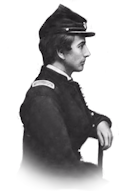
February 4th. The great hall grows rapidly and is going to be a fine affair. The notables throughout the land have generally accepted invitations. A special train will be run from Washington, and all army circles are on the very tip toe of expectation. At our headquarters the tents are decorated with evergreens, sabres, swords, pistols, etc.; we have remade the beds with the softest of cedars and put everything in order for the reception of our guests, who will soon come along. Our plan is to give up our quarters to the ladies and take shelter in the great hall ourselves after the festivities of the evening are over. We have portable bunks made for this purpose and our men will put them up after the floors are deserted. There will be two girls in each tent, except that Alvord’s is to be devoted to his sister alone. Major Hancock, Captain Martin, and the general each will have their wives with them, and Mrs. Curtin will have a whole tent to herself and maid.
All interest centering in the army, of course, it is immensely popular, and the ladies write most enthusiastically of the coming visit; every woman in the land has taken intense interest in the army, which, necessarily, has been to nearly all of them only a shadow; now they are to see the reality.
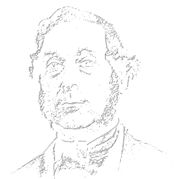
by John Beauchamp Jones
FEBRUARY 4TH.—Clear and pretty cold. We have news of another brilliant affair at Kinston, N. C., where Gen. Pickett has beaten the enemy, killing and wounding and taking some 500 men, besides capturing another gun-boat! Thus the campaign of 1864 opens auspiciously.
And Gen. Early has beaten the foe in HardyCounty, Northwest Virginia, capturing, it is said, some 800.
It is supposed that Gen. Pickett will push on to Newbern, and probably capture the town. At all events we shall get large supplies from the tide-water counties of North Carolina. General Lee planned the enterprise, sending some 15,000 men on the expedition.
Yesterday the Senate Committee reported against the House bill modifying the act making all men liable to conscription who have hired substitutes. But they are debating a new exemption bill in the House.
It is true Mr. Toombs was arrested at Savannah, or was ejected from the cars because he would not procure a passport.
To-day Mr. Kean, the young Chief of the Bureau of War, has registered all the clerks, the dates of their appointments, their age, and the number of children they have. He will make such remarks as suits him in each case, and submit the list to the Secretary for his action regarding the increased compensation. Will he intimate that his own services are so indispensable that he had better remain out of the field?
The following “political card” for the Northern Democrats was played yesterday. I think it a good one, if nothing more be said about it here. It will give the Abolitionists trouble in the rear while we assail them in the front.
The following extraordinary resolutions were, yesterday, introduced in the House of Representatives by Mr. Wright of Georgia. The House went into secret session before taking any action upon them.
“WHEREAS: The President of the United States, in a late public communication, did declare that no propositions for peace had been made to that government by the Confederate States, when, in truth, such propositions were prevented from being made by the President of the United States, in that he refused to bear, or even to receive, two commissioners, appointed to treat expressly of the preservation of amicable relations between the two governments.
“Nevertheless, that the Confederate States may stand justified in the sight of the conservative men of the North of all parties, and that the world may know which of the two governments it is that urges on a war unparalleled for the fierceness of the conflict, and intensifying into a sectional hatred unsurpassed in the annals of mankind. Therefore,
“Resolved, That the Confederate States invite the United States, through their government at Washington, to meet them by representatives equal to their representatives and senators in their respective Congress at ______, on the ___ day of ______ next, to consider,
“First: Whether they cannot agree upon the recognition of the Confederate States of America.
“Second: In the event of such recognition, whether they cannot agree upon the formation of a new government, founded upon the equality and sovereignty of the States; but if this cannot be done, to consider
“Third: Whether they cannot agree upon treaties, offensive, defensive, and commercial.
“Resolved, In the event of the passage of these resolutions, the President be requested to communicate the same to the Government at Washington, in such manner as he shall deem most in accordance with the usages of nations; and, in the event of their acceptance by that government, he do issue his proclamation of election of delegates, under such regulations as he may deem expedient.”
Eighteen car loads of coffee went up to the army to-day. I have not tasted coffee or tea for more than a year.
February 4.—The British steamer Nutfield, from Bermuda to Wilmington, N. C, was chased ashore and destroyed near New-River Inlet, N. C, by the National war steamer Sassacus.— Admiral Lee’s Report.
Wednesday, 3rd—We started this morning at 8 o’clock and marched to the Black river, where we bivouacked for the night. Our brigade was train guard for the provision train. Our entire expedition is supposed to have about twenty-five thousand men, composed of infantry, artillery and cavalry, with one engineers’ corps in charge of a pontoon bridge. The weather is fine for marching. General Crocker’s Division has started ahead.
3rd. Hugh and I went to town in evening and heard the Swiss Bell Ringers. Good time. Zettler House.
Wednesday, February 3d.
Last night we were thrown into the most violent state of commotion by the unexpected entrance of Captain Bradford. He has been brought here a prisoner, from Asphodel, where he has been ever since the surrender of Port Hudson, and taking advantage of his tri-weekly parole, his first visit was naturally here, as he has no other friends.
Poor creature, how he must have suffered! The first glance at his altered face where suffering and passion have both left their traces unmistakably since we last met, and the mere sight of his poor lame leg, filled my heart with compassion.
• • • • • • • •
How he hates Mr. Halsey! I could not forego the pleasure of provoking him into a discussion about him, knowing how they hated each other. He would not say anything against him; understand, that as a gentleman and a companion, Mr. Halsey was his warmest and best friend; there was no one he admired more; but he must say that as a soldier, he was the worst he had ever seen — not that he was not as brave and gallant a man as ever lived, but he neglected his duties most shamefully while visiting Linwood so constantly, eluding the sentinels daily as he asked for neither pass nor permission, and consulting only his inclinations instead of his superior officers or his business. And that last night at Linwood, when he absented himself without leave, why could he not have signified to him, his Captain, that he wished to say good-bye, instead of quietly doing as he pleased? When the Colonel sent for a report of the number of men, quantity of forage and ammunition, etc., and it was discovered that John Halsey was absent without leave, with the books locked up and the keys in his pocket — even after this lapse of time, the fire flashed through the ice as the Captain spoke. Sergeant Halsey, I am sorry for you when you reported yourself next day! All the fun that could have been crowded into an evening at Linwood could not have repaid you for the morning’s scene. And after all, what was it beyond very empty pleasure, with a great deal of laughter? He could have dispensed with it just as well. Looking back, I congratulate myself on being the only one who did not ask him to stay.
Huntsville, Wednesday, Feb. 3. Colder night than we have had for two weeks. Water frozen a quarter of an inch and obliged to tuck up close to sleep warm. Instead of the usual drill this morning, was general policing, ground to be swept from rear of quarters to behind the guard house, about five acres. Guard house and kitchen whitewashed. A well started. I climbed Russell Hill for evergreen boughs for brooms in company with a couple of others, and managed it so as not to return until nearly recall; that is soldiers’ strategy. “Do no more than you can” is the motto.
Diary And Memoranda, 1864
Feb. 3rd. Went to the Washington theatre last night. Miss Keene played “She stoops to conquer.” It was a laughable affair. She did look splendidly arrayed in all her beauty, before the foot lights, a splendid form; but paint was too profuse, I would rather have seen her natural complextion.


