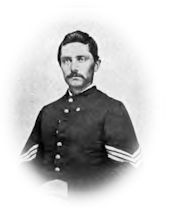
Thursday, 17th—Our boat has been running steadily since starting, it having stopped but once, and that was to take on wood for the boilers of the engine. The time has passed without incident.
March 2014
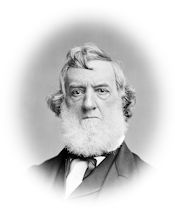
March 17, Thursday. Sent a letter to Chase in reply to his rather captious communication concerning the Ann Hamilton and the Princeton. Shall not be surprised if he takes offense, for I think I have put him in the wrong, and this is to him very uncongenial. In this respect he differs greatly from Seward, who will receive correction very easily, provided others do not know it.
March 17.—Colonel William Stokes, in command of the Fifth Tennessee cavalry, surprised a party of rebel guerrillas under Champ Ferguson, at a point near Manchester, Tenn., and after a severe fight routed them, compelling them to leave behind twenty-one in killed and wounded.—This morning, at a little before three o’clock, an attempt was made on Seabrook Island by a large force of rebels, who came down the Chickhassee River in boats. They approached in two large flats, filled with men, evidently sent forward to reconnoitre, with a numerous reserve force further back, to cooperate in case any points were found to be exposed. One of the boats came down to the mouth of Skull Creek, where they attacked a picket-boat containing a corporal and four men of the Seventy-sixth Pennsylvania. They first fired three shots and then a whole volley, and succeeded in capturing the boat and those in it, after a severe hand-to-hand fight. Whether there were any casualties could not be ascertained. Further on, meeting an unexpected resistance, they retreated.
—Lieutenant-general Grant formally assumed the command of the armies of the United States to-day. The following was his order on the subject:
Headquarters of the Armies of the United States,
Nashville, Tenn., March 17, 1864.
General Orders, No. 12.
In pursuance of the following order of the President:
“Executive Mansion, Washington, D. C,
March 10, 1864
“Under the authority of the Act of Congress to appoint the grade of Lieutenant-General in the army, of February 29, 1864, Lieutenant-General Ulysses S. Grant, U. S. A., is appointed to the command of the armies of the United States.
“Abraham Lincoln.”
—I assume command of the armies of the United States. Headquarters will be in the field, and, until further orders, will be with the army of the Potomac. There will be an office headquarters in Washington, D. C, to which all official communications will be sent, except those from the army where the headquarters are at the date of their address.
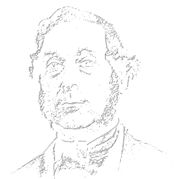
by John Beauchamp Jones
MARCH 17TH.—Bright, clear, and pleasant; frosty in the morning.
Letters from Lieut.-Gen. Hood to the President, Gen Bragg, and the Secretary of War, give a cheering account of Gen. Johnston’s army at Dalton. The men are well fed and well clothed. They are in high spirits, “and eager for the fray.” The number is 40,000. Gen. H. urges, most eloquently, the junction of Polk’s and Loring’s troops with these, making some 60,000,—Grant having 50,000,—and then uniting with Longstreet’s army, perhaps 30,000 more, and getting in the rear of the enemy. He says this would be certain to drive Grant out of Tennessee and Kentucky, and probably end the war. But if we lie still, Grant will eventually accumulate overwhelming numbers, and penetrate farther; and if he beats us, it would be difficult to rally again for another stand, so despondent would become the people.
Gen. Hood deprecates another invasion of Pennsylvania, which would be sure to result in defeat. He is decided in his conviction that the best policy is to take the initiative, and drive the enemy out of Tennessee and Kentucky, which could be accomplished to a certainly.
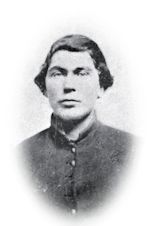
Huntsville, Wednesday, March 16. A very cold and blustering day. All feel pinched as in January. Tommy Hungerford continues quite ill. Fever has left him, but he suffers from inflamation of the lungs. Confined to his bed all the time, and kept drowsy all the time by noxious drugs. Byron Babcock taken to the post hospital last night and M. Murphy today. He is very bad with measles. Hauled wood in the afternoon with D. Wallace and Milton Hungerford, ash-wood from the hill which is needed to keep warm. Bought Atlantic Monthly of J. Lester. Good reading.

16th. Melissa wrote a letter to F. I enclosed a note speaking of my burning the letters and asking F. to do the same way with mine and also my pictures. Melissa took my letters around to Minnie’s. Thede and I walked around before supper.
16th. Melissa wrote a letter to F. I enclosed a note speaking of my burning the letters and asking F. to do the same way with mine and also my pictures. Melissa took my letters around to Minnie’s. Thede and I walked around before supper.
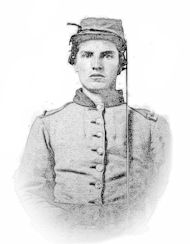
Thursday, 16th.—Corps drill and sham battle of Hood’s Corps to-day. Made some gallant charges.
Wednesday, 16th—This is a beautiful day. I left for home on my thirty-day furlough. I embarked with the Fifteenth Iowa and the Thirty-second Illinois, on board the “Olive Branch.” We left for Cairo, Illinois, at 3 p. m. We say adieu to thee, Vicksburg, the Gibraltar of the West! We leave thee with some pleasant memories, notwithstanding the many hardships we had to endure while with thee! Before we left Vicksburg the railroad station caught fire and was completely consumed with two thousand bushels of oats stored there.
March 16, Wednesday. I have matters arranged for young Mr. Wilson to go to New York and attend to the subjects that are undergoing investigation. Gave him cautionary advice both yesterday and again to-day. Want vigilance and firmness but not harshness or oppression:


