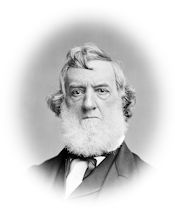
March 10, Thursday. The developments of fraud and swindling by contractors, and I fear by Navy agents and probably other officials, are represented to be astounding. Olcott, the detective, is an employé of the War Department and has been detailed to us for duty. I know less of him than I wish, for one intrusted with so delicate and responsible a duty. Fox is so greedy to get hold of the fellows that I fear he does not sufficiently respect private rights. I therefore hope Olcott is discreet and truthful.
March 2014

Thursday, 10th—It rained all day yesterday, and today it is quite cool. The expedition that is going up the Red river left this afternoon. Regiments are leaving every day for the North, going home on their veterans’ furloughs. We are still on guard at the roundhouse.
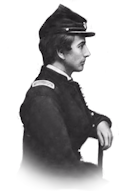
The following appeared in our “Camp Journal” some time after the great ball:
“The appearance of this charming and accomplished author and lecturer (Grace Greenwood) before our lecture association last week and her entire visit to the corps is a source of pride and pleasure alike to all of us. The entire winter has been very gay and spirited in its numerous festivities in the gallant old corps; and it was certainly an appropriate finale to them that this cultivated and accomplished lady should come from the refinement of her quiet home to the very outskirts of the rebel army and lay the rich treasures of her loyal, womanly heart and fertile mind at the feet of the men, who have come from their far Northern homes, to plant the dear old flag once more upon the mountain tops and domes, where it was ruthlessly torn by traitors’ hands. We shall not soon forget her earnest, burning words in behalf of justice, liberty, and law, nor cease to feel their inspiration, as night after night they gave some new charm to the holiness and majesty of our great cause. Our only regret is that we have not the room at this late hour to give a synopsis of her eloquent lecture before the officers of the corps, and that the exigencies of the service were such that she could not have spoken to every corps in the army.
“During her stay, Mrs. Lippencott has been the guest of General Caldwell and staff and has received many attentions at the hands of our most distinguished officers.”
The enemy has had the good taste not to disturb the festivities by any ill timed demonstrations on the approach of a party of ladies and their attendants; they have frequently saluted them and have always refrained from firing or other disagreeable attentions. The picket lines, in fact, fraternize very agreeably, and unless closely watched get to be unduly familiar, that is, for the safety and good of the army.
Horse races, in many of which I ride, hurdle races, division and brigade drills occupy our daily life, which runs as smoothly as could be desired. The army is, of course, bountifully supplied and clothed and is fast filling up again to its normal standard.
By dint of steady and indefatigable work we have managed to empty the guard house, straighten out the muster rolls, relieve the oppressed and punish the guilty.
The Irish brigade was for a time in a most chaotic state; nearly every other officer and man had charges preferred against him, thereby stopping their pay and taking them off the roster for duty; by assiduous labor we have gone through the entire command, dismissing the charges in most cases as frivolous and unworthy of attention.
The ladies remained at our headquarters their allotted time, and then took leave with great reluctance. They were escorted to the train by the entire body of officers, who wished to show their appreciation of their great kindness. Several officers’ wives and daughters remained, and Miss Hamlin is still a visitor at our quarters and promises to remain in the army for some time to come.
March 10.—A party of “over one hundred citizen guerrillas” entered Mayfield, Ky., and after pillaging the stores and severely wounding one of the citizens, left, carrying away their booty.
—Governor Joseph E. Brown’s annual message was read in the Legislature of Georgia, It concluded as follows:
“Lincoln has declared that Georgia and other States are in rebellion to the Federal Government, the creature of the States, which they could destroy as well as create. In authorizing war, he did not seek to restore the Union under the Constitution as it was, by confining the Government to a sphere of limited powers, They have taken one hundred thousand negroes, which cost half a million of whites four thousand millions of dollars, and now seek to repudiate self-government—subjugate Southern people, and confiscate their property. The statement of Lincoln, that we offer no terms of adjustment, is made an artful pretext that it is impossible to say when the war will terminate, but that negotiation, not the sword, will finally terminate it.
“We should keep before the Northern people the idea that we are ready to negotiate, when they are ready, and will recognize our right to self-government, and the sovereignty of the States. After each victory, our government should make a distinct offer of peace on these terms, and should the course of any Slate be doubted, let the armed force be withdrawn, and the ballot-box decide. If this is refused even a dozen times, renew it, and keep before the North and the world that our ability to defend ourselves for many years has been proved.”
—Pilatka, Florida, was occupied by the Union forces under Colonel Barton. The force, consisting of infantry and artillery, left Jacksonville on the transports General Hunter, Delaware, Maple Leaf, and Charles Houghton last evening, and, under the direction of good pilots, reached Pilatka at about daylight this morning. The night was densely dark, and a terrible thunder-storm added not a little to the difficulty of the passage of the boats up the tortuous channel. The troops disembarked at sunrise, and found but few of the enemy. The rebels probably had only a small cavalry picket in the town, and on the approach of the Nationals it was withdrawn, and the place given up without firing a shot on either side. The town was found entirely deserted, except by three small families, who professed Union sentiments, and desired to remain at their homes.—The rebel iron-clad war steamer Ashley was successfully launched at Charleston, S. C.

by John Beauchamp Jones
MARCH 10TH.—Raining fast all day.
There was a rumor to-day that the enemy were approaching again, but the Secretary knew nothing of it.
Major Griswold is at variance with Gen. Winder, who has relieved him as Provost Marshal, and ordered him to Americus, Ga., to be second in command of the prisons, and assigned Major Carrington to duty as Provost Marshal here. Major Griswold makes a pathetic appeal to the President to be allowed to stay here in his old office.
The following, from the Dispatch, differs from the Examiner’s account of the disposal of Col. Dahlgren’s body:
“Col. Dahlgren’s Body.—On Sunday afternoon last, the body of Col. Ulric Dahlgren, one of the leaders of the late Yankee raid on this city, and on whose body the paper revealing their designs, if successful, were found, was brought to this city on the York River Railroad train, and remained in the car (baggage) in which it was till yesterday afternoon, when it was transferred to some retired burial place. The object in bringing Dahlgren’s body here was for identification, and was visited, among others, by Captain Dement and Mr. Mountcastle, of this city, who were recently captured and taken around by the raiders. These gentlemen readily recognized it as that of the leader of the band sent to assassinate the President and burn the city. The appearance of the corpse yesterday was decidedly more genteel than could be expected, considering the length of time he has been dead. He was laid in a plain white pine coffin, with flat top, and was dressed in a clean, coarse white cotton shirt, dark blue pants, and enveloped in a dark military blanket. In stature he was about five feet ten inches high, with a long, cadaverous face, light hair, slight beard, closely shaven, and had a small goatee, very light in color. In age we suppose he was about thirty years, and the expression of his countenance indicated that of pain.”

March 10.—There has been much excitement in Richmond about Kilpatrick’s and Dahlgren’s raids, and the death of the latter. The cannon roared around the city, the alarm-bell rang, the reserves went out; but Richmond was safe, and we felt no alarm. As usual, they did all the injury they could to country-people, by pillaging and burning. They steal every thing they can; but the people have become very adroit in hiding. Bacon, flour, etc., are put in most mysterious places; plate and handsome china are kept under ground; horses are driven into dense woods, and the cattle and sheep are driven off. It is astonishing, though much is taken, how much is left. I suppose the raiders are too much hurried for close inspection.
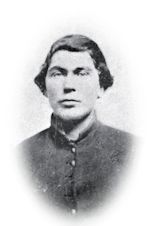
Huntsville, Wednesday, March 9. Hitched up four guns and caisson and went out for battery drill under Lieutenant Hood. Horses balky and unused to work, had to unhitch one and returned with but little drill. I rode on lead, third caisson. Standing gun drill and parade in the afternoon. Rainy evening. Privates had a grand ball to-night in Alabama Hotel to try to excel the shoulder-strap fizzle of Feb. 22. I understand they had a grand time. No officers allowed, no one with shoulder straps on. Forty ladies in all. Lieutenant Clark little better with the smallpox.
Jacksonville, Fla., March 9, 1864.
Dear Father:—
We are still at Jacksonville, and the whole force is hard at work nearly all the time, either on the fortifications or on picket. Last week we were moving every day. One day we would go outside the works and bivouac, and the next the pickets would fire a few guns and we would hustle inside again, to go back the next morning, and so on.
Saturday afternoon we moved into our present position and have remained here so far since.
Ever since the battle the men have slept with their shoes and equipments on, and they fall in every morning an hour before light and stand in line till sunrise. This looks to me very much like “locking the stable door,” etc.
Vague rumors reach us of all sorts of stories in the papers in regard to the battle. The Herald (of unquestionable veracity, so they say) says that the Eighth retired in confusion after Colonel Fribley fell. There may be some truth in it, but not as most persons would take it, i. e., meaning a complete rout. From all I can learn it appears that the regiment was under fire for more than two hours, though it did not seem to me so long. I never know anything of the time in a battle, though.
The veracious “Lieutenant Colonel Hall, Provost-Marshal, Department of the South,” is probably the author of this story. He was the first to inform Mrs. Fribley of the death of the colonel, and he chivalrously and consolingly added that his death was the result of his own rash exposure and that the officers of the regiment were “as badly scared as the men” and he “rallied the regiment himself.” It is all an infamous lie, and there is more than one officer in the regiment ready to tell him so at the first opportunity. He was seen riding about the field with his pistol cocked and shouting to every wounded man to halt. The man who could coolly tell a poor widow alone in this country that her husband was killed by his own fault, is a brute to say the least. Colonel Fribley exposed himself no more than was necessary. He dismounted as soon as the line was formed and was in the rear of the regiment when he was shot.
I want to see justice done the regiment, I don’t claim that they fought well, only as well as they could, and that the officers had all they could do to get them to fall back at all after the first halt. The “confusion” in which they “retired” was owing to this, that there was no line and the men would only leave the trees, behind which they were firing, on direct orders to do so. The regiment had no commander after the colonel and major fell, and every officer was doing the best he could with his squad independent of any one else.
I have been on a court-martial for the last week and probably will be for some time to come. Two cases have been finished thus far—Corporal Smith of our regiment, for mutiny in shooting his sergeant while in discharge of his duties, and another case similar. I am considered rather fortunate in being detailed, as it relieves me from other duties which are very onerous just now.
We are having beautiful weather, very much like our own July. We have not had forty-eight hours of rainy weather since we came here.
Julius Tyler writes that Dennison, Newton Bushnell and several others from Ararat are down in Tennessee in an engineer corps constructing a railroad.
News from New York and Brooklyn is all about the Sanitary Fair. Brooklyn is wild over it and the Independent is full of it.
I wish you would send me that money, $10 at a time, in letters to Hilton Head. I am getting short. Kiss ye babie for ye boy who fights ye rebels.

Jane Eliza Newton Woolsey to her daughters, Jane and Georgy.
8 Brevoort Place, March 9, 1864.
My dear Girls: We are all sitting together at the round table, Abby looking over the old letters from Point Lookout, and reading an incident occasionally aloud; Carry composing an address on her Bloomingdale orphans for their May anniversary. It is too amusing to have Caroline Murray and all those old lady-managers deferring to our Carry on all subjects connected with the asylum. . . . Mary is very much engaged in her arrangements for the floral department at the Fair, and very much interested in it. All the ladies are agog for novelties. They will be charmed with an occasional communication from the Hospital at Fairfax! We are to have a daily paper too, which is to beat the “Drum Beat”—” The Fair Champion.” Do send in poetry and prose and as many incidents as you can; get your doctor and the soldiers to send me an article for it, or letters for the Post Office. Send whatever you have to me, that I may have the pleasure of handing it to the committee on literature! Abby says, “Georgy, may I write out the German soldier-boy’s dream, or any other extract from your old letters that is not too stale ?” I am sure you will say yes. Abby is getting quite warmed up about the Fair; it is difficult not to feel so when everybody else is full of excitement about it. She is making a beautiful silk flag, a dozen or two of the new style of tidy-covers of muslin or embroidery edged with lace, beside lots of other little matters. Mary’s idea of having garden hats of white straw, with broad ribbons, and their ends painted in flowers, is a pretty one, to be hung in her arbor of flowers. She is also painting a lot of little wooden articles. Every thing of hers is to be of the garden style. We find a use now for all our old flower baskets, rustic stands, etc., and a huge pile of them now stands ready to be carried to the flower department. My chair, the cover for which I was obliged to give up working, is under way, also three silk comfortables, all spandy new, none of your old gowns, lined with silk and beautifully quilted in scrolls and medallions by a Fish-kill woman, and trimmed with ribbon quillings; also one dozen ladies’ dressing-sacks of various styles; also, one India satin sofa cushion, one embroidered worsted do., four elegant toilette cushions, one doll’s complete street dress, (even to an embroidered pocket-handkerchief), one doll’s stuffed chair, and other articles “too tedious to mention,” are all under way. I dare say we shall all do our full part, both in making and purchasing.
Mrs. Chauncey has already sold her baby-house, Sarah Coit tells me, for five hundred dollars! Kate Hunt has received her Parisian purchases for the Fair, for which she expects to realize a very large amount; says she is furnishing things to the amount of a thousand dollars! Eliza is coming down to-morrow. . . .
March 9th, 1864.
The beautiful weather of the past week terminated in a violent storm of rain, which continued without interruption forty-eight hours. The roads, before in good condition, are now a sea of mud, almost impassable; consequently that thirty days’ expedition, of which we have heard so much, is indefinitely postponed. But the sky is once more clear, and the soil here soon dries out. Perhaps, in another week, they may make a start. I have been suffering lately from what the Doctor calls periodical neuralgia. It comes on at regular intervals, and is very painful. I am anxious to get around again. The men are very kind, nurses and convalescents, but everything seems to go wrong. It takes two men to do my work, and then, of course, they do not do it as I would. It is much like managing a school of unruly boys. It requires the same tact, and the gift of government which few possess. The Inspector complimented me on the neatness and general appearance of my ward. Our ward Surgeon told him I kept it fit for inspection every day.


