Following the American Civil War Sesquicentennial with day by day writings of the time, currently 1863.

March 2014

March 8, Tuesday. Received a telegram from Admiral Lee this P.M., confirming a rumor that was whispered yesterday of the death of young Dahlgren. He was surrounded, it seems, by superior forces near King and Queen Court-House, and fell attempting to cut his way through. Most of his command was captured. A few escaped and got on board of the gunboat which had been sent for their relief.

A more gallant and brave-hearted fellow was not to be found in the service. His death will be a terrible blow to his father, who doted upon him and not without reason. I apprehend this raid was not a wise and well-planned scheme. Tested by results, it was not. Whether the War Department advised it I do not know. I heard it spoken of indefinitely and vaguely, but with no certainty till the expedition had started.

Fox is full of zeal to get hold of the fraudulent contractors and all that belongs to them, and the whole subject is committed to him. I exceedingly dislike these irregular proceedings. There should be proper law officers to whom these matters should be committed, and not impose them upon the heads of Departments. I must try to have Congress take the matter in hand, and pass the necessary laws, or devise some proper action. I do not like matters as they now are.


Tuesday, 8th—I was detailed with six men from the Eleventh under me, as special guard at the roundhouse. We were detailed about midnight to relieve the Ninety-fifth Illinois, which will accompany a part of the Sixteenth Army Corps down the river, and then on an expedition up the Red river. The Seventeenth Army Corps is going home on veterans’ furlough.

by John Beauchamp Jones

            MARCH 8TH.—An application of Capt. C. B. Duffield, for a lieutenant-colonelcy, recommended by Col. Preston, came back from the President to-day. It was favorably indorsed by the Secretary, but Gen. Cooper marked it adversely, saying the Assistant Adjutant-General should not execute the Conscription act, and finally, the President simply said, “The whole organization requires revision.—J. D.” I hope it will be revised, and nine-tenths of its officers put in the army as conscripts.

            Raining this morning, and alternate clouds and sunshine during the day.

            One of the clerks who was in the engagement, Tuesday night, March 1st, informed me that the enemy’s cavalry approached slowly up the hill, on the crest of which the battalion was lying. At the word, the boys rose and fired on their knees. He says the enemy delivered a volley before they retreated, killing two of our men and wounding several.

            Reports from the Eastern Shore of Virginia indicate that Gen. Butler’s rule there has been even worse than Lockwood’s. It is said that the subordinate officers on that quiet peninsula are merely his agents, to tax and fine and plunder the unoffending people,—never in arms, and who have, with few exceptions, “taken the oath” repeatedly. One family, however (four sisters, the Misses P.), relatives of my wife, have not yielded. They allege that their father and oldest sister were persecuted to death by the orders of the general, and they could not swear allegiance to any government sanctioning such outrages in its agents. They were repeatedly arrested, and torn from their paternal roof at all hours of the day and night, but only uttered defiance. They are ladies of the first standing, highly accomplished, and of ample fortune, but are ready to suffer death rather than submit to the behests of a petty tyrant. Butler abandoned the attempt, but the soldiery never lose an opportunity of annoying the family.

March 8.—Four Yankee negro soldiers, captured in James City County, were brought to this city yesterday and delivered at the Libby, where they were distributed, as far as they would go, into the solitary cells of the Yankee officers captured during the recent raid. This is a taste of negro equality, we fancy, the said Yankee officers will not fancy overmuch. The negroes represent themselves as James W. Cord, company C, Fifth United States volunteers; P. F. Lewis, company I, Fifth United States volunteers; R. P. Armistead, company H, Sixth United States volunteers; John Thomas, ditto.— Richmond Whig.

—The rebel steamer Sumter was captured on Lake George, Florida, by the National steamer Columbine, under the command of Acting Master J. C. Champion.—Forty-eight Union officers and over six hundred prisoners arrived at Fortress Monroe from Richmond, Va., for exchange.— The steam-tug Titan, which was captured near Cherry Stone Point, Va., was burned at Freeport on the Piankatank River.

March 8th. A cold, wet, disagreeable night for picket duty. We are about as miserable as we can be. When off duty we find shelter in an old barn, until the arrival of our tents. Maryland mud is fully as bad as Virginia. Trying to make the best of our condition, hoping for sunshine and warmer weather. All is quiet along the picket line. Once in a while the boys take chances and shoot at the turkey buzzards, sailing through the air.

Huntsville, Monday, March 7. A cloudy, dismal morning. Felt gloomy and sad in spirits. After dinner in hopes of driving such feelings away, I took my pen to write to Thomas. While thus engaged, I was interrupted by a loud talking and cheering in front of the tent, which called me out. There I found that the recruits had arrived from Camp Randall, thirty stout and hearty looking men with mouths wide open, gazing at their “to be” comrades. Anyone could see that they were raw recruits, but nearly everyone had friends to receive and congratulate, but I knew no one, but was cheered by the handing of a package to me by a stranger. It was from home. Hardly waiting to go to my tent, I tore it open, found a pair of socks knit by the hands of my mother; she who so often in times gone by has contributed to my comfort and happiness, had again remembered me in her labors, while suffering severely under the ruthless hand of disease. Oh how precious she is to me, and how fondly I will cherish her humble gift. Also a number of the Phrenological Journals bound in with the calico strip as of old—my favorite paper, loaded with valuable reading matter; also a gift from Brother John, a diary such as I need. The whole so impressed me with the scenes of home and its endearments that I could hardly refrain the tears. When the mail arrived I received four letters—nearly enough for one day.

7th. At 10 A. M. went to the east side with Roxena. Fine Arts Hall and then for bath. P. M. called at Mr. Barnitz’, Bys’, Mrs. Cobb’s and Cous. Brougham’s. Fannie and I rode out—E. Cleveland, etc. Enjoyed myself hugely. We also went to hear Anna Dickinson. “Words for the Hour.” After lecture, walked and talked over our love affairs, and discussed our relations and feelings. Had it not been for a few hindrances and contingencies, I think we would have engaged ourselves. Under the circumstances I could and would not entertain the thought. I love the girl and hope she loves me. God forbid that we should ever be married to be unhappy, if ever done must be mutual self-sacrifice from choice. God help and bless both of us.

Tuesday, March 7th.—Witnessed solemn scene to-day. Made to go out and see Isaac Evans shot for leaving Company G of our regiment and joining Home Guards.

March 7th.—Shopping, and paid $30 for a pair of gloves; $50 for a pair of slippers; $24 for six spools of thread; $32 for five miserable, shabby little pocket handkerchiefs. When I came home found Mrs. Webb. At her hospital there was a man who had been taken prisoner by Dahlgren’s party. He saw the negro hanged who had misled them, unintentionally, in all probability. He saw Dahlgren give a part of his bridle to hang him. Details are melancholy, as Emerson says. This Dahlgren had also lost a leg.

Constance Cary, in words too fine for the occasion, described the homely scene at my house; how I prepared sandwiches for my husband; and broke, with trembling hand, the last bottle of anything to drink in the house, a bottle I destined to go with the sandwiches. She called it a Hector and Andromache performance.

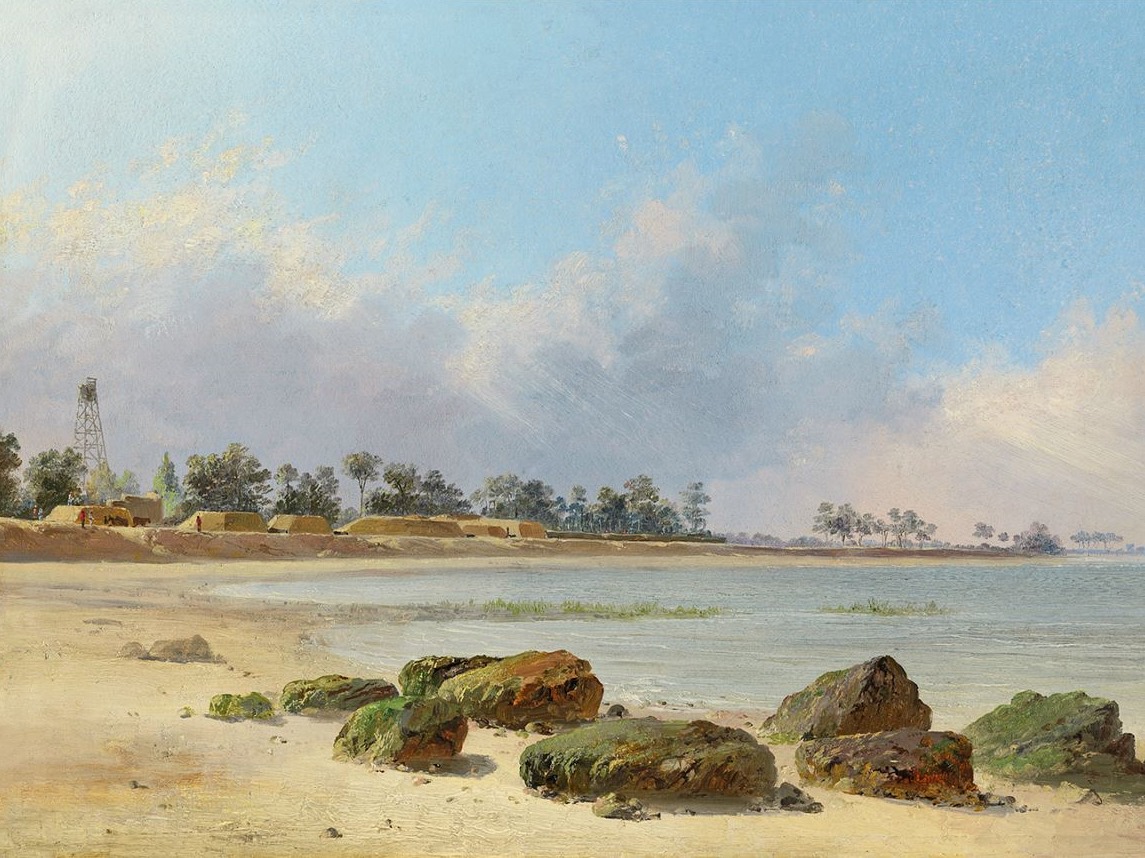
Battery Halston

Painting by Conrad Wise Chapman. (no date provided)

“This was an important battery. Men are at work on the fortifications. The rocks shown in the picture have (sic) brought out remarkably well; in fact the artist himself has stated that he has used these rocks in a great number of his pictures, having never had a better combination of such.” – Conrad Wise Chapman, 1898