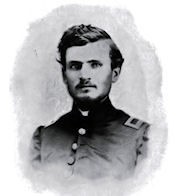
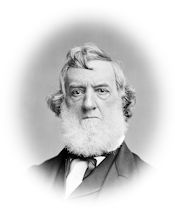
Following the American Civil War Sesquicentennial with day by day writings of the time, currently 1863.

March 2014

March 5th.—Tom Fergurson walked home with me. He told me of Colonel Dahlgren’s[1] death and the horrid memoranda found in his pocket. He came with secret orders to destroy this devoted city, hang the President and his Cabinet, and burn the town! Fitzhugh Lee was proud that the Ninth Virginia captured him.

Found Mrs. Semmes covering her lettuces and radishes as calmly as if Yankee raiders were a myth. While “Beast” Butler holds Fortress Monroe he will make things lively for us. On the alert must we be now.


[1] Colonel Ulric Dahlgren was a son of the noted Admiral, John H. Dahlgren, who, in July, 1863, had been placed in command of the South Atlantic Blockading Squadron and conducted the naval operations against Charleston, between July 10 and September 7, 1863. Colonel Dahlgren distinguished himself at Fredericksburg, Chancellorsville, and Gettysburg. The raid in which he lost his life on March 4, 1864, was planned by himself and General Kilpatrick.

March 5—We left the mills this morning and returned to our brigade, a distance of five miles. Nothing more up to the 17th.

by John Beauchamp Jones

            MARCH 5TH.—Clear and pleasant, after a slight shower in the morning.

            The raid is considered at an end, and it has ended disastrously for the invaders.

            Some extraordinary memoranda were captured from the raiders, showing a diabolical purpose, and creating a profound sensation here. The cabinet have been in consultation many hours in regard to it, and I have reason to believe it is the present purpose to deal summarily with the captives taken with Dahlgren, but the “sober second thought” will prevail, and they will not be executed, notwithstanding the thunders of the press. Retaliation for such outrages committed on others having been declined, the President and cabinet can hardly be expected to begin with such sanguinary punishments when their own lives are threatened. It would be an act liable to grave criticism. Nevertheless, Mr. Secretary Seddon has written a letter to-day to Gen. Lee, asking his views on a matter of such importance as the execution of some ninety men of Dahlgren’s immediate followers, not, as he says, to divide the responsibility, nor to effect a purpose, which has the sanction of the President, the cabinet, and Gen. Bragg, but to have his views, and information as to what would probably be its effect on the army under his command. We shall soon know, I hope, what Gen. Lee will have to say on the subject, and I am mistaken if he does not oppose it. If these men had been put to death in the heat of passion, on the field, it would have been justified, but it is too late now. Besides, Gen. Lee’s son is a captive in the hands of the enemy, designated for retaliation whenever we shall execute any of their prisoners in our hands. It is cruelty to Gen. Lee!

            It is already rumored that Gen. Butler has been removed, and a flag of truce boat is certainly at City Point, laden with prisoners sent up for exchange.

            The Commissary-General has sent in a paper saying that unless the passenger cars on the Southern Road be discontinued, he cannot supply half enough meal for Lee’s army. He has abundance in Georgia and South Carolina, but cannot get transportation. He says the last barrel of flour from Lynchburg has gone to the army.

            We have news from the West that Morgan and his men will be in the saddle in a few days.

            After all, Mr. Lyon’s house was not touched by any of the enemy’s shells. But one shell struck within 300 yards of one house in Clay Street, and not even the women and children were alarmed.

            The price of a turkey to-day is $60.
March 5.—Yazoo City, garrisoned by one white and two negro regiments of National troops, was attacked by a body of rebels under the command of Ross and Richardson, who were repulsed after a severe contest—(Doc. 109.)

—A large force of rebel cavalry attacked ninety-three men of the Third Tennessee regiment at Panther Springs, East-Tennessee. The Union loss was two killed and eight wounded and twenty-two captured. The rebels had thirty killed and wounded.

March 5th. Cold rain storm. A disagreeable day in camp. We are ready for duty at any time, no matter how bad the weather may be. We are starting on the fourth year of this awful war. Many more brave men must fall before the end comes.

Huntsville, Friday, March 4. Evie Evans and myself went to the city on pass. Visited the Christian Commission rooms. Bought stamps. Also went to the colored school under charge of Chaplain of 17th Colored. Had school-teachers, being volunteers from the ranks, teaching the little woolly-heads their “A. B. C.’s”. One class of youngsters was taught by a large negro. A class of young ladies was reading in the Second Reader. All seemed attentive and anxious to receive the instruction but poorly imparted to them. Harnesses were opened and distributed to the platoons. I was given one set. No horses.

4th. Read and visited during the morning. Floy, Thede and I went to Cleveland on the P. M. train. Went to the various halls at Fair (Sanitary Commission) and to Uncle’s to tea. Mrs. D. so hoarse as to be unable to speak. Floy and Thede went to Minstrels. I called at Mr. Cobb’s. Spent a very pleasant evening with F. and Mrs. Cobb. Saw Floy off on morning train.

March 4 — Another alarm reached camp to-day, that the raiders were advancing on our camp. We moved out on the Charlottesville road and were ready for their approach, but like yesterday the report was false. I wonder how and where all the flying rumors and false reports originate; I would certainly like to find the nest where they are hatched, just to see what kind of egg or germ it takes to produce such fallacious reports and how they are developed.

March 4th.—The enemy has been reenforced and is on us again. Met Wade Hampton, who told me my husband was to join him with some volunteer troops; so I hurried home. Such a cavalcade rode up to luncheon! Captain Smith Lee and Preston Hampton, the handsomest, the oldest and the youngest of the party. This was at the Prestons’. Smith Lee walked home with me; alarm-bells ringing; horsemen galloping; wagons rattling. Dr. H. stopped us to say “Beast” Butler was on us with sixteen thousand men. How scared the Doctor looked! And, after all, it was only a notice to the militia to turn out and drill.

March 4, Friday. Seward sends me the copy of a communication which he proposes to send to Lord Lyons respecting the rights and duties of our naval officers, particularly those on blockade duty in the Gulf. It is a singularly weak and erring document. My first thought was to criticize and attempt to correct it, but this could not well be done without making a new paper of it and would appear badly. Talked over the subject with Fox and also with Watkins. Finally gave the latter my views, suggested the points, and directed him to prepare a letter based on these points.

A pleasant Cabinet-meeting. Chase and Blair both absent. Seward and Stanton had a corner chat and laugh about Chase, whose name occasionally escaped them, and whom they appeared to think in a dilemma, and they were evidently not unwilling we should know the subject of their conversation. I could not avoid hearing some of their remarks, though I changed my position to escape them.

A week or two since, Admiral Lee sent me certain papers in the case of the steamer Princeton, then at Norfolk, among them a permit from General Butler, authorizing the vessel to go on a trading voyage in the sounds and rivers of North Carolina, provided Admiral Lee would consent. The latter would not consent without orders from the Navy Department, and I approved his course in refusing. Now the Messrs. Oliver & Co. file a paper arguing their claims to proceed on the voyage under a permit of General Butler, dated last December, authorizing the Princeton to clear for Hampton Roads. This paper of Oliver & Co. is addressed to the Assistant Secretary and ingeniously designed to cover the transaction. Watkins and Fox were disposed to favor the latter application, but I told them it was not permissible, pointed out the discrepancies, told them the vessel had, as authorized, cleared for Hampton Roads, but she wanted to go further, which that permit did not warrant; and a further permit was secured.