March 4—I am as stiff as an old man this morning from yesterday’s march on the plank road.
March 2014
Friday, 4th—The army left bivouac at daylight this morning and the vanguard reached Vicksburg at 2 o’clock, while our rear did not get in till dark. We found our camps, clothing and all in good shape. The Sixteenth Army Corps went into camp out east of Vicksburg. We were relieved from the duty of headquarters’ guard this morning. The expedition was out thirty-two days, and marched three hundred and twenty-five miles; it destroyed an immense amount of property, thus inflicting a tremendous blow to the Confederacy, and foraged on the country the whole way.
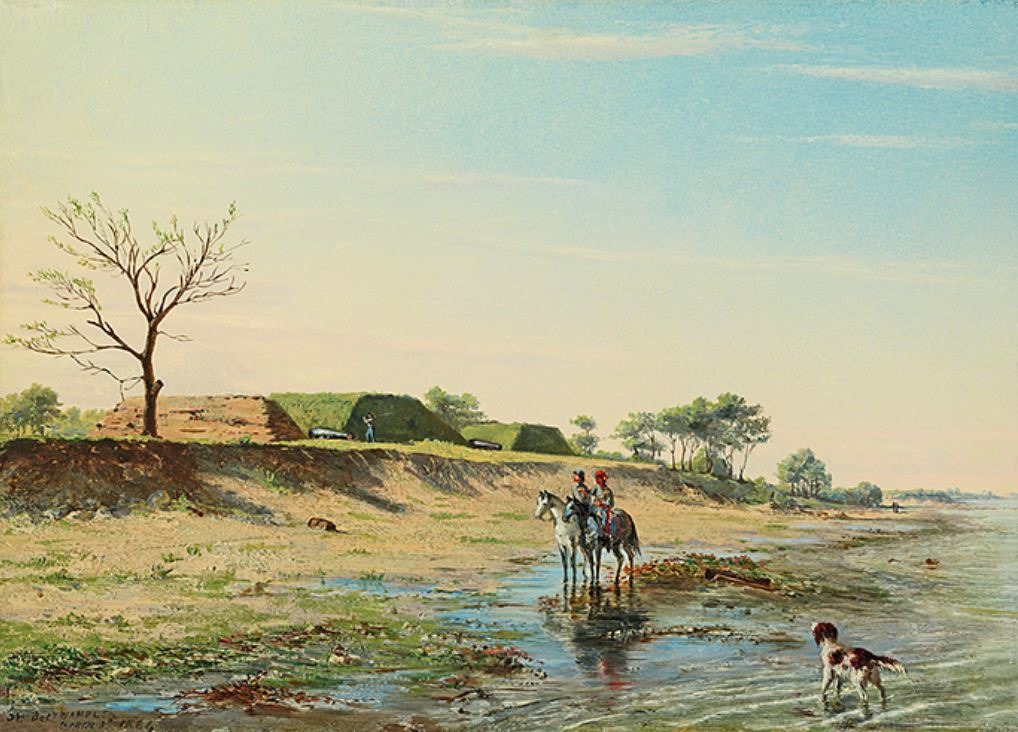
Painting by Conrad Wise Chapman.
This battery was on James Island; of the two figures on horesback, one was an officer of the regular artillery, and one an officer of the regular infantry of the Confederate States. – Conrad Wise Chapman, 1898.
by John Beauchamp Jones
MARCH 4TH.—Bright and frosty in the morning; warm and cloudy in the afternoon. The enemy have disappeared.
On the 17th inst., Gen. Lee wrote the Secretary of War that he had received a letter from Gen. Longstreet, asking that Pickett’s Division be in readiness to join him; also that a brigade of Gen. Buckner’s Division, at Dalton, be sent him at once. He says the force immediately in front of him consists of the 4th, 11th, 9th, and 23d corps, besides a large body of cavalry from Middle Tennessee. Gen. Lee says the railroad from Chattanooga to Knoxville, being about completed, will enable the enemy to combine on either Johnston or Longstreet. He (Gen. Lee) says, however, that the 4th and 11th corps are small, and may have been consolidated; the 23d also is small; but he does not know the strength of the enemy. He thinks Pickett’s Division should be sent as desired, and its place filled with troops from South Carolina, etc., where operations will probably soon cease. The Secretary sent this to the President. The President sent it back today, indorsed, “How can Pickett’s Division be replaced?—J. D.”
Henly’s Battalion returned this evening; and Custis can resume his school, unless he should be among the list doomed to the rank in the field, for which he is physically incapable, as Surgeon Garnett, the President’s physician, has certified.
March 4.—The English steamer Don, while attempting to run the blockade of Wilmington, N. C, was captured by the National steamer Pequot—Michael Hahn was installed as Governor of Louisiana, at New-Orleans. An address was made by General Banks, and other interesting ceremonies performed.—Orders requiring the draft to be made on the tenth instant were suspended.
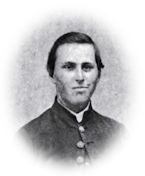
March 4th. Received a number of letters from friends at home. Snow has disappeared. While the weather is fine, the mud is very sticky and plenty of it. A large quantity will stick to one’s feet, or rather to our army brogans, as we attempt to walk in it. This all comes in the life of a soldier. We are not serving our country for pleasure. We are very anxious to have the war stop. We are not in love with the life but the war must be stopped right, so that we can have a free country.
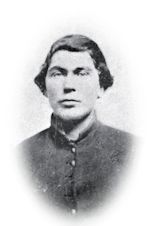
Huntsville, Thursday, March 3. A pleasant day. Off duty at 9 A. M. Did not come on till six hours hence according to regulations. A very heavy detail sent foraging with brigade teams, ours being allowed a short rest. Policing in the afternoon. J. M. Hood was to-day appointed orderly sergeant; Corporal Alba Sweet, 6th sergeant, vice Hood promoted; private Malish, corporal, vice Sweet promoted; Sergeant Hauxhurst court-martialed to-day; charges, refusing to obey Sergeant Hood’s orders. The result I have not learned. He is able to defend his case I think, able to prove much that the officers don’t like.
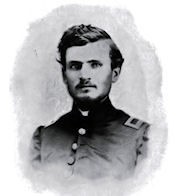
3rd. Spent the morning at home. In evening called upon Fannie Henderson. To my joy a letter from F. came this P. M.
March 3 — A flying report came to camp to-day that the raiders were again advancing on Charlottesville. We hitched up hurriedly on the strength of the report, and were ready with our guns to give them an old Virginia greeting, with shot and shell mixed in it. The report proved to be false, as there were no Yankees in sight or hearing, and we settled down again in the ashes of our old winter quarters.
March 3d.
I have been a little “off my feed” for three or four days past. Not sick—only a little overworked. A patient by the name of Hooper was assigned to my ward on the 15th of last month. His disease was typhoid fever of a virulent type. He was “out of his head” and very violent. He required the constant attention of two strong men. I dared not leave him to the doubtful care of nurses, consequently for twelve days and nights my eyes were seldom off him, or them. No one—not even the Doctor—thought he could live; but God was pleased to spare him “yet a little longer.” The twelfth day he slept, for the first time, and when he awoke, after a few hours of quiet sleep, he awoke to reason—but oh, so weak. His poor, worn-out body scarcely retained the breath of life. Carefully I watched each fluttering pulsation, administering stimulants as required, and by morning felt that he would live. All he needed now was care, and for three days more I watched and waited, until the Doctor pronounced him out of danger.
Then, when I would have slept, I could not. For three nights I hardly slept at all, and I tried so hard.
Yesterday I took plenty of quinine, and had a good night’s rest last night, and awakened this morning much refreshed.


