Following the American Civil War Sesquicentennial with day by day writings of the time, currently 1863.

April 2014

April 21— Took stage this morning at New Market and arrived in Staunton at sunset. When I got on the stage this morning I noticed a man on it wearing a Yankee uniform. He asked me whether I was going to Lee’s army; I told him that was my destination. He remarked then that there would be some hard fighting this spring and summer, as their side was making great preparations for an aggressive, vigorous, and an active campaign, by filling up their regiments with new recruits, and, if anything, were increasing the size of their armies. He was in good humor, and I saw that he was no prisoner. I asked him what he was doing here in Dixie, and where he was going. He said that he was very tired of war and that he knew that there would be a great deal of hard marching and hot fighting this year, and the easiest way out of it all would be to desert and come South, which he did; and was now on his way to the south side of the Virginia Central Railroad, where, he said, Yankee deserters are allowed to roam at will.

I put up for the night at the American Hotel, but just for lodging, as meals cost five dollars and my pocketbook is now struggling in the last stage of consumption, and I am almost certain that the consumption will be sure to win, especially if I would do any eating at this house, as one meal would clean me up on the currency question until next pay-day. This is a beautiful, bright, balmy, spring night. Luna, queen of the stars, is sailing in a cerulean sea full of diamond-like isles, and not a single speck of cloud or mist stains the azure dome. The roofs and the spires and the verdant hills that are piled up around Staunton all glow and shimmer in a silvery sea of moonlight. After nightfall I strolled through the principal streets, most of which as they approach the suburbs bend skyward as they mount the encircling hills.

I saw the lunatic asylum, institute for the blind, and the deaf and dumb asylum — all good substantial brick structures.
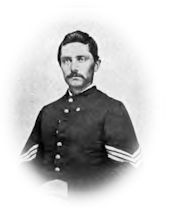
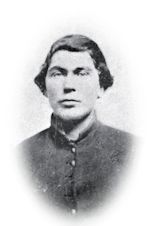
Thursday, 21st—This is a warm, pleasant day and I bade farewell to my home folks and friends and started back to the army, my thirty-day furlough being almost up. I went on horseback, brother John going along as far as Allen’s Grove, to Uncle John Moore’s to remain over night, while John returned home, taking back the horse which I rode. Though the spring has been very late, the farmers here have all their small grain in and it is starting fine. The country around Allen’s Grove is very nice farming land; it is rolling, with plenty of timber and close to a good market; it is becoming very thickly settled. Scott county, Iowa.

Huntsville, Thursday, April 21. Awoke this morning with eyes heavily sealed and jaw from which the tooth was taken swollen to a mouthful. Felt very well otherwise. Pleasant ride to the spring in the morning. Returned in time to fall in for policing, a big job, very dusty and wind blowing. Did not get through till noon. Artillery firing heard this afternoon, at times very rapidly. Gunboat on Tennessee River it is said. Skirmish in vicinity of Decatur continues.

April 21, Thursday. There was a pleasant party at our house last evening, with an attendance of about three hundred. All passed off pleasantly, and all who expressed themselves seemed much gratified, as we were. It is spoken of as one of the most agreeable parties of the season.

Olcott and Wilson were here on Tuesday. The former is very full of frauds in Boston and is rabid to be at the books of certain parties. The man has an insatiate appetite to get on the track of suspected parties. He shows not only keen scent but much sagacity. Mr. Wilson has his charges and specifications against the parties in New York prepared and in the hands of the copyists.

April 21.—Major-General Peck issued the following general order at Newbern, N. C, this day: “With feelings of the deepest sorrow, the Commanding General announces the fall of Plymouth, N. C, and the capture of its gallant commander, Brigadier-General H. W. Wessells, and his command. This result, however, did not obtain until after the most gallant and determined resistance had been made. Five times the enemy stormed the lines of the General, and as many times were they handsomely repulsed with great slaughter, and but for the powerful assistance of the rebel iron-clad ram and the floating sharp-shooter battery, the Cotton Plant, Plymouth would still have been in our hands. For their noble defence, the gallant General Wessells and his brave band have and deserve the warmest thanks of the whole country, while all will sympathize with them in their misfortune.

“To the officers and men of the navy, the Commanding General renders his thanks for their hearty cooperation with the army, and the bravery, determination, and courage that marked their part of the unequal contest. With sorrow he records the death of the noble sailor and gallant patriot, Lieutenant Commander C. W. Flusser, United States navy, who in the heat of battle fell dead on the deck of his ship, with the lanyard of his gun in his hand.

“The Commanding General believes that these misfortunes will tend not to discourage the troops, but to nerve the army of North-Carolina to equal deeds of bravery and gallantry hereafter.

“Until further orders, the headquarters of the sub-district of the Albemarle will be at Roanoke Island. The command devolves upon Colonel D. W. Wardrop, of the Ninety-ninth New-York infantry.”

—The English schooner Laura was captured off Velasco, Texas, by the National gunboat Owasco.—As expedition in boats, from the gunboats Niphon and Fort Jackson, under command of Captain Breck, of the Niphon, proceeded to within seven miles of Wilmington, N. C, where they succeeded in destroying the North-Carolina salt-works and other property valued at over $100,000, and brought away fifty-five prisoners—laborers in the salt-works.

by John Beauchamp Jones

            APRIL 21ST. —Bright sunshine all day, but cool.

            Gen. Bragg received a dispatch to day from Gen. Hoke, of Plymouth, N. C., stating that he had (yesterday) stormedPlymouth, taking 1600 prisoners, 25 cannon, stores, etc. etc. This put the city in as good spirits as possible.

            But the excitement from Hoke’s victory was supplanted by an excitement of another kind. A report was circulated and believed that the President resolved yesterday to remove the government to South Carolina or Alabama ; and the commotion was very great. The President’s salary is insufficient to meet his housekeeping expenditures ; and Mrs. D. has become, very naturally, somewhat indignant at the conduct of the extortioners, and, of course, the President himself partook of the indignation.

            At 2 P.M. to-day the President’s papers came in. Among them was one from the Commissary-General, stating that the present management of railroad transportation would not suffice to subsist the army. This had been referred to Gen. Bragg yesterday (who seems to rank the Secretary of War), and he made an elaborate indorsement thereon. He recommended that all passenger trains be discontinued, except one daily, and on this that government agents, soldiers, etc. have preference ; that arrangements be made at once to hasten on the freight trains (taking military possession of the roads) without breaking bulk ; and finally to reduce consumers here as much as possible by a reduction of civil officers, etc. etc. in the departments—that is, sending to other places such as can perform their duties at distant points. On this the President indorsed a reference to the Secretary of War, requiring his opinion in writing, etc. Since then, the President and cabinet have been in consultation, and we shall probably know the result to-morrow.

            If the departments are sent South, it will cause a prodigious outburst from the press here, and may have a bad, blundering effect on the army in Virginia, composed mostly of Virginians; and Gen. Bragg will have to bear the brunt of it, although the government will be solely responsible.

            Gov. Vance recommended the suspension of conscription in the eastern counties of North Carolina the other day. This paper was referred by the Secretary to the President, by the President to Gen. B. (who is a native of North Carolina), and, seeing what was desired, Gen. B. recommended that the conscription be proceeded with. This may cause Gov. V. to be defeated at the election, and Gen. B. will be roundly abused. He will be unpopular still.

Annapolis, Md., April 20, ’64.

Dear Father, — I am afraid that you will not have a chance to see me before we start. We shall probably leave here before the end of the week. I think letters may be addressed Ninth Army Corps, via Washington. They will probably reach me, where a great many other of my letters have.

We draw shelter tents for our men to-morrow and turn in our A tents. The officers will likewise have to draw shelter tents. Everything points to an active and speedy campaign, and I imagine that a week from to-day, or perhaps two weeks, may see us in a fight. I feel pretty confident that the regiment will do well, and will be an honor to the state. I most certainly hope so.

I am very glad indeed that we have General Stevenson with us. He is to command our brigade and Major General Crittenden our division. General S. is temporarily commanding the division until General Crittenden’s arrival, which gives Colonel G[riswold] our brigade for a few days, and me the command of this regiment.

We leave on Saturday morning at 4 o’clock.

Wednesday, April 20. — Day pleasant. General Stevenson was here in the morning. He takes command of the division temporarily. It is to be commanded by Major General Crittenden. Colonel Griswold is temporarily in command of the brigade. Received orders to be ready to march Saturday morning at 4 A.M. Also to turn in A tents and draw shelter tents. 57th Massachusetts arrived this evening.

20th. Received orders to turn in A Tents and draw shelter tents in readiness to go to Washington for outfit. Went to town late on bus. Drake received commission and Brown acceptance of resignation, good all around. Gave an oyster supper. Was not present.

Camp White, April 20, 1864.

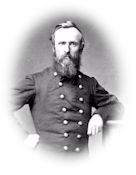
Dear Uncle: — It now seems certain that we are to take an active part in the summer’s campaign. We expect to see some of the severe fighting. The Rebel troops in our front are as good as any, and we shall attempt to push them away. My brigade is three large regiments of infantry, containing a good many new recruits. They have been too much scattered (at ten or twelve places) to be properly drilled and disciplined. Still we have some of the best men in service. Of course, if they should break or falter in action, I will be a good deal exposed, otherwise, not so much as heretofore. Still I have no misgivings on my own account, and even if I had, you know my views of such things well enough to know that it would not disturb me much.

Lucy and the boys will soon go to Chillicothe to stay in that vicinity with or near her relatives. Birch would like to go to Fremont, if his mother could go with him.

Sincerely,

R. B. Hayes.

S. Birchard.