June 17th. Moved forward half a mile on the right of the road, layed all night, the Artillery threw shells over us, at night, which was not very pleasant. Did not have a good night’s rest.
June 2014
Friday, June 17th.
At 5 A. M. the regiment formed in line and marched to a point said to be within a mile and a half of Petersburg, into the streets of which we can look, where we remained for the rest of the day. Captain Jones, of Company D, commanding the Coehorn Mortar Battery, which is not now with the regiment, was killed to-day by a sharpshooter, and I learn that Sergeant Jones, of my company, who was missing after the Spottsylvania fight, was then taken prisoner. While laying out our camp and receiving our much-needed rations, Companies A, B, F, G and H, now numbering about five hundred men, were detailed as a working party to build a line of rifle pits in front of Gen’l Barlow’s position and as near as possible to the rebel outer line, at a point not far from the City Point Railroad. As soon as it became sufficiently dark to partially conceal our movements, we shouldered our muskets and, under command of Major Williams, marched about through the woods until we reached a ravine, into which opened a deep trench or run-way, dry at the time, which came directly down from the rebel lines and formed a sort of covered way, offering complete protection on either side, but so straight that a solid shot traversing it lengthwise would probably have killed every man in it. Up this narrow defile, gradually growing more and more shallow, we crept as noiselessly as we could until we reached a point some twenty yards from the enemy’s line, when we clambered out and, extending to the right and left in single file a few feet apart, began, each man for himself, to sink holes and gradually connect them, until by daylight we had constructed a very respectable rifle pit. An occasional but harmless shot at an officer as his outline was seen against the sky, indicated that our presence was known, but the limited number of shots convinced us that the force in our immediate front was small, as subsequent events proved it to be.

by John Beauchamp Jones
JUNE 17TH.—Clear and pleasant.
A dispatch from Beauregard states that two assaults of the enemy yesterday, at Petersburg, were repulsed with loss; and it is reported that he recovered all lost ground to-day. Yet Beauregard has an enemy in his rear as well as in his front.
When the battles were fought on the south side of the river in May, it appears that one of Gen. B.’s brigadiers (Colston) stopped some battalions on the way to Richmond, in an emergency, and this has certainly given umbrage to the President, as the following indorsement, which I found on a paper to-day, will show:
“No officer has a right to stop troops moving under the orders of superior authority. If he assumes such power, he does it at his hazard, and must be justified by subsequent events rather than by good intentions.
“Gen. Beauregard has, in this case, by approving and continuing the order (Gen. Colston’s) assumed the responsibility of the act. —J. D. June 16th, 1864.”
Near Big Shanty, Ga., June 17, 1864.
Has rained steadily all day, wetting everybody, but “drying up” all shooting. A very disagreeable day. I saw 83 Rebels come in to-day, about one-half of whom were deserters and the rest figured to get captured.
June 16th. Last night some member of our company started a small fire close to the root of a pine tree. It was decayed through the center, which quickly caught fire, the blaze shooting out at the top, like a high chimney. The tree being away up the mountain, the blaze could be seen for miles along the Lynchburg Valley. Attempts were made to put out the fire with dirt.
This morning finds us in the mountains, between the Peaks of Otter, the highest mountains in Virginia. Our signal corps climbed to the top of one of the peaks. We get an early start, on down the mountain over a rough stony road. At the same time we get a grand view of the surrounding country. It certainly is fine. Good growing crops in all directions. Passed through a large peanut field. The vines were fine but not much left of them after the army had passed through the field. The advance are skirmishing, as we can plainly hear. Fifteen miles from the Peaks of Otter, we pass through the town of Liberty, after a hot, dusty march. Out on the Lynchburg Pike we go. Hungry, tired, foot-sore, we stop for the night in a cornfield, near New London, after a march of about twenty-four miles. Sharp skirmishing kept up all day, showing the enemy is contesting our advance on Lynchburg. We hear it reported that the Yankee army has never visited this section of Virginia before. With us, it is now on for Lynchburg, which we seem confident that we can capture. We hope so.

16th. Engineer Corps came out and made fortifications. 2nd had strong works. Co. D left in a fort thing built by Co. in evening over night. Just at dusk before regt. fell back, rebels came out to open place and we gave them a volley. Co. D withdrew to works soon after daylight—rebs appearing in force. Great deal of sport. Rebs came down to mill. Our boys would fire and they would aim to kill. Dropped one horse and probably one man. Withdrew at dark to Charles City Landing, arriving at 3 A. M., horses having remained under the saddle 108 hours with no feed and little grazing, horses very weak. Report that Petersburg had been captured —false.

Thursday, 16th—Skirmishing commenced again early this morning. The rebel batteries off on the left would fire a round or two and just as soon as our guns would open on them they would stop firing. General Leggett’s Division on the left drove the rebels back about a mile, and there was some very heavy cannonading in the afternoon on the right, where it is reported that General Thomas made a charge on the rebels’ left, around the rear and got possession of Pine Hills. It was reported that at one point a rebel regiment, the Forty-third Mississippi, was ordered to make a charge on our lines and when they started their colonel ordered them to reverse arms, and they came marching right into our lines, surrendering themselves as prisoners of war. While our men were making demonstrations all along the line yesterday, about one thousand rebels were taken prisoners, some of them surrendering without firing a gun. They said that there was a great discontent in the ranks of their army around Atlanta: that they were tired of continually falling back, and that many had come to the conclusion that the war on their part could be nothing else than a failure. Company E is lying quiet today. The rough treatment we experienced yesterday was a hard blow to the company, for the loss of nine men from one company in a skirmish line, in less than four hours, does not often happen.[1]
[1] Our losses were as follows: William Alexander, killed; Lieutenant Alfred Carey, mortally wounded; John Zitler, a thumb shot oft; Thomas R. McConnell, a minie ball passed through thigh; John Ford, LeRoy Douglas, George G. Main and John Albin, slightly wounded. James Martin, it was thought at the time, had been taken prisoner, but on the fifth day after the skirmish his body was found by an Ohio regiment, lying with the bodies of two Confederate soldiers. They had made Martin a prisoner, it seems, but before they could get to the rear with him, a shell from one of our batteries exploded over them, killing all three. Then, as they were considerably back from our lines, the body was not found until the enemy had fallen back and our army had advanced; besides, our brigade in the meantime had moved two miles to the left.
Martin had both legs cut off by the shell. A captain from the Ohio regiment which had found his body, brought his silver watch, Bible, some letters and other articles found on his person, and turned them over to our captain, informing him how Martin, in all probability, lost his life.—A. G. D.
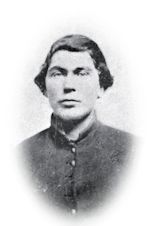
Huntsville, Thursday, June 16. Pleasant day. All quiet. 10th Minnesota arrived by rail 9 A. M. 3rd Brigade marched in from Decatur 3 P. M. Roddey made a dash upon the place before they were barely out of sight, driving the 100-day men inside their works, and the Brigade of Dodge’s Corps had to go back and drive them off. General hospital is being moved, patients sent North and the stores and goods farther south. Visited the pest hospital in the evening, where two of our boys are lying. Had quite a homelike appearance compared with that I laid in at Corinth, more clean, having soft beds and good treatment.
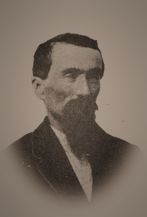
June 16 — We received ammunition for the first gun yesterday evening, and early this morning we left camp for the front, to rejoin the rest of the battery. We passed Beaver Dam Station early this morning, then marched in an eastern direction all day; we forded the North Anna river at Alexander’s mill just above Chilesburg, a small village in the southwestern edge of Caroline County. We passed St. Paul’s Church, situated in a beautiful grove half mile east of Chilesburg. We marched hard all day. Camped this evening at Mount Carmel Church, in Caroline County, about six miles north of Hanover Junction.
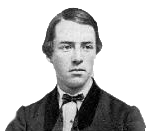
June 16. —We marched all last night, and all to-day until 6 P.M., when we went into position behind General Potter, on the left of our line in front of Petersburg. Heard that the 5th Cavalry did well. Col. Henry S. Russell was wounded slightly in the shoulder. We carried their first line of works, and took 18 guns.[1]
[1] This was the beginning of the investment of Petersburg.


