Following the American Civil War Sesquicentennial with day by day writings of the time, currently 1863.

July 2014

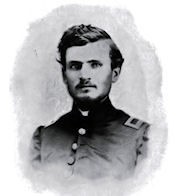
Colonel Lyon’s Letters.


Claysville, Ala., Fri., July 15, 1864 (at sunrise).— You will think it strange that I am writing to you at this time of day. I will tell you how it happened. I got back from my trip, concerning which I have already written you, yesterday afternoon, and went to bed at nine last night, very tired and sleepy, I assure you. Between 11 and 12 o’clock Johnny (my orderly) burst into my room with, ‘Colonel, the rebels are crossing the river with a large force down at the landing.’ (This is where Lieut. Fish is stationed, one mile from headquarters.) I was sleeping very soundly, but managed to tumble out of bed, wondering why they couldn’t just as well have waited until morning. So I dressed, and Jerry saddled the horse, and off the Adjutant and I galloped to the river (I am getting to be a famous horseman). There we found every evidence that there was a large force, and a very demonstrative one, on the other bank. We supposed that they had artillery from the noise made by their wagon train. So we went to work collecting our men, notifying the other companies on the river, sending out scouts and patrols, and making every possible arrangement for the battle that we expected to fight at daylight this morning. But daylight came and revealed to us a large force on the other side of the river, but the men were all in blue.

It turned out to be a large scout from Decatur, of which we had received no notice. We the more readily believed it a rebel force from the fact that only last Tuesday morning Lieut. Fish was across the river with only eight men and was attacked by between forty and fifty rebel cavalry, fought them, and with the aid of a few of our men, who succeeded in getting on an island near by, whipped them handsomely. The rebels admit a loss of three killed and four wounded. Not a man of ours received a scratch. It was almost a miracle.

I wondered often during the night what you would think had you known that we were passing the hours of the night in the trenches, expecting a fight in the morning; but the luck of the 13th still clings to them, and nobody is hurt.

The force on the other side sent over a wounded officer, and behold, it was Captain Wilcox, of the 5th Iowa Cavalry, an old friend. He got a charge of buckshot in the hip the other day on a raid south of this. He is doing well.

I find on going to my room that Jerry has packed and boxed all of my traps, and had them ready to load on the wagon in case we were worsted. I gave him no directions about them—did not even think of them. During the night, the Adjutant, who remained at headquarters, tells me, Jerry volunteered to go one and a half miles alone to call in an outpost, and went. He was as cool and brave as any of the soldiers.
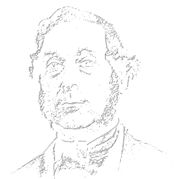
by John Beauchamp Jones

            JULY 15TH.—Clear and cool; subsequently cloudy.

            The Washington Chronicle of the 12th, received yesterday, indicates that Washington or Baltimore, or both, were in danger of falling into our possession.

            Lieut.-Col. G. W. Lay said, this morning, in my office, that Grant would not leave—that he held a most important position—that he would not fail in his campaign; that our operations beyond the Potomac were not of sufficient magnitude to produce important results; and, finally, that Germany and Ireland would replenish the armies of the United States, while our last reserves were now in the field. The colonel had come into my office more than a month ago and said Grant had outgeneraled Pemberton, and would captureVicksburg. I reminded him of this to-day, and asked his opinion on the present aspect of affairs. He has been recently on Gen. Beauregard’s staff, and is irritated at the supposed hard treatment which that general receives from the President. He is a little bitter against the President, and is no special admirer of Lee, who, he thinks, committed a blunder in not fighting Grant at Hanover Junction. And he thinks, if Gen. Johnston forbears to fightSherman, in pursuance of orders fromRichmond, disaster will ensue. But neither he nor any one is capable of sounding the profound plans of Lee. Grant’s forces are now far away fromWashington.

            2½ o’clock P.M. An officer just fromPetersburg, arrived at the War Department with the intelligence that aWashington paper of the 13th inst. had been received at headquarters, announcing the capture of BALTIMORE by our troops! The inhabitants within, or a large proportion of them, co-operated with our army! Our people are in ecstasies! This is the realization of the grand conception of a great general, and Lee is immortalized—if it only be true.

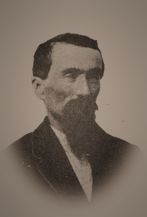
Etowah Bridge, Friday, July 15. Grazed in forenoon. Detail and three wagons sent out after oats. Harvested it and brought it to camp. Fed to horses in evening. Found plenty four miles down the river. Brought back piles of apples. No break in the monotony of camp. Evans obtained pass for himself and eight men to go outside pickets to pick blackberries. Spencer, Evans, D. Wallace, Hayes and myself started one morning, followed the secesh railroad running up south side of river to iron works. Walked about five miles, saw a large flouring mill and rolling mills, two of the largest water powers I ever saw, all the works completely destroyed.

Crossed over mountains, through gorges, till at last found blackberries with no ending. Eyes could not wish for more Surrounded by the wildest of hills, but little trace of civilization. We picked our dishes full. I picked nine quarts in about two hours. Awful warm, sweat more than I ever did in August field. Reached camp but little before retreat. Tired and loaded down with berries. Our mess at night ate nearly one-half bushel of berries. Ate till nearly sick. Whew! what a country.

July 15th. Came off picket very early. A fine morning. The army again on the march. Our regiment in the rear, waiting for orders. Passed through Knoxville, pushing on to Berlin, Maryland. Coming to a halt discovered the advance wading the Potomac River, over into Virginia, the Loudon Valley country. At this point there was a stony ridge running diagonal across the river. At low water it could be forded. At this time the water was about waist deep and the stones were very slippery. In order to keep our ammunition and rations dry we carried our equipments and haversacks fastened to the muzzle of our muskets, over our shoulder. Some of the boys lost their footing, went down under the water, getting a ducking. There was much laughing, joking, and shouting, in spite of the wetting we were all getting. On reaching the Virginia shore no time to halt, not even to stop and pour the water out of our shoes. Must push on in our wet clothes over dusty roads which soon formed a mud covering. After a time our clothes began to dry as we marched on in the hot sun, the dirt dropping off. By night our clothes were all dry and we were all in better spirits. Many reports are in circulation that we are following on after the rebs under the command of Jubal Early, who have been raiding into Maryland. Late tonight camp near Hillsborough.

Friday, 15th—There is nothing new. We have very poor food here in the hospital, but we have good water. Rome was selected for our field hospital because of the good water and because it was on high, rolling ground, thus affording drainage. There are very few citizens living in Rome, they having gone before our army took possession of the town, some going to the North, others to the South. There was no burning of property here, our officers having placed guards about town to prevent it.

Thursday, July 14. — Shelled again to-day. Troops were up all night expecting an attack, as a deserter came in and said that a great many more would come in if we would throw up rockets. We saw rockets thrown up, but whether the deserters came or not, I don’t know. Day pleasant.

Thursday, July 14th.

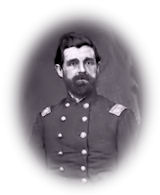
Ten companies of the regiment under Lieut. Col. Alcock were to-day ordered to report to General Hunt, Chief of Artillery of the Army of the Potomac, and were assigned to the Siege Train, Col. Henry S. Abbott commanding, and as soon as other infantry troops arrived to take our place on the lines, we moved to a point in the woods near the Engineers and laid out our first regular camp since we left Culpepper. This is the ninth disposition that has been made of my battalion since we left Fort Marcy, but the officers and men feel particularly elated that the regiment, or the greater part of it, has been brought together, and that at last, after losing more than half of our men, we are to be permitted to perform the duty for which we enlisted, and we wonder whether our letter to the President had anything to do with this assignment but, of course, we shall never know.

14th. Papers of the 13th. Grand panic in Baltimore and Washington.

July 14th. We have to turn out at daylight. Soon after rations, again in line and marching. We are getting very ragged. Many are barefooted. Clothes will wear out in this rough life. Pushing along. Marched over Bolivar Heights, down through Harper’s Ferry, over the Potomac River on the railroad bridge, into Maryland, taking the river road along the canal through Sandy Hook, camping near Knoxville. A mail received. Very tired tonight. It is thought we have marched about fifteen miles. Detailed for picket.

July 14 — We are still quietly camping on the Nottoway.