
July 13th. Moved 2½ miles to the right, at 7 A.m. Had to pick our way, the dust so thick could not see far ahead. Had the sun as usual.
July 2014
July 13, 1864.
We passed through Marietta this morning at 9; rested in a cool, nice, woody place from 11 to 2, and made this place in the cool of the evening. We marched about 14 miles today. I would rather be in a fight than endure such a day’s march, and I think fighting lacks very much as deserving to rank as amusement.
I saw a number of cases of congestion of the brain, and a few had real sun stroke. Saw one poor fellow in a graveyard between two little picketed graves, who I made sure was gasping his last. Some heartless fellow made a remark as we passed about his luck in getting sun struck so near good burying facilities. After one heat of only three miles the regiment had all fallen out but about 50 men, and we had more than any other in the brigade. If we had been given one hour more in rests, we would not have lost a man.

by John Beauchamp Jones
JULY 13TH.—Bright and pleasant.
The city is in great excitement and joy. Gen. Early has gained a victory in Maryland, near Frederick, defeating Gen. Wallace, capturing Gen. Tyler and Col. Seward (son of the Secretary), besides many prisoners. The slaughter was great, and the pursuit of the routed army was towardBALTIMORE.
Grant is certainly sending away troops.
Gen. Lee writes a particular letter to the Secretary (dated 9th inst.), desiring most specially that the papers be requested to say nothing of his movements for some time to come, and that the department will not publish any communication from him, which might indicate from its date his distance from Richmond. This is mysterious. He may be going toMaryland.
Gen. Johnston telegraphs from nearAtlanta that the enemy holds several fords above, and a portion of his forces have crossed, and are intrenched. Some cannonading is going on—ineffective aimed at the railroad depot. Some think Lee is going thither. Others that he is going to flank what remains of the Federal army in front ofPetersburg.
Etowah Bridge, Ga., Wednesday, July 13. Up early. Moved 6 A. M. 4th Minnesota, 18th Wisconsin, 80th Ohio and 12th Battery moved on to Allatoona, four miles further on. We went into a fort on a steep cliff or point on the Etowah River and commanding the railroad bridge seventy feet high, erected by Sherman’s Construction Corps. Found everything ready for us, a luck we never before met with, strong fortifications already built, good and neat shebangs, horse-sheds for most of the horses made of lumber, stalls and mangers all ready, and in a few minutes we were as much at home as though we had worked a week. The scenery here is romantic and I hope we may stay here for a time at least. Bathed in the river early evening. Pretty stream.
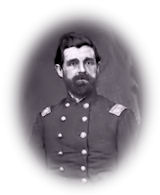
Colonel Lyon’s Letters.
Clarksville, Ala., July 13, 1864.—Here I am, tired as a dog. I left Claysville yesterday morning and have just got here, having traveled over mountains, through swamps and canebrakes, escorted by about 30 Union guerillas, or home guards.
Stayed last night at Company D’s, and expect to get back there tonight, and home tomorrow night. This point is on the Tennessee river, half way between Flint and Paintrock rivers, and some 20 miles below Claysville. It is the headquarters of Company F, Captain Hart.
I have passed through some wild, magnificent scenery on this trip, which I have no time to describe. I can write but little this time, but was not willing to let this anniversary of your birthday pass without letting you know that I remembered it.

Wednesday, 13th—There are a great many sick and wounded at this place. All of the vacant store buildings are filled with the sick, while the wounded are cared for in tents east of town. Nothing of any importance.

Headquarters 56th Mass. Vols.,
Near Petersburg, Va., July 12, ’64.
Dear Father, — . . . Lee seems to be playing a bold game. The rumors are that all his old army have gone up into Maryland, and that Beauregard’s men are left in our front. If true, I suppose we shall have another campaign in Maryland and Penn. One consolation is that our men fight much better there than they do here.
Please tell Hannah that I received the letter she sent by Colonel Bartlett this afternoon. It was forwarded by him. He apologized for not being able to deliver it in person.
Will you please collect any money that may be due me from my bond or railroad shares, and divide it between Hannah and Alice. They can use it to help pay for going to the sea-shore, or in any other way they see fit. Now that things are so high, I imagine that it will be acceptable to them. I enclose the orders for the money.
I received a letter from —— yesterday. I cannot like her. It seems to me that she likes to parade her sufferings to every one. I am sorry for her, although I must say that I dislike her as a woman extremely.
We move out to the front line to-night and remain there four days.
I went to General Meade’s headquarters last night, and saw all my friends there. I then went into General Meade’s tent with Captain Bache, and called on him. He remembered me, much to my astonishment, and we had quite a pleasant conversation for 15 minutes.
I saw George Barnard and Tom Sherwin yesterday. Both were well. . .
Tuesday, July 12. — Lieutenant French was wounded in the side to-day. Also a man named Kurtz in A Company, in the face. We moved to the front line in the evening. One of the color-guard was killed while we were moving out. Lieutenant Lipp and Captain Fay went to City Point.

12th. Drew and issued clothing. Very sultry day. Sprinkled this morning and tonight. Wrote to Tom Wood’s wife. Nettleton went to Point. Good many rumors about our going away North, and others.

July 12.— Our hospital is filled with sick and wounded. The army is now eight miles east of Atlanta. The enemy have driven it back step by step. General Johnston has given up every stronghold. All are now breathless with expectation, waiting to see what move he will make next. There is much conjecturing on the subject. Few seem to have lost confidence in General J.; they think he is acting as well as he can with his means.
We have had some desperately fought battles lately; our side does not lose nearly as many as the enemy.
We have a captain from Tennessee who lost a leg at the battle of New Hope Church. He was for some time a prisoner, and was sent through the lines. He says he saw the dead of the enemy at New Hope Church, and at some places they were piled six deep. They told him that in every battle fought lately they had lost at least five to our one.
As the army has moved east of us, this part of the country is left open, so the enemy can pay us a visit any time they please. It is a moral impossibility for our army to protect the whole country. The enemy have Rome, and they have hung some of the first citizens of the place. Not a day passes but we hear of some brutal outrage committed by these vandals. I have been told that when they reached Cassville the town was given up for them to sack. The whole place has been laid in ruins, and other outrages committed, all because some of the ladies thoughtlessly insulted the prisoners who passed through there about two years ago. We daily see droves of wagons passing, filled with people who have been driven from their homes by the ruthless invader.
We have a very nice old man—Mr. Yerby—who is forager and a little of every thing else; we call him our right-hand man. When we want any thing extra done, or any particular message carried, we call on him. He is friendly with all the country people, and if there is a possible chance of getting any thing from them he gets it. Many a bundle of nice rags he brings us, and a great treat they are. He entered the service at the commencement of the war, and he has two sons in it; one of whom is a prisoner, and he has not heard from him for many a day.
A day or two ago he heard of the death of a young brother, who had just received a commission.
Lately he received a letter from a sister, living in Athens, Georgia, informing him that her cousin, living near there, an old man, between seventy and eighty years of age, was riding in a wagon, when he was accosted by some Federal cavalry, who ordered him out of his wagon, and took all he had from him. They unharnessed his horse, and put a negro who was with him on it, and made the old man walk along side of the negro. He remonstrated, and the vandals beat him; then placed him on an old unsaddled mule, and carried him off. These valiant knights, who war so bravely on helpless old age, women, and children, have sent this old man to a prison in the North.
Our men are not all killed off yet; if these heroes wish to display their valor they will find a few who are ready to combat with them. How hard it is for us to know of these outrages, without the bitterest and most deadly hatred being aroused against these fiends in human shape.
If there was ever one spark of Union feeling in the breast of the Georgians, surely this will extinguish it.
We have a number of Louisianians, members of Point Coupee Battery. Like all from that state, they are very clannish. One, Mr. Dodart, ever since the war commenced, has fought side by side with his son. Poor man I ho can scarcely restrain the tears when he talks about his wife and children, who are now in New Orleans. Another of them, Mr. Lambert, informed me that in coming through Alabama, I think near Demopolis, the battery encamped a few days near the house of a wealthy lady. She very kindly invited them to spend the evening at her house, and entertained them very handsomely. She told them that a few days previous an Alabama battery had been there, and by their misbehavior had frightened all who came in contact with them.
Among these Louisianians is a little boy; I am told he is as brave as any of them, and has done good service in the field.


