
Wednesday, August 10. — Colonel Marshall was appointed commandant of the prison by order of Captain Senn. Had a game of whist with the navy. Nothing new from Mobile.
August 2014
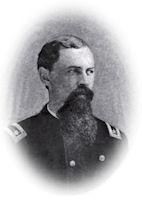
August 10, 1864.
Our “color” that has floated over the 103d for nearly two years has become much worn and torn. One shell and bullets innumerable have passed through it. It is entitled to be inscribed with the following battles: Vicksburg, Black River, Jackson, Miss., Mission Ridge, Dalton, Resaca, Dallas, New Hope, Big Shanty, Kenesaw Mountain, Atlanta. It has been under the enemy’s fire 72 days on this campaign. Nearly 300 of the regiment have fallen under it.
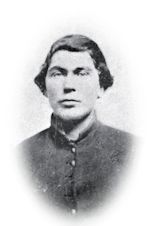
Etowah Bridge, Wednesday, Aug. 10. On guard, second relief. Two men under arrest again. Such cases getting frequent. Rainy afternoon. No mail nor papers. All healthy, corn and peaches in plenty.
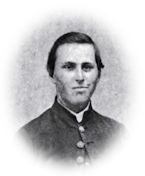
August 10th. A hot morning. Marching orders came early, to be ready to march at the report of a signal gun. It will be our first movement under the command of General Sheridan. The advance is in three grand divisions, the 19th Corps on the right, the 6th center, the 8th on the left along the river road. Signal Corps and cavalry on the advance. A part of the time we advance in line of battle. We watch, but do not understand, the work of the Signal Corps. Those boys seem to find the highest hills to work from. After advancing about ten miles, ordered to camp for the night. While all is quiet we are reminded there is trouble brewing for us. The boys talk and discuss all the movements of the day, as night comes on, and wonder what the morrow will bring.

by John Beauchamp Jones
AUGUST 10TH.—Hot and dry until 4 P.M. Gust, and 15 minutes’ rain. Good for turnips.
Forts Gaines and Powell are lost—the latter blown up. Gen. Maury telegraphs for infantry, has some 4000 men for the defense ofMobile, etc.
Our raiders, under McCausland and Bradley Johnson, it is said were surprised and defeated last Sunday, with loss of 400 men, 500 horses, and 4 pieces of artillery. A rumor prevails that Early has gained another victory nearWinchester.
No news yet from our agent sent to North Carolina to purchase supplies, but we learn flour and bacon are not held one-quarter as high there as here. I do sincerely hope Grant’s raiders will keep quiet until I can get something to eat!
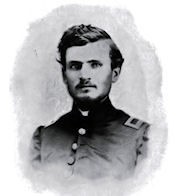
9th. Tuesday. Thede sold his horse. Went over to town and procured some clothing.
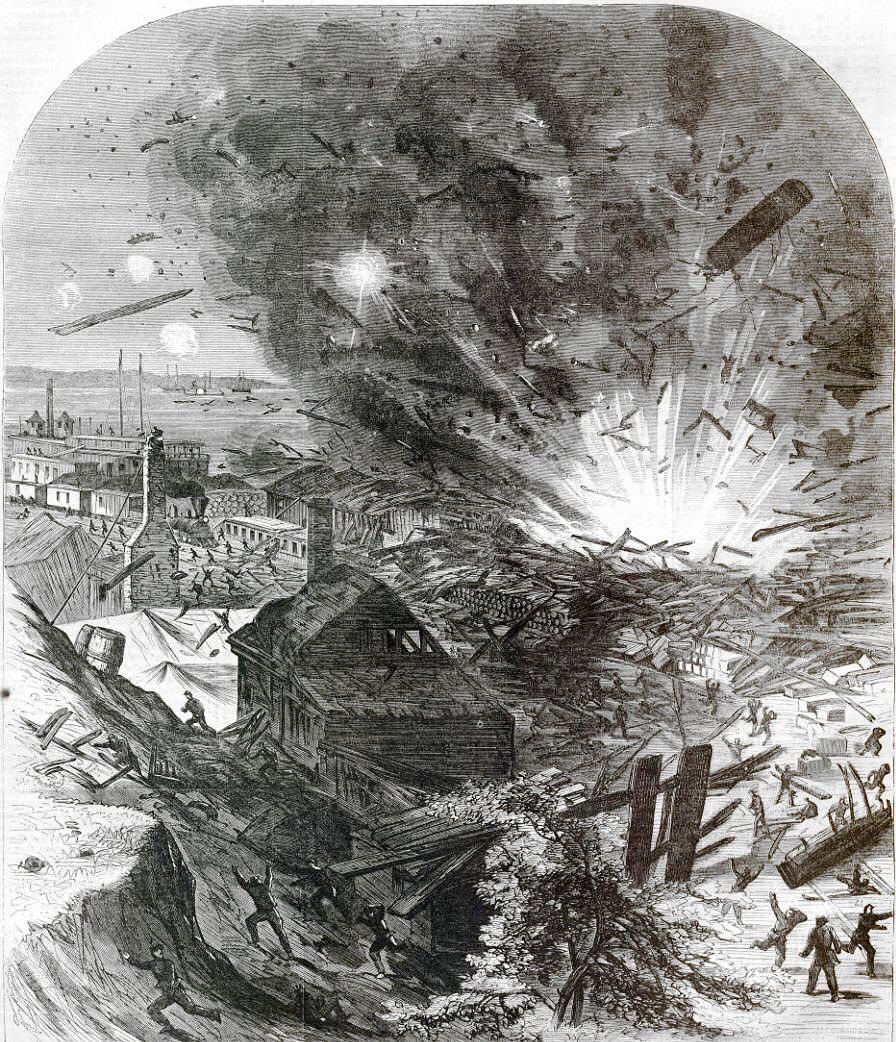 Richmond, December 16, 1864.
Captain: I have the honor to report that in obedience, to your order, and with the means and equipment furnished me by you, I left this city 26th of July last, for the line of the James River, to operate with the Horological torpedo against the enemy’s vessels navigating that river. I had with me Mr. K. K. Hillard, who was well acquainted with the localities, and whose services I engaged for the expedition. On arriving in Isle of Wight County, on the 2d of August, we learned of immense supplies of stores being landed at City Point, and for the purpose, by stratagem, of introducing our machine upon the vessels there discharging stores, started for that point. We reached there before daybreak on the 9th of August last, with a small amount of provisions, having traveled mostly by night and crawled upon our knees to pass the east picket-line. Requesting my companion to remain behind about half a mile I approached cautiously the wharf, with my machine and powder covered by a small box. Finding the captain had come ashore from a barge then at the wharf, I seized the occasion to hurry forward with my box. Being halted by one of the wharf sentinels I succeeded in passing him by representing that the captain had ordered me to convey the box on board. Hailing a man from the barge I put the machine in motion and gave it in his charge. He carried it aboard. The magazine contained about twelve pounds of powder. Rejoining my companion, we retired to a safe distance to witness the effect of our effort. In about an hour the explosion occurred. Its effect was communicated to another barge beyond the one operated upon and also to a large wharf building containing their stores (enemy’s), which was totally destroyed. The scene was terrific, and the effect deafened my companion to an extent from which he has not recovered. My own person was severely shocked, but I am thankful to Providence that we have both escaped without lasting injury. We obtained and refer you to the inclosed slips* from the enemy’s newspapers, which afford their testimony of the terrible effects of this blow. The enemy estimates the loss of life at 58 killed and 126 wounded, but we have reason to believe it greatly exceeded that. The pecuniary damage we heard estimated at $4,000,000, but, of course, we can give you no account of the extent of it exactly.
I may be permitted, captain, here to remark that in the enemy’s statement a party of ladies, it seems, were killed by this explosion. It is saddening to me to realize the fact that the terrible effects of war induce such consequence; but when I remember the ordeal to which our own women have been subjected, and the barbarities of the enemy’s crusade against us and them, my feelings are relieved by the reflection that while this catastrophe was not intended by us, it amounts only, in the providence of God, to just retaliation.
This being accomplished, we returned to the objects of our original expedition. We learned that a vessel (the Jane Duffield) was in Warwick River, and with the assistance of Acting Master W. H. Hinds, of the C. S. Navy, joined a volunteer party to capture her. She was boarded on the 17th of September last, and taken without resistance. We did not destroy her, because of the effect it might have had on the neighboring citizens and our own further operations. At the instance of the captain she was bonded, he offering as a hostage, in the nature of security to the bond, one of his crew, who is now held as a prisoner of war on this condition in this city.
In the meanwhile we operated on the James as the weather and moon co-operated, but without other success than the fear with which the enemy advanced, and the consequent retarding of his movements on the river. We neared success on several occasions. Finding our plan of operations discovered by the enemy, and our persons made known and pursued by troops landed from their boats at Smithfield, we deemed it best to suspend operations in that quarter and return to report to you officially our labors. Your orders were to remain in the enemy’s lines as long as we could do so; but I trust this conduct will meet your approval. The material unused has been safely concealed.
I have thus, captain, presented you in detail the operations conducted under your orders and the auspices of your company, and await further orders.
Very respectfully, your obedient servant,
John Maxwell.
Capt. Z. McDaniel.
* Not found.
(First indorsement.]
December 17, 1804.
Respectfully forwarded to Brigadier-General Rains.
Z. McDANIEL, Captain Company A, Secret Service.
[Second indorsement. ]
Hon. Secretary Of War,
Present:
Respectfully forwarded, with remark that John Maxwell and R. K. Dillard were sent by Captain McDaniel into the enemy’s lines by my authority for some such purpose, and the supposition was strong, as soon as the tremendous explosion occurred at City Point on the 9th of August last, that it was done through their agency, but of course no report could be made until the parties returned, which they did on Wednesday last, and gave an account of their proceedings. This succinct narrative is but an epitome of their operations, which necessarily implies secrecy for the advantage of this kind of service as well as their own preservation. John Maxwell is a bold operator and well calculated for such exploits, and also his coadjutor, R. K. Dillard.
G. J. RAINS,
Brigadier- General, Superintendent.
City Point, August 9th, 1864.
A fearful tragedy was enacted here today. A barge, laden with ammunition, was blown to atoms, scattering death and destruction around. How it happened will forever remain a mystery, as not one that was on board lives to tell the tale. Near as can be ascertained at this time, about two hundred were killed and wounded. A vast amount of property was destroyed. Blocks of timber, shells, grape shot and other missiles were thrown over a mile. We are situated about a mile and a half from the landing. I was on my way to the Point; had covered, perhaps, one-half the distance. As I looked toward the landing I saw a lady, mounted on a white horse that belonged to the Commission, ride up the bank from the river and turn in the direction of Grant’s head quarters. I recognized her as a member of the Michigan Relief Society. The horse was a spirited one, and I could but admire the ease and grace with which she restrained him and compelled him to do her bidding. He tossed his beautiful head and spurned the ground beneath his feet as he lightly galloped over the plain.
They had reached a point perhaps half a mile from the landing, when a violent concussion rent the air. From the landing fire, smoke and innumerable missiles were being hurled upward, in a whirling eddy, as from the mouth of a volcano. Heavy timbers and other debris flew over and around me. I looked for the lady on horseback. For an instant I could see nothing in that direction but a swirling cloud of dust; in another instant I saw, through the dispersing gloom, a white horse clearing the ground with rapid strides, and on his back, cool and erect, a lady.
I was afterward informed the lady was Mrs. Wheelock, of Jackson, Michigan, a member of the Michigan Relief Society.
Tuesday, 9th—A train loaded with wounded came in last night from Marietta, Georgia, and they were sent out to the field hospital east of town.
Tuesday, August 9. — Heard of the surrender of Fort Gaines to Powell at Mobile. Some of the officers refused to recognize Colonel Marshall as commandant. Troubled all night by bed-bugs. Had some trouble with Corporal Patterson, who was drunk and wanted to run me through.


