
Monday, August 29. — Rumors about that we have suffered a defeat on the Weldon R. R. with a loss of six thousand prisoners, and that Sherman had retreated. One of the men in the yard escaped, and a tunnel was found leading from their barracks.
August 2014
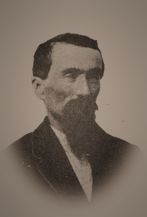
August 1 — To-day we moved back again toward the Nottoway River. This evening we are camped in a low pine woods on the right bank of Stony Creek, west of the Weldon Railroad, and about twenty miles south of Petersburg. The land around camp is poor, some of the fields being nothing but white shiny sand with a few sickly briers scattered over it.
Monday, August 1. — We started at 4 A.M. and marched to the depot of the Petersburg & Danville R.R. where we were put on cars, and started off for Danville at 6.30 o’clock. All along the road we saw traces of Wilson’s raid. At Burkesville Junction we were delayed until late in the evening, on account of a train having been thrown off the track.
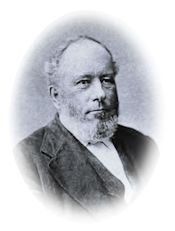
I Receive An Appointment.
August 1. The ward next me on the left is a colored one, and contains from 60 to 80 men, according to recruits and drafts. Until recently they have been pretty much on their own hook, no one seeming to care for them. Some days ago Doctor Sadler asked me if I would take charge of them. I said I should like to do anything where I could be of any use. He gave me my instructions and some blank reports, and set me up in business. My duties are to attend roll-calls, surgeon’s calls, keep an account of arrivals, discharges, desertions, deaths, march them up to the kitchen three times a day for rations and make my report to him every morning. Entering on the discharge of my duties the first thing I did was to set them to work cleaning and fixing up their quarters, so they would be more comfortable.
A couple of hours’ work showed a great improvement in the condition of things, and while it was being done it gave me a chance to find out who among them were the worst off and needed the most care and favors. A sick nigger is a curious institution and you can’t tell so well about him as you can about a sick mule. He can put on the sickest look of anything I ever saw and appear as though he would die in seven minutes, but a nigger is never really sick but once, and is then sure to die. There is no more help for one than there is for a sick pig. I have three that are sick and I have no more faith in their getting well than I have that Gen. Lee will drive Gen. Grant from before Petersburg. Two of them are now unable to attend the surgeon’s call in the morning and the other I expect will be in a few days. I have about 40 hobbling around with canes, spavined, ring-boned and foundered. The others arc simply a little war-worn and tired.
The kitchen is about 30 rods from the camp, and when I march them up there there are so many lame ones they straggle the whole distance. Doctor Sadler called my attention to this and said he should like to see them march in little better order. I replied: “Surgeon, come out in the morning and see the parade; you will see them marching a 28 inch step and closed up to 18 inches from stem to stern.” He promised he would. The next morning at breakfast call I formed every one of those darkies that carried canes on the right, and the very lamest I put at the head of the column, and gave them a send-off. It was a comical show, they marched at the rate of about one mile an hour, and those in the rear kept calling out to those in advance: “Why don ye goo long dar! Hurry up dar; shan’ get breakfas’ fo’ noon.” They kept closed up a good deal better than they kept the step as the rear crowded the advance to push them along. We were cheered along the route as almost everybody was out to see the fun. We marched in review before the doctor, and by the way he laughed and shook himself I thought he was well satisfied with the parade, at any rate he complimented me on my success when I carried in my morning report.
One day one of my fellows came to me for a pass to go fishing. He said he could catch as many bull-heads as would do us two for three days. I gave him a pass, but didn’t see anything of him again for four days. When I asked him where he had been so long, he looked pretty sober for a minute or two, and then rolling around the whites of his eyes and showing his teeth, said: “Yah, yah, yah! ize no idee ize don gon so long; yah, vah, yah.”

Aug. 1st. Started back for our old camp in the woods at 9 A.M. I was detailed to report at Regt. Head Quarters.
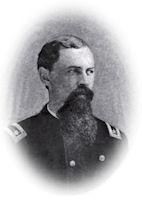
August 1, 1864.
Since the glorious battle of the 28th, everything has been quiet in our immediate front, though the heavy artillery firing continues to the left. I think it is between the 14th and 20th Corps and some Rebel forts. Prisoners say that our shells have hurt the city very much. We all think that the last battle is by far the most brilliant of the campaign. Our officials’ reports show that we buried 1,000 Rebels in front of our and M. L. Smith’s divisions.
In fact, our two divisions and two regiments of Osterhaus’ did all the fighting. Our total loss was less than 550, the Rebels 8,000. In the last 12 days they must have lost 25,000 men. Our loss in the same time will not reach 4,500. There is no shadow of gas in this, as you would know if you could see an unsuccessful charge on works.
The enemy is reported as moving to our right in heavy force.
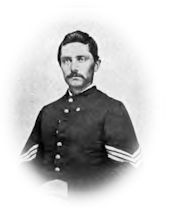
Monday, 1st—Quite warm and sultry. There isn’t any news from the front. There is a force of about two thousand here under command of General Vandever, with an equal number of convalescents. The courthouse, located on the highest point of ground in Rome, is our citadel, strongly fortified with guns facing in all directions. The place is soon to be garrisoned with two regiments of negro troops, and the few remaining citizens are greatly agitated over the thought of being stopped on the streets by negro guards and required to show their passes.
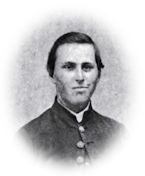
August 1st. Cloudy, muggy morning. After a good night’s rest, am feeling fine. Early on the march. After a march, about four miles, came to a halt on a road leading through woodland of very large trees. Later we camp in the woods, near the town of Wolfsville, Maryland. A report has reached us that the rebs have burned the town of Chambersburg, Pennsylvania. Reported the enemy may come through this section and we may get a crack at them. Infantry cannot pursue cavalry. Mounted men have a great advantage over us fellows on foot. Weather very fine, water very poor, and not very much of it. We appreciate good water, where we can have plenty of it
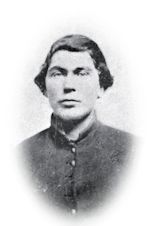
Etowah Bridge, Monday, Aug. 1. On guard, second relief. Health good. Everthing passed off smoothly with the exception of no papers came. By order of General Sherman none to be sold this side of the front, his policy being “those that fight shall read”. Right, and we cannot grumble, but hope they will furnish enough for both soon.

by John Beauchamp Jones
AUGUST 1ST.—Hot and clear; but it rained yesterday three-quarters of an hour in the afternoon.
Our loss in the affair atPetersburg is about 800, the enemy’s 3500. We captured 2000 small arms.
We have nothing yet fromAtlanta, but no doubt there has been another battle. I hope no disaster has befallen us there. No doubt the wires have been cut by the raiders, and roads also. It is a critical time inGeorgia. But ifVirginia triumphs over the assaults of Grant, all will go well.


