Following the American Civil War Sesquicentennial with day by day writings of the time, currently 1863.

A Rebel War Clerk’s Diary at the Confederate States Capital, By John Beauchamp Jones

JULY 13TH.—The Secretary made peace yesterday between the general and the colonel, or a duel might have transpired.

To-day the colonel carried into the Secretary a number of applications for commissions as surgeons. Among the applicants were some of the colonel’s friends. He returned soon after in a rage, slamming the door after him, and then throwing down the papers violently on the floor. He picked them up the next moment, however, and sitting down beside me, became instantaneously as gentle as a dove. He said the men of science were thrust aside to give way to quacks; but, laughing, he remarked that the quacks would do well enough for the wounded——. Our men would have too much sense to submit to their malpractice.

Post image for Rebel War Clerk’s Diary

JULY 12TH.—The colonel’s temper is as variable as an April day—now all smiles and sunshine, but by-and-by a cloud takes all away. He becomes impatient with a long-winded story, told by some business applicant—and storms whenever any one asks him if the Secretary is in.

To-day, for the first time, I detected a smile on the lip of Col. Myers, the Quartermaster-General, as he passed through the office. A moment after, Gen. Walker, of Georgia, came in, and addressed the colonel thus

“Is the Secretary in?”

Col. (with a stare). I don’t know.

Gen. W. (returning the stare). Could you not ascertain for me? I have important business with him; and am here by appointment.

Col. B. You can ascertain for yourself. I am not his door-keeper. There is his door.

Gen. W. (after a moment’s reflection). I asked you a civil question in a courteous manner, and have not deserved this harshness, and will not submit to it.

Col. B. It is not courteous to presume I am acting in the capacity of a messenger or door-keeper.

Just then the Secretary appeared at the door, having heard the loud language, and Gen. W. immediately entered his office.

Afterward the colonel fumed and fretted like an angry volcano. He disliked Col. Myers, and believed he had sent the general in under prompting to annoy him about the Secretary, whom he (Myers) really hated.

JULY 11TH.—The colonel tried his hand to-day at dictating answers to certain letters. Together we pitched upon the proper replies, which, after being marked with his pencil, I elaborated with the pen. These were first approved by the Secretary, then signed by the Chief of the Bureau, and copied by Mr. Scott.

To-day the colonel essayed a flight with his own plumage. I followed his dictation substantially in the answers. But the moment the Secretary’s eyes rested upon them, they were promptly reversed. The Secretary himself, suspecting how it was, indeed he saw the colonel’s pencil marks, brought them to me, while a humorous smile played upon his usually not very expressive lip. When the colonel came in, and beheld what had been done, he groaned, and requested me to write the proper answers. From that day he ceased to have anything more to do with the correspondence than to sign his name to the letters I prepared for him. He remarked to-day that if he was to have nothing to do, he would do nothing.

JULY 10TH.—There are indications of military operations on a large scale on the Potomac. We have intelligence that McDowell is making preparations to advance against our forces at Manassas. Gen. Johnston is expected to be there in time; and for that purpose is manœuvring Gen. Patterson out of the way. Our men have caps now—and will be found in readiness. They have short-commons under the Commissary Department; but even with empty stomachs, they can beat the Yankees at the ordeal of dying. Fighting is a sport our men always have an appetite for.

JULY 9TH.—Mr. Toombs is to be a brigadier-general. That is what I looked for. The two brothers Cobb are to be colonels; and Orr is to have a regiment.

Mr. Hunter succeeds Toombs in the State Department—and that disposes of him, if he will stay there. It is to be an obscure place; and if he were indolent, without ambition, it would be the very place for him. Wise is done for. He has had several fights, always drawing blood; but when he gets ready to make a great fight, he is ordered back for fear of his “rashness.” Exacting obedience in his own subordinates, of course he will, obey the orders of Adjt.-Gen. Cooper. In this manner I apprehend that the three giants of Virginia, Wise, Hunter, and Floyd, will be neutralized and dwarfed at the behest of West Point. Napoleon’s marshals were privates once—ours—but perhaps West Point may be killed off in the end, since they rush in so eagerly at the beginning of the war.

Post image for Rebel War Clerk’s diary.—Major John Winder (future commander over Confederate prisons) is applying to be made a general.

JULY 8TH—There is a stout gray-haired old man here from Maryland applying to be made a general. It is Major J. H. Winder, a graduate of West Point, I believe ; and I think he will be successful. He is the son, I believe, of the Gen. Winder whose command in the last war with England unfortunately permitted the City of Washington to fall into the hands of the enemy. I have almost a superstitious faith in lucky generals, and a corresponding prejudice against unlucky ones, and their progeny. But I cannot suppose the President will order this general into the field. He may take the prisoners into his custody—and do other jobs as a sort of head of military police; and this is what I learn he proposes. And the French Prince, Polignac, has been made a colonel; and a great nephew of Kosciusko has been commissioned a lieutenant in the regular army. Well, Washington had his Lafayette—and I like the nativity of these officers better than that of the Northern men, still applying for commissions.

Post image for Rebel War Clerk’s Diary.—”The President is appointing generals enough, one would suppose. I hope we shall have men for them.”

JULY 7TH—Major Tyler’s health has improved, but I do not perceive a resumption of his old intimate relations with the Secretary. Yet he is doing the heavy epistolary work, being a lawyer; and the correspondence sometimes embracing diverse legal points. My intimacy with the colonel continues. It seems he would do anything in the world for me. He has put Mr. Shepherd to issuing passports to the camps, etc.—the form being dictated by the Secretary. These are the first passports issued by the government. I suggested that they should be granted by and in the name of the Chief of the Bureau of War—and a few were so issued—but the Secretary arrested the proceeding. The Secretary was right, probably, in this matter.

The President is appointing generals enough, one would suppose. I hope we shall have men for them. From five to ten thousand volunteers are daily offered—but not two thousand are accepted. Some have no arms; and others propose to serve only for six or twelve months. Infantry will not fight with hunting rifles or shot-guns; and the department will not accept mounted men, on account of the expense of transportation, etc. Oh, that I had power but for a week! There should then be accepted fifty regiments of cavalry. These are the troops for quick marches, surprises, and captures. And our people, even down to the little boys, are expert riders. If it were to be a short war —or if it were to be a war of invasion on our part—it might be good policy, economically, to discourage cavalry organizations. But we shall want all our men; and many a man would fight in the saddle who could not or would not march in the infantry. And mounted men are content to use the double-barreled shot-gun—one barrel for ball, the other for buck-shot and close quarters.

JULY 6TH—Col. Bledsoe complains that the Secretary still has quite as little intercourse with him, personal and official, as possible. The consequence is that the Chief of the Bureau is drawing a fine salary and performing no service. Still, it is not without the sweat of his brow, and many groans.

JULY 5TH.—We have news of a fight at Gainesville between Gen. Patterson and Col. Jackson; the latter, being opposed by overwhelming numbers, fell back after punishing the Philadelphia general so severely that he will not be likely to have any more stomach for fighting during the remainder of the campaign.

JULY 4TH.—These simple things provoked some remarks from the young gentlemen in the department, and gave rise to predictions that he would soon supplant us all in the affections of the Secretary. And he is nimble of foot too, and enters the Secretary’s room twice to Col. B.’s or Major T.’s once. I go not thither unless sent for; for in a cause like this, personal advancement, when it involves catering to the caprices of functionaries dressed in a little brief authority, should be spurned with contempt. But Col. Bledsoe is shocked, and renews his threats of resignation. Major Tyler is eager to abandon the pen for the sword; but Congress has not acted on his nomination; and the West Pointers, many of them indebted to his father for their present positions, are inimical to his confirmation.

.john beauchamp jones cartoon

.

.(First cartoon in yesterday’s post.)

.

.


John Beauchamp Jones images.

john beauchamp jones cartoon2

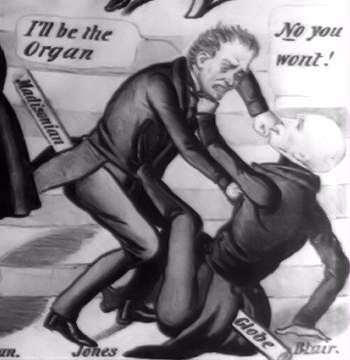
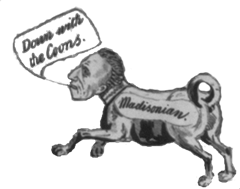
The only actual images of Jones that I have been able to find online are as a minor figure in two political cartoons from before the civil war when he was the editor of a newspaper, the “Madisonian.”
In a second cartoon from 1844, minor characters John Beauchamp Jones and Francis Preston Blair, editors of influential rival newspapers, the “Madisonian” and the “Globe,” fight for the privilege of being the administration organ for the newly elected James K. Polk. (from
original image at Library of Congress)