John Beauchamp Jones images.
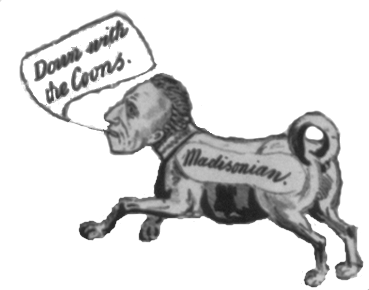
The only actual images of Jones that I have been able to find online are as a minor figure in two political cartoons from before the civil war when he was the editor of a newspaper, the “Madisonian.” For this image, during the 1844 presidential contest, Democratic presidential nominee James Polk is portrayed as a buckskinned hunter who has treed “coons” Henry Clay and Theodore Frelinghuysen. (Clay’s nickname “that old coon” had wide currency in the campaign.)
See the full cartoon at the Library of Congress website.
JULY 3D—The Secretary said to me to-day that he desired my young friend, the classical teacher, to assist me in writing letters. I told him I needed assistance, and Mr. Jacques was qualified. Major Tyler’s ill health keeps him absent half the time. There was abundance of work for both of us. Mr. J. is an agreeable companion, and omitted no opportunity to oblige me. But he trenches on the major’s manor, and can write as long letters as any one. I would never write them, unless the subject-matter demanded it; and so, all the answers marked “full” by the Secretary, when the sum and substance is to be merely an affirmative or a negative, will fall to my co laborer’s share.
JULY 2D.—There has been some brilliant fighting by several brothers named Ashby, who led a mounted company near Romney. One of the brothers, Richard, was slain. Turner Ashby put half a dozen Yankees hors du combat with his own arm. He will make a name. We have accounts of an extraordinary exploit of Col. Thomas, of Maryland. Disguised as a French lady, he took passage on the steamer St. Nicholas at Baltimore en route for Washington. During the voyage he threw off his disguise, and in company with his accomplices, seized the steamer. Coming down the Bay, he captured three prizes, and took the whole fleet into Fredericksburg in triumph. Lieut. Minor, C. S. N., participated in this achievement. Gen. Patterson, who conciliated the mob in Philadelphia, which had intended to hang me, seems to be true to his pledge to fight the Southern people. He is now advancing into Virginia at the head of a brigade.
JULY 1st.—My family are gone. We have moved the department to Mechanics’ Hall, which will be known hereafter as the War Department. In an evil hour, I selected a room to write my letters in, quite remote from the Secretary’s office. I thought Mr. Walker resented this. He had likewise been piqued at the effect produced by an article I had written on the subject of the difficulty of getting arms from Georgia with the volunteers from that State. One of the spunky Governor’s organs had replied with acerbity, not only defending the Governor, but striking at the Secretary himself, to whom the authorship was ascribed. My article had been read and approved by the Secretary before its insertion; nevertheless he now regretted it had been written—not that there was anything improper in it, but that it should have been couched in words that suggested the idea to the Southern editor that the Secretary might be its author. I resolved to meddle with edged tools no more; for I remembered that Gil Blas had done the same thing for the Duke of Lerma. Hereafter I shall study Gil Blas for the express purpose of being his antithesis. But I shall never rise until the day of doom brings us all to our feet again.
JUNE 30TH. —My family engaged packing trunks. They leave immediately.
JUNE 29TH.—I cannot support my family here, on the salary I receive from the government; and so they leave me in a few days to accept the tendered hospitality of Dr. Custis, of Newbern, N. C., my wife’s cousin.
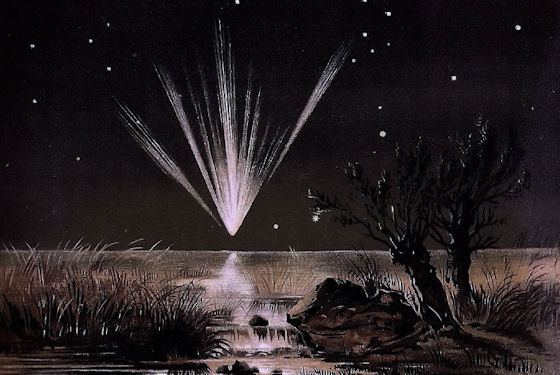
JUNE 28TH.—We have a flaming comet in the sky. It comes unannounced, and takes a northwestern course. I dreamed last night that I saw a great black ball moving in the heavens, and it obscured the moon. The stars were in motion, visibly, and for a time afforded the only light. Then a brilliant halo illuminated the zenith like the quick-shooting irradiations of the aurora borealis. And men ran in different directions, uttering cries of agony. These cries, I remember distinctly, came from men. As I gazed upon the fading and dissolving moon, I thought of the war brought upon us, and the end of the United States Government. My family were near, all of them, and none seemed alarmed or distressed. I experienced no perturbation; but I awoke. I felt curious to prolong the vision, but sleep had fled. I was gratified, however, to be conscious of the fact that in this illusory view of the end of all things sublunary, I endured no pangs of remorse or misgivings of the new existence it seemed we were about to enter upon.
JUNE 27TH.—We have, I think, some 40,000 pretty well armed men in Virginia, sent hither from other States. Virginia has—I know not how many; but she should have at least 40,000 in the field. This will enable us to cope with the Federal army of 70,000 volunteers, and the regular forces they may hurl against us. But so far as this department is aware, Virginia has not yet two regiments in the service for three years, or the war. And here the war will be sure to rage till the end!
JUNE 26TH.—The President revised one of my articles for the press to-day, suggesting some slight modifications, which, perhaps, improved it. It was not a political article; but designed exclusively to advance the cause by inciting the people of Virginia and elsewhere to volunteer for the war. Such volunteers are accepted, and ordered into active service at once; whereas six and twelve months’ men, unless they furnish their own arms, are not accepted.
It is certain the United States intend to raise a grand army, to serve for three years or the war. Short enlistments constituted the bane of Washington’s army; and this fact is reiterated a thousand times in his extant letters.
There are a great many applications for clerkships in the departments by teachers who have not followed their pupils to the army. Army and naval officers, coming over at this late day, are commissioned in our service. In regard to this matter, the President is supposed to know best.
JUNE 25TH.—More accounts of battles and massacres in Missouri and Kansas. I never thought the Yankees would be permitted to ascend the Missouri River. What has become of the marksmen and deer hunters of Missouri? There has been also a fight at Leesburg, and one near Romney, Va. Blood has been shed in all of them. These are the pattering drops that must inevitably be succeeded by a torrent of blood!
JUNE 24TH.—To-day I was startled by the announcement from Col. Bledsoe that he would resign soon, and that it was his purpose to ask the President to appoint me chief of the bureau in his place. I said I preferred a less conspicuous position—and less labor—but thanked him. He said he had no influence with the Secretary— an incontrovertible fact; and that he thought he should return to the University. While we were speaking, the President’s messenger came in with a note to the colonel; I did not learn the purport of it, but it put the colonel in a good humor. He showed me the two first words : “Dear Bledsoe.” He said nothing more about resigning.
I must get more lucrative employment, or find something for my son to do. The boarding of my family, alone, comes to more than my salary; and the cost of everything is increasing.