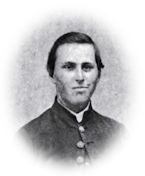
June 20th. Scouts brought in many prisoners. All were obliged to report to the General at headquarters. I very often heard the conversation. One question always asked. “Whose command do you belong to?” While on duty at the General’s headquarters we received a call from two citizens from our home town, Norwich, Dr. Charles M. Carleton and Henry H. Starkweather. Came to learn all the particulars about our regiment’s part in the three days’ battle at Winchester. There was much excitement at home over the results. A full report had not been received. The casualties at this time were not really known. We were questioned as to what we knew about the disaster that had overtaken our regiment. Those of us who escaped received many letters from home asking for information about members of the regiment. At this time the regiment was well scattered, prisoners, a detachment reported at Hancock, Md., and ours at Maryland Heights.
Civil War Diary of Charles H. Lynch, 18th Conn. Vol’s.
June 16th. Up very early this morning. All Major Peale could muster of the 18th Regiment was only thirty members. The rest of those who escaped were with Captain Matthewson, they taking a different route from Major Peale who followed the route taken by General Milroy.
After breakfast of hardtack and coffee, the Major marched us on through Harper’s Ferry, crossing the Potomac River on a pontoon bridge. On, up Maryland Heights, halting under low pine trees, well up to the top of the Heights. Here we were allowed to remain for rest and sleep. General Dan Tyler, a Connecticut man, was in command of a large force at this point. From the top of the Heights we could see the enemy crossing the Potomac River at Williamsport into Maryland. Our detachment was detailed for headquarters guard at the quarters of General Tyler. The duty was easy and made very interesting about all the time.
June 15th. Last night we were under arms, ready for a call to duty at any moment. Prisoners report that Ewell has about forty thousand men with eighty cannon under his command. While in the fort waiting for orders we talked over the events that might happen when daylight came. About 2 A. M. we silently marched out of the Star Fort to the Martinsburg Pike. The movement was very slow which kept us guessing, wondering what was in store for us. When out on the road about four miles, just at break of day, at Carter’s Farm, near Summit station on the Harper’s Ferry & Winchester Railroad, the enemy opened a fierce fire upon us. The cavalry were to the right of us, marching in fours or parallel to the infantry lines. They broke and ran through our lines, causing much confusion. While we were re-forming, the enemy kept up a severe fire on us. They were well posted across a deep railroad cut. A case of ambush, waiting in the dark for us, having a good range of the pike. Our regiment soon had line formed, with the 5th Maryland on our left. Ordered to charge on the battery which the enemy had well posted and supported. Charging through the woods and the severe firing of the enemy, our lines became broken, when we were ordered to fall back and re-form. The second charge in the woods on the battery. We were again ordered to fall back and re-form. The 18th Connecticut was now the only regiment left on the field with General Milroy. After a short drill by our Colonel, under fire all the time, I heard him report to the General that he was now ready for orders. Our company, C, being center and color company, the Colonel’s position was right in our rear, so that we heard all his orders, even in battle. The Lieutenant-Colonel and the Major were on the right and left of the regiment to repeat orders. The 18th Connecticut Regiment made the third and last charge un-supported, all others having left the field. We held the enemy in check until the General, his staff, and escort, left the field, guided by scouts through fields, on to Harper’s Ferry. That was a hot fight in that early June morning. The cannon and musketry firing was a grand and awful sight to us young fellows, who were getting our first lessons in a real battle, a hard one and against great odds.
Coming out of the woods after the third and final charge, our Major Peale directed us to go to the right and get away. I followed his orders. For some reason, best known to himself, the Colonel ordered a halt and a surrender to the enemy, when he and between four and five hundred were made prisoners. Major Peale and between two and three hundred got away. I was one of those who followed the Major and reached Harper’s Ferry after a long and tedious march. Tired and discouraged, we dropped to the ground for rest and sleep. Our regiment was badly broken up. Many killed, wounded, and prisoners. The trials of the past few days were something fearful to endure. It was wonderful that we came out as well as we did. Short of rations, sleeping on the ground. Cool nights follow the hot days. On the march through Charlestown. Saw the Confederate cavalry on the Berryville Pike. In case of an attack we are ready. While marching on to Halltown a force of cavalry came to meet us from Harper’s Ferry. Stopped for the night on Bolivar Heights.
In the battle I lost my pocket-book, containing over five dollars with gold pen and silver pen-holder. We were obliged to fill our pockets with cartridges. As they were loose we used them first, so must have pulled my pocket-book out in the excitement.
June 14th. Last night our position was changed from the south to the east side of the town, on the Berryville road. The night was a very dark, stormy one, with severe lightning and thunder. We were wet through. Not allowed fires as it might draw the enemy’s fire. Passed a very uncomfortable night. This morning, at daylight, our position was again changed, extending our lines further towards the north, under fire from the enemy as we attempted to enter the rifle pits. In the movement Lieutenant Merwin commanding our company was wounded in the foot.
The enemy had possession of a large brick house a short distance in front of our position in the pits. Their sharpshooters made it hot for us. A charge on the house was ordered. The enemy ran, but we captured a few prisoners. Later in the day the rebs again took possession of the house making it hot for us in the pits. We had to lie low or zip would come a bullet, and at times many of them. Colonel ordered a section of a battery. Two guns putting a few shells through the house, the enemy left it. No more trouble came from that point, the house was ruined. About 6 P. M. General Milroy called in all his forces and formed them around the Star Fort, the largest fort. A fierce battle came on. It was a hot place. The roaring of the big guns, explosion of shells, rattling of musketry, was something fearful. The charging of both sides was hot work. We drove the enemy back and they also forced our lines back. Darkness put an end to the carnage and I had passed through the battle unharmed. The end of the second day. The casualties were great as I could not help seeing. It gave me an opportunity to see what a horrible thing war really was. We were fighting Jackson’s old corps, now commanded by General Ewell, reported to number forty thousand.
June 13th. Turned out very early this morning. Waiting for orders to march. While waiting for orders our cavalry scouts are coming in, reporting the enemy coming down the valley in force. Somewhat of a surprise, they having come through the mountain passes in the night, making a forced march. While near the Colonel’s quarters I saw a scout coming, almost flying, down the pike. Jumped his horse over a stone fence that surrounded our camp. Headed straight for the Colonel’s tent. Without any ceremony rushed in, informed the Colonel the enemy was almost upon us. I ran to the Colonel’s quarters and heard the report. With a shout the Colonel called out “Fall in, fall in, double quick.” We soon formed in line, ready for orders. Left our camp on double quick time to meet the enemy. They opened fire on us and our camp with a battery well posted on a high hill about one mile from our camp. We held them in check for a while when orders came for us to fall back and take position in the line of battle that had been formed near the town. In the meantime the enemy had taken possession of our camp with all its equipage and our knapsacks that contained all our belongings, making a great loss to every man. The sudden appearance of so large a force was a surprise. We were under fire all day and were obliged to change our position at different points to meet the enemy, who were trying to get into Winchester. It was plainly seen that a large force of Confederates were surrounding the town and that we were in a bad fix, as we could see the gray in all directions and knew that we were more than outnumbered.
June 12th. All is ready for our scouting trip, rations, with a good supply of ammunition, and equipment all in good condition. Tonight finds us still in camp, ready to start.
June 11th. Orders received to prepare for three days’ scouting up the valley. A sharp lookout must be kept for the enemy through the valley and the mountain passes. Tonight we have three days’ rations all prepared for an early start on the morrow.
On the Front Royal Pike at the Shawnee Springs. A fine supply of good cold water. The location was fine and the camp was known as Camp Shawnee. Severe duty began right away. Picket, scouting through the country, working on the fort and rifle pits, with axe, pick, and shovel. The large fort was known as the Star Fort. Many of the boys had never used or handled that kind of tools. It was hard work. After a hard day’s work came the march back to camp, a distance of about four miles. Then clean up and get something to eat. Various duty came to us each day. Made out to get some pleasure out of the life of a soldier as the days passed by.
May 30th. The regiment, with cavalry escort, ordered up the valley. After a march of ten miles came to a halt at Newtown. Muskets stacked along the main street. The cavalry continued to advance with flag of truce. After a few hours’ wait the cavalry returned and with them were some poor people who were ordered out of the rebel lines. They were Union people, mostly women and children. They were nearly famished and were known as refugees. Their faces brightened up when they saw us and the flags. We divided our rations with them and made coffee for them. We guarded them back to Winchester. Later on they were sent North. Not very much change in our line of duty from day to day. Scouting, picket duty, working on the forts and rifle pits which kept us very busy.
May 25th. Again on the march after an early breakfast. Marched in good order through the town, by music of the drum corps. The town is an old Virginia one. Many old buildings, some showing the effects of the war. Reaching the center of town, filed to the right, going west, on the Winchester Pike. On the march we were obliged to ford three small rivers, or creeks, as the natives called them. Passed a number of large mansions. Many small outhouses, the homes of slaves in prosperous times. We surely are now in the enemy’s country. In conversation with the natives we would try and keep them talking, on account of their peculiar dialect. We never could find out how far it was to the next town, in miles. The answer would be “Right smart aways, I reckon.” After a tiresome march we reached the town of Winchester late in the afternoon. After a halt in the town for a while, until the Colonel could report to the Commander, General Milroy, we again were on the march, out the south side of the town, to locate camp about two miles from town.
May 24th. After a night’s rest and breakfast I was very much improved, taking my place in the company. We left the camp at 6 A. M. Sunday morning with drums and fifes, to the tune of Old John Brown, which was kept up until we passed through the town. In this town John Brown had been tried and hung, which event had become history. The town was pleasantly located but showed the effects of the war by its ruined buildings. The scenery was fine looking up the valley. The march continued on towards Berryville, a hot dusty one. It caused many of the boys to fall out by the roadside. After a march of about ten miles we camped for the night near Berryville.


