May 23d. After an uneventful ride we arrived at Sandy Hook at four o’clock this morning, getting our first view of the Potomac River. Orders received to turn out and form in line for a march. The road was along the side of the Ohio and Chesapeake Canal, under the Maryland Heights. The march continued on over the iron railroad bridge crossing the Potomac River into Harper’s Ferry. Here we first put foot on what was called the sacred soil of Virginia. Harper’s Ferry was historical ground. Here John Brown started an insurrection to liberate the slaves. Our march through the town was by way of Shenandoah Street, then by file left into a large open lot in town. Here we prepared our breakfast. Later we were allowed to visit the town and the points of interest. The old brick fire-engine house, known as John Brown’s Fort was one of the points of interest. Saw where the bricks had been knocked out for port-holes to fire through. A government arsenal had been located here. Destroyed by the rebels, only the old walls remained standing. Some severe fighting had taken place in this side hill town. At 5 P. M. we left the town on the march for Winchester. After a march of eight miles camped for the night in woods. Not being strong, after my illness, I was obliged to fall out by the roadside. Lieutenant Merwin wished me to return to the hospital. I answered no, I would rather die in the field, I wanted to stay with the boys. The Lieutenant was very kind to me, he taking my knapsack and the boys my equipment. After a short rest and a bath in a brook I was able to follow on, finding the regiment in camp for the night near Charlestown.
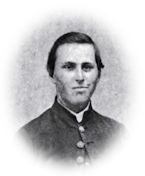
Civil War Diary of Charles H. Lynch, 18th Conn. Vol’s.
May 22d. We bid farewell to Fort Marshall and Baltimore. Marched across the city to the Camden Street railway station, Baltimore and Ohio R. R. After a long wait a train of box cars ready to receive us, into which we were packed and started on our journey. A slow tiresome ride in the old cars.
May 20th. We remained here until this date having the finest of times, when orders were received to pack up and report to the regiment at Fort Marshall. Orders having been received for the regiment to report to General Robert H. Milroy at Winchester, Virginia.
April 29th. Our company was ordered for guard duty to guard the railroad bridge over the Gunpowder River, on the Baltimore & Philadelphia Road. A very pleasant change and much enjoyed in the fine early spring weather. The fishing and sailing were fine. Many boats at that point we were allowed to use. Many attempts had been made to burn the bridge. It had to be kept well guarded. (It was later destroyed by rebel guerillas making a raid through Maryland.)
April. Having been an inmate in the hospital for three months, at my own request, I was allowed to join my company, located at Fort Marshall, east end of Baltimore. Reported to Lieutenant Merwin, commanding company. He would not allow me to go on duty. Wished me to remain at Regimental Hospital for a while until I could get stronger.
(Jarvis Hospital, at the west end of Baltimore ) Received good care from the nurses, one woman and four men, two by day and night. My comrades of Company C called on me quite often until the company was ordered to Fort Marshall at the east end of Baltimore, about five miles from the Hospital. In good quarters. All were very sorry I could not be with them. While in the hospital the officers of the company called on me. I also received a call from our good Governor Buckingham. Promised friends at home that he would call on me, see that I was having good care. His home was in Norwich.
I told the Governor that I had no fault to find and for him to tell the folks at home that I was receiving good care. Also received calls from Mrs. Henry Bingham, the wife of a comrade of our company and an old friend at home. Comrade Bingham was very ill in the same hospital with me. On the wall, at the head of our beds, was a card with our name, company, and regiment. The loyal people of Baltimore often visited the hospital, furnishing entertainment for the patients in songs and recitations. Was very much enjoyed and appreciated as the time dragged slowly along.
In our camp was located Battery L, 5th U. S. Regulars. The battery boys did not like being inside the guard line of volunteers. Would run the guard line, making trouble for us. A sergeant of the battery, under the influence of drink, attempted to run the guard. Was halted, grabbed the sentinel’s musket, resulted in the sergeant’s being badly wounded. The wooden plug in the muzzle, with the bullet, passed through the sergeant’s body. He was not killed. (After a time he recovered.) After that event the battery boys and the 18th Regiment were friends. All were sorry over the event. No one blamed the sentinel. Cold rain and snow making the life of a soldier a very disagreeable one in tents, sleeping on the ground. Deep mud and very sticky all through our camp.
January 6th. Last night, while on guard duty, I was taken suddenly ill. Had to be relieved from duty. Placed in an old barn, used for a field hospital, with a leaky old roof, the rain coming down on me. Colonel, I was informed, came to the barn, saw my condition, ordered me carried to a general hospital known as Stuart’s Mansion, afterward named the Jarvis Hospital, at the west end of Baltimore. At the hospital I was examined by a surgeon who pronounced my illness typhoid fever and the pleurisy. I was placed in Ward 4. I was very ill. My side was cupped for the pleurisy.
January 2d. Late last night, our second night out, pickets began firing. We were called out and soon had line formed. The supposed enemy proved to be Union scouts with orders for the Colonel to return to Baltimore. The enemy did not come into Maryland. The command was complimented for the way it turned out into line ready for duty. This morning, in line by the railroad waiting for the train. After a long wait in the cold the dirty train of box cars came along which we soon boarded. On to Baltimore. Arriving in the city, ordered to the west end, going into camp in Stuart’s woods. A surprise and disappointment as we expected to return to Camp Emory, our good quarters, in good warm barracks. Many disappointments come to soldiers.
January 1st. When off picket duty try to keep comfortable by the picket fires and chopping wood for the large camp fire just outside the church. No place in the church for fires.
December 31st. We passed a very uncomfortable night in old dirty box cars. After a ride of sixty miles we reached a station known as Monrovia very early in the morning, just before daylight. Pickets were soon posted on the roads crossing the railroad. A sharp lookout was kept. After daylight we took possession of a small Quaker church and sheds for our quarters. We were obliged to, as we did not have any tents. Started off in light marching order. Most of the inhabitants were Quakers, very fine people. Kind to us. The warm rain turned to snow with freezing weather, making us feel very uncomfortable for picket duty.


