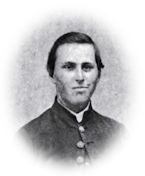
Following the American Civil War Sesquicentennial with day by day writings of the time, currently 1863.

Civil War Diary of Charles H. Lynch, 18th Conn. Vol’s.

August 22d. Friday. Early this morning great crowds began to arrive in camp as we were to leave for the war. About 10 A. M. a large delegation of Norwich ladies came into camp with fine flags, National and State, which they presented to the regiment, Governor Buckingham making the presentation for the ladies from whom the flags came. The flags were received by Colonel Ely and then turned over to the color-sergeants who had been selected to carry them. Then assigned to Company C, our company. This event over, the regiment broke ranks.

About 3 P. M. the regiment broke camp, formed in line, and began our march to the city. Business was suspended. Great crowds lined the streets as the regiment marched along. Near five hundred young men from Norwich were in the regiment, leaving home for the life of a soldier in the great war. It was a very sad day in old Norwich. The boys marched on, going on board the large, fine steamer City of Boston, of the New York and New London Line. Many sad farewells as we marched on board the boat. The Norwich Brass Band volunteered its services as far as New York. About 7 P. M. the boat left the dock, going slowly down the Thames River. The music by the band, cheering by the people, roaring of cannons, and the great crowds made a scene that could not be forgotten. As the steamer rounded a bend in the river our view of Norwich was cut off and the shades of night were coming on. The lights of New London began to show up. Passing on, the steamer was soon out into Long Island Sound.

August 18th. Monday. Regiment mustered into the United States service, William G. Ely, Colonel, having been promoted from Lieutenant-Colonel of the 6th Connecticut Regiment. A resident of Norwich. The remaining days in camp brought many visitors and peddlers. Those were sad and very exciting days while we were preparing for the life of a soldier. The weather hot and dry in camp.

August 17th. Sunday in camp. Most of the members of the regiment were allowed to leave camp and visit homes and the city. It would be our last Sunday in the state. I was detailed for guard duty and could not leave camp. Many visitors in camp during the day. I was on duty two hours and off four during the day and night.

During the spring and summer of 1862 the war fever was running very high. Great excitement prevailed. Darkness and gloom seemed to cover the country. Men were urged to enlist, go to the war, and help save the country. It was preached from the pulpits, printed by the press, talked about at great war meetings that were held by day and nights. Business at times was suspended. Drums and fifes were heard continuously being paraded through the streets and followed by men and boys. Churches were open in country towns, giving men an opportunity to enlist.

Mr. Isaac H. Bromley, City Editor of the Norwich Morning Bulletin, at a great war meeting held at Breed’s Hall, had enlisted to go to the war. He came out with a card in the Bulletin asking one hundred young men to go with him and organize a company for the 18th Regiment that was forming at the time.

On the evening of August 6th, 1862, I visited the recruiting office with my mind fully made up to enlist for the war and go in Bromley’s company.

On the 12th the members were requested to meet at the recruiting office at 1 P. M. to form company and march to the fair grounds where camp had been located. Distance about two miles. At 2 P. M. with drum and fife we began our march to the camp. Cheers greeted us all along the line of march.

The camp was known as Camp Aiken, so named in honor of General Aiken, son-in-law of Connecticut’s war Governor, William A. Buckingham. At camp we were assigned two rows of tents, mattresses and army blankets included. After the medical examination, uniforms were given to us. Then began the life of a real soldier, learning how to march and drill and also doing guard duty.

A meeting of the company was called to elect officers. Isaac H. Bromley was elected Captain, Samuel T. C. Merwin, a lawyer, ist Lieutenant, Henry F. Cowles, 2nd Lieutenant. In due time we were selected as color company, also known as Company C. It was considered a very great honor to be the color company of a regiment. With cheers and congratulations we pledged ourselves to be true and to carry the flags with honor. We are now getting the new experience of a soldier’s life in camp.

August 11th. Early on the march. A hot dry morning. Passed on through Berryville, pushing south through open lots and woods. Skirmishing on the extreme right, at Stony Point. A hot, hard, day’s march. Suffered very much for water. After marching about twenty miles, late tonight came to a halt near a large spring. Many of the boys were obliged to fall out. We are all very tired and about exhausted as we lie down for the night.