Following the American Civil War Sesquicentennial with day by day writings of the time, currently 1863.

Diary of Gideon Welles

July 6, Monday. There was a special Cabinet-meeting at 9 A.M. on the subject of A. H. Stephens’s mission. Seward came prepared with a brief telegram, which the President had advised, to the effect that Stephens’s request to come to W. was inadmissible, but any military communication should be made through the prescribed military channel. A copy of this answer was to be sent to the military officer in command at Fortress Monroe by the Secretary of War, and the Secretary of the Navy was to send a copy to Admiral Lee. The President directed Mr. Seward to go to the telegraph office and see that they were correctly transmitted. All this was plainly prearranged by Seward, who has twice changed his ground, differing with the President when Chase and Stanton differed, but he is finally conimissioned to carry out the little details which could be done by an errand boy or clerk.

The army news continues to be favorable. Lee is on the retreat, and Meade in hot pursuit, each striving to get possession of the passes of the Potomac.

A note from Wilkes stating he had reached home, and would have reported in person but had received an injury. A letter is published in one of the papers, purporting to be from him at Havana, written by himself or at his instigation, expressing a hope that Lardner, his successor, will be furnished with men and more efficient vessels. I hope so too. Wilkes has not had so large a force as I wished; he could not under any circumstances have had so large a squadron, as he desired. To say nothing of the extensive blockade, Farragut’s detention through the winter and spring before Vicksburg was unexpected, and the operations before Charleston have been long and protracted.

The papers this evening bring us the speeches of the two Seymours, Horatio and Thomas Henry, on the Fourth at New York. A couple of partisan patriots, neither of whom is elated by Meade’s success, and whose regrets are over Rebel reverses.

July 5, Sunday. A Cabinet-meeting to-day at 11 A.M. The principal topic was the mission of Alexander H. Stephens. The President read a letter from Colonel Ludlow, United States Agent for exchange of prisoners, to Secretary Stanton, stating that Stephens had made a communication to Admiral Lee, which the Admiral had sent to the Secretary of the Navy. After reading them, the President said he was at first disposed to put this matter aside without many words, or much thought, but a night’s reflection and some remarks yesterday had modified his views. While he was opposed to having Stephens and his vessel come here, he thought it would be well to send some one —perhaps go himself — to Fortress Monroe. Both Seward and Stanton were startled when this remark was made.

Seward did not think it advisable the President should go, nor any one else; he considered Stephens a dangerous man, who would make mischief anywhere. The most he (Seward) would do would be to allow Stephens to forward any communication through General Dix. Seward passes by Admiral Lee and the Navy Department, through whom the communication originally came. Stanton was earnest and emphatic against having anything to do with Stephens, or Jeff Davis, or their communication. Chase was decided against having any intercourse with them. Blair took a different view. He would not permit Stephens to come here with his staff, but would receive any communication he bore, and in such a case as this, he would not cavil about words. Something more important was involved.

While this discussion was going on, I wrote a brief answer to Lee, and said to the President I knew not why Colonel Ludlow was intruded as the medium of communication, or General Dix, — that neither of them was in any way connected with this transaction. Admiral Lee, in command of the blockading force, received a communication from Mr. Stephens, and had made known to the Navy Department, under whose orders he is acting, the application of the gentleman who had a mission to perform, and was now with Admiral Lee waiting an answer. In this stage of the proceeding, the Secretary of State proposes that Admiral Lee should be ignored, and the subject transferred from the Navy to some military officer, or one of his staff. Was it because Admiral Lee was incompetent, or not to be trusted? Admiral Lee has informed Stephens he cannot be permitted to pass until he has instructions from the Navy Department. Nothing definite has yet been suggested in reply. He and the parties are waiting to hear from me, and I propose to take some notice of his application, and, unless the President objects, send an answer as follows to Admiral Lee: —

“The object of the communication borne by Mr. Stephens is not stated or intimated. It is not expedient from this indefinite information that you should permit that gentleman to pass the blockade with the Torpedo.”

None of the gentlemen adopted or assented to this, nor did they approximate to unity or anything definite on any point. After half an hour’s discussion and disagreement, I read what I had pencilled to the President, who sat by me on the sofa. Under the impression that I took the same view as Chase and Stanton, he did not adopt it. Seward, in the mean time, had reconsidered his proposition that the communication should be received, and thought with Stanton it would be best to have nothing to do with the mission in any way. The President was apprehensive my letter had that tendency. Mr. Blair thought my suggestion the most practical of anything submitted. Chase said he should be satisfied with it. Stanton the same. Seward thought that both Stanton and myself had better write, each separate answers, Stanton to Ludlow and I to Lee, but to pretty much the same effect.

The President said my letter did not dispose of the communication which Stephens bore. I told him the dispatch did not exclude it. Though objection was made to any communication, an answer must be sent Admiral Lee. Everything was purposely left open, so that Stephens could, if he chose, state or intimate his object. I left the dispatch indefinite in consequence of the diversity of opinion among ourselves, but that I had not the least objection, and should for myself prefer to add, “I am directed by the President to say that any communication which Mr. Stephens may have can be forwarded.”

This addendum did not, as I knew it would not, meet the views entertained by some of the gentlemen. The President prefers that a special messenger should be sent to meet Stephens, to which I see no serious objection, but which no one favors. I do not anticipate anything frank, manly, or practical in this mission, though I do not think Stephens so dangerous a man as Mr. Seward represents him. It is a scheme without doubt, — possibly for good, perhaps for evil, — but I would meet it in a manner not offensive, nor by a rude refusal would I give the Rebels and their sympathizers an opportunity to make friends at our expense or to our injury. This, I think, is the President’s purpose. Mr. Blair would perhaps go farther than myself, the others not so far. We must not put ourselves in the wrong by refusing to communicate with these people. On the other hand, there is difficulty in meeting and treating with men who have violated their duty, disregarded their obligations, and who lack sincerity.

I ought to answer Lee, and, because I have not, Ludlow and Dix have been applied to. Seward will make the Secretary of War or himself the medium and not the Secretary of the Navy, — Ludlow or Dix, not Admiral Lee. I proposed to inform Admiral Lee that his communication should be answered to-morrow, it having been decided we would not reply to-day. Seward said the subject would not spoil by keeping. The President thought it best to send no word until we gave a conclusive answer to-morrow.

At 5 P.M. I received a telegram that the Torpedo with Mr. Stephens had gone up the river. Another telegram at eight said she had returned.

July 4, Saturday. I was called up at midnight precisely by a messenger with telegram from Byington, dated at Hanover Station, stating that the most terrific battle of the War was being fought at or near Gettysburg, that he left the field at half-past 6 P.M. with tidings, and that everything looked hopeful. The President was at the War Department, where this dispatch, which is addressed to me, was received. It was the first word of the great conflict. Nothing had come to the War Department. There seems to have been no system, no arrangement, for prompt, constant, and speedy intelligence. I had remained at the War Department for news until about eleven. Some half an hour later the dispatch from Byington to me came over the wires, but nothing from any one to Stanton or Halleck. The operator in the War Department gave the dispatch to the President, who remained. He asked, “Who is Byington?” None in the Department knew anything of him, and the President telegraphed to Hanover Station, asking, “Who is Byington?” The operator replied, “Ask the Secretary of the Navy.” I informed the President that the telegram was reliable. Byington is the editor and proprietor of a weekly paper in Norwalk, Connecticut, active and stirring; is sometimes employed by the New York Tribune, and is doubtless so employed now.

The information this morning and dispatches from General Meade confirm Byington’s telegram. There is much confusion in the intelligence received. The information is not explicit. A great and bloody battle was fought, and our army has the best of it, but the end is not yet. Everything, however, looks encouraging.

Later in the day dispatches from Haupt and others state that Lee with his army commenced a retreat this A.M. at three o’clock. Our army is waiting for supplies to come up before following, —a little of the old lagging infirmity.

Couch is said to be dilatory; has not left Harrisburg; his force has not pushed forward with alacrity. Meade sent him word, “The sound of my guns should have prompted your movement.” Lee and the Rebels may escape in consequence. If they are driven back, Halleck will be satisfied. That has been his great anxiety, and too many of our officers think it sufficient if the Rebels quit and go off, — that it is unnecessary to capture, disperse, and annihilate them.

Extreme partisans fear that the success of our arms will be success to the Administration. Governor Curtin is in trepidation, lest, if our troops leave Harrisburg to join Meade, the Rebels will rush in behind them and seize the Pennsylvania capital. On the other hand, Stanton and Halleck ridicule the sensitiveness of the Governor, and are indifferent to his wishes and responsibilities. Of course, matters do not work well.

Received this evening a dispatch from Admiral Lee, stating he had a communication from A. H. Stephens,[1] who wishes to go to Washington with a companion as military commissioner from Jefferson Davis, Commanding General of Confederate forces, to Abraham Lincoln, President and Commanding General of the Army and Navy of the United States, and desires permission to pass the blockade in the steamer Torpedo on this mission, with Mr. Olds, his private secretary. Showed the dispatch to Blair, whom I met. He made no comment. Saw Stanton directly after, who swore and growled indignantly. The President was at the Soldiers’ Home and not expected for an hour or two. Consulted Seward, who was emphatic against having anything to do with Stephens or Davis. Did not see the President till late. In the mean time Stanton and others had seen him, and made known their feelings and views. The President treats the subject as not very serious nor very important, and proposes to take it up to-morrow. My own impression is that not much good is intended in this proposition, yet it is to be met and considered. It is not necessary that the vessel should pass the blockade, or that Stephens should come here, but I would not repel advances, or refuse to receive Davis’s communication.

I learn from Admiral Lee that General Keyes with 12,000 men has moved forward from the “White House” towards Richmond, and other demonstrations are being made.

Two intercepted dispatches were received, captured by Captain Dahlgren. One was from Jeff Davis, the other from Adjutant-General Cooper, both addressed to General Lee. They disclose trouble and differences among the Rebel leaders. Lee, it seems, had an understanding with Cooper that Beauregard should concentrate a force of 40,000 at Culpeper for a demonstration, or something more, on Washington, when the place became uncovered by the withdrawal of the Army of the Potomac in pursuit of Lee. Davis appears not to have been informed of this military arrangement, nor satisfied with the programme when informed of it. Lee is told of the difficulty of defending Richmond and other places, and that he must defend his own lines, instead of relying upon its being done from Richmond.

_________________________

[1] Vice-President of the Confederacy.

July 3, Friday. I met the President and Seward at the War Department this morning. A dispatch from General Meade, dated 3 P.M. yesterday, is in very good tone. The Sixth Army Corps, he says, was just arriving entire but exhausted, having been on the march from 9 P.M. of the preceding evening. In order that they may rest and recruit, he will not attack, but is momentarily expecting an onset from the Rebels.

They were concentrating for a fight, and, unless Meade is greatly deceived, there will be a battle in the neighborhood of Gettysburg. I hope our friends are not deceived so that the Rebel trains with their plunder can escape through the valley.

July 2, Thursday. A telegram this morning advises me of the death of General R. C. Hale, the brother of Mrs. Welles, at Reedsville in the County of Mifflin, Pennsylvania. He was the efficient Quartermaster-General of Pennsylvania, a good officer and capable and upright man. The public never had a more faithful and honest officer.

Met Sumner and went with him to the War Department. The President was there, and we read dispatches received from General Meade. There was a smart fight, but without results, near Gettysburg yesterday. A rumor is here that we have captured six thousand prisoners, and on calling again this evening at the War Department I saw a telegram which confirms it. General Reynolds is reported killed. The tone of Meade’s dispatch is good.

Met the elder Blair this evening at his son’s, the Postmaster-General. The old gentleman has been compelled to leave his pleasant home at Silver Spring, his house being in range of fire and Rebel raiders at his door. He tells me McClellan wrote Stanton after the seven days’ fight near Richmond that he (Stanton) had sacrificed that army. Stanton replied cringingly, and in a most supplicating manner, assuring McClellan he, Stanton, was his true friend. Mr. F. P. Blair assures me he has seen the letters. He also says he has positive, unequivocal testimony that Stanton acted with the Secessionists early in the War and favored a division of the Union. He mentions a conversation at John Lee’s house, where Stanton set forth the advantages that would follow from a division.

Mr. Montgomery Blair said Stanton was talking Secession to one class, and holding different language to another; that while in Buchanan’s Cabinet he communicated Toucey’s treason to Jake Howard and secretly urged the arrest of Toucey. During the winter of 1860 and 1861, Stanton was betraying the Buchanan Administration to Seward, disclosing its condition and secrets, and that for his treachery to his then associates and his becoming the tool of Seward, he was finally brought into the present Cabinet.

These things I have heard from others also, and there have been some facts and circumstances to corroborate them within my own knowledge. Mr. Seward, who has no very strong convictions and will never sacrifice his life for an opinion, had no belief that the insurrection would be serious or of long continuance. Familiar with the fierce denunciations and contentions of parties in New York, where he had, from his prominent position and strong adherents, been accustomed to excite and direct, and then modify, the excesses roused by anti-Masonry and anti-rent outbreaks by pliable and liberal action, he entertained no doubt that he should have equal success in bringing about a satisfactory result in national affairs by meeting exaction with concessions. He was strengthened in this by the fact that there was no adequate cause for a civil war, or for the inflammatory, excited, and acrimonious language which flowed from his heated associates in Congress. Through the infidelity of Stanton he learned the feelings and designs of the Buchanan Administration, which were not of the ultra character of the more impassioned Secession leaders. One of the Cabinet already paid court to him; Dix and some others he knew were not disunionists; and, never wanting faith in his own skill and management, he intended, if his opponents would not go with him, as the last alternative to go with them and call a convention to remodel the Constitution. Until some weeks after Mr. Lincoln’s inauguration Seward never doubted that he could by some expedient — a convention or otherwise —allay the storm. Some who ultimately went into the Rebellion also hoped it. Both he and they overestimated his power and influence. Stanton in the winter of 1861 whispered in his ear state secrets, it was understood, because Seward was to be first in the Cabinet of Lincoln, who was already elected. The Blairs charge Stanton with infidelity to party and to country from mere selfish considerations, and with being by nature treacherous and wholly unreliable. Were any overwhelming adversity to befall the country, they look upon him as ready to betray it.

July 1, Wednesday. We have reports that the Rebels have fallen back from York, and I shall not be surprised if they escape capture, or even a second fight, though we have rumors of hard fighting to-day.

June 30, Tuesday. The President did not join us to-day in Cabinet. He was with the Secretary of War and General Halleck, and sent word there would be no meeting. This is wrong, but I know no remedy. At such a time as this, it would seem there should be free and constant intercourse and interchange of views, and a combined effort. The Government should not be carried on in the War or State Departments exclusively, nor ought there to be an attempt of that kind.

I understand from Chase that the President and Stanton are anxious that Dix should make a demonstration on Richmond, but Halleck does not respond favorably, —whether because he has not confidence in Dix, or himself, or from any cause, I do not know. This move on Richmond is cherished by Chase, and with a bold, dashing, energetic, and able general might be effective, but I agree with the President that Dix is not the man for such a movement. Probably the best thing that can now be done, is to bring all who can be spared from garrison duty to the assistance of General Meade.

Lee and his army are well advanced into Pennsylvania, and they should not be permitted to fall back and recross the Potomac. Halleck is bent on driving them back, not on intercepting their retreat; is full of zeal to drive them out of Pennsylvania. I don’t want them to leave the State, except as prisoners. Meade will, I trust, keep closer to them than some others have done. I understand his first order was for the troops at Harper’s Ferry to join him, which was granted. Hooker asked this, but it was denied him by the War Department and General Halleck.

Blair is much dissatisfied. He came from the Executive Mansion with me to the Navy Department and wrote a letter to the President, urging that Dix’s command should be immediately brought up. Says Halleck is good for nothing and knows nothing. I proposed that we should both walk over to the War Department, but he declined; said he would not go where Stanton could insult him, that he disliked at all times to go to the War Department, had not been there for a long period, although the Government of which he is a member is in these days carried on, almost, in the War Department.

We have no positive information that the Rebels have crossed the Susquehanna, though we have rumors to that effect. There is no doubt the bridge at Columbia, one and a half miles long, has been burnt, and, it seems, by our own people. The officer who ordered it must have been imbued with Halleck’s tactics. I wish the Rebel army had got across before the bridge was burnt. But Halleck’s prayers and efforts, especially his prayers, are to keep the Rebels back, — drive them back across the “frontiers” instead of intercepting, capturing, and annihilating them. This movement of Lee and the Rebel forces into Pennsylvania is to me incomprehensible, nor do I get any light from military men or others in regard to it. Should they cross the Susquehanna, as our General-in-Chief and Governor Curtin fear, they will never recross it without being first captured. This they know, unless deceived by their sympathizing friends in the North, as in 1861; therefore I do not believe they will attempt it.

I have talked over this campaign with Stanton this evening, but I get nothing from him definite or satisfactory of fact or speculation, and I come to the conclusion that he is bewildered, that he gets no light from his military subordinates and advisers, and that he really has no information or opinion as to the Rebel destination or purpose.

June 29, Monday. Great apprehension prevails. The change of commanders is thus far well received. No regret is expressed that Hooker has been relieved. This is because of the rumor of his habits, the reputation that he is intemperate, for his military reputation is higher than that of his successor. Meade has not so much character as such a command requires. He is, however, kindly favored; will be well supported, have the best wishes of all, but does not inspire immediate confidence. A little time may improve this, and give him name and fame.

Naval Order No. 16 on the death of Foote and the congratulatory letter to Rodgers have each been well received. The allusion to the character of the monitors was a questionable matter, but I thought it an opportunity to counteract Du Pont’s mischief which should not pass unimproved. Some of the Rebel sympathizers assail that part of it, as I supposed they probably would. Of Foote I could have said more, but brevity is best on such occasions.

June 28, Sunday. The President convened the Cabinet at 10 A.M. and submitted his reply to the Vallandigham committee. Save giving too much notoriety and consequence to a graceless traitor who loves notoriety and office, and making the factious party men who are using him for the meanest purposes that could influence men in such a crisis conspicuous, the letter is well enough, and well conceived.

After disposing of this subject, the President drew from his pocket a telegram from General Hooker asking to be relieved. The President said he had, for several days as the conflict became imminent, observed in Hooker the same failings that were witnessed in McClellan after the Battle of Antietam, — a want of alacrity to obey, and a greedy call for more troops which could not, and ought not to be taken from other points. He would, said the President, strip Washington bare, had demanded the force at Harper’s Ferry, which Halleck said could not be complied with; he (Halleck) was opposed to abandoning our position at Harper’s Ferry. Hooker had taken umbrage at the refusal, or at all events had thought it best to give up the command.

Some discussion followed in regard to a successor. The names of Meade, Sedgwick, and Couch were introduced. I soon saw this review of names was merely a feeler to get an expression of opinion — a committal — or to make it appear that all were consulted. It shortly became obvious, however, that the matter had already been settled, and the President finally remarked he supposed General Halleck had issued the orders. He asked Stanton if it was not so. Stanton replied affirmatively, that Hooker had been ordered to Baltimore and Meade to succeed him. We were consulted after the fact.

Chase was disturbed more than he cared should appear. Seward and Stanton were obviously cognizant of what had been ordered before the meeting of the Cabinet took place, — had been consulted. Perhaps they had advised proceedings, but, doubtful of results, wished the rest to confirm their act. Blair and Bates were not present with us.

Instead of being disturbed, like Chase, I experienced a feeling of relief, and only regretted that Hooker, who I think has good parts, but is said to be intemperate at times, had not been relieved immediately after the Battle of Chancellorsville. No explanation has ever been made of the sudden paralysis which befell the army at that time. It was then reported, by those who should have known, that it was liquor. I apprehend from what has been told me it was the principal cause. It was so intimated, but not distinctly asserted, in Cabinet.

Nothing has been communicated by the War Department, directly, but there has been an obvious dislike of Hooker, and no denial or refutation of the prevalent rumors. I have once or twice made inquiries of Stanton, but could get no satisfactory reply of any kind. . . . The War Department has been aware of these accusations, but has taken no pains to disprove or deny them, — perhaps because they could not be, perhaps because the War Department did not want to. The President has been partial to Hooker in all this time and has manifested no disposition to give him up, except a casual remark at the last Cabinet-meeting.

Whether the refusal to give him the troops at Harper’s Ferry was intended to drive him to abandon the command of the army, or is in pursuance of any intention on the part of Halleck to control army movements, and to overrule the general in the field, is not apparent. The President has been drawn into the measure, as he was into withholding McDowell from McClellan, by being made to believe it was necessary for the security of Washington. In that instance, Stanton was the moving spirit, Seward assenting. It is much the same now, only Halleck is the forward spirit, prompted perhaps by Stanton.

Of Meade I know very little. He is not great. His brother officers speak well of him, but he is considered rather a “smooth bore” than than a rifle. It is unfortunate that a change could not have been made earlier.

Chase immediately interested himself for the future of Hooker. Made a special request that he should be sent to Fortress Monroe to take charge of a demonstration upon Richmond via James River. The President did not give much attention to the suggestion. I inquired what was done, or doing, with Dix’s command, — whether that considerable force was coming here, going to Richmond, or to remain inactive. The President thought a blow might at this time be struck at Richmond; had not, however, faith much could be accomplished by Dix, but though not much of a general, there were reasons why he did not like to supersede him. Foster he looked to as a rising general who had maintained himself creditably at Washington, North Carolina. Chase admitted F. was deserving of credit, but claimed credit was due Sisson[1], who relieved him, also.

Had two or three telegrams last night from Portland in relation to pirate privateers, which are cleared up to-day by information that Reed had seized the revenue cutter Calhoun, and was himself soon after captured.

The city is full of strange, wild rumors of Rebel raids in the vicinity and of trains seized in sight of the Capitol. They are doubtless exaggerations, yet I think not without some foundation. I am assured from men of truth that a Rebel scouting party was seen this morning in the rear of Georgetown. Just at sunset, the Blairs rode past my house to their city residence, not caring to remain at Silver Spring until the crisis is past.

A large portion of the Rebel army is unquestionably on this side the Potomac. The main body is, I think, in the Cumberland Valley, pressing on toward Harrisburg, but a small force has advanced toward Washington. The War Department is wholly unprepared for an irruption here, and J. E. B. Stuart might have dashed into the city to-day with impunity. In the mean time, Philadelphians and the Pennsylvanians are inert and inactive, indisposed to volunteer to defend even their own capital. Part of this I attribute to the incompetency of General Halleck to concentrate effort, acquire intelligence, or inspire confidence; part is due to the excitable Governor, who is easily alarmed and calls aloud for help on the remotest prospect of danger. He is very vigilant, — almost too vigilant for calm consideration and wise conclusion, or to have a commanding influence. Is not only anxious but susceptible, impressible, scary.


[1] Colonel Henry T. Sisson, with his Fifth Rhode Island Volunteers, reinforced General Foster in the siege of Washington, North Carolina.
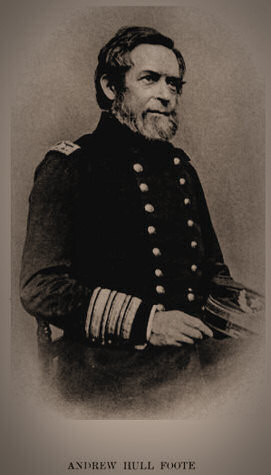
June 27, Saturday. A telegram last night informed me of the death of Admiral Foote. The information of the last few days made it a not unexpected event, yet there was a shock when it came. Foote and myself were schoolboys together at Cheshire Academy under good old Dr. Bronson, and, though three or four years younger than myself, we were pursuing some of the same studies, and there then sprang up an attachment between us that never was broken. His profession interrupted our intimacy, but at long intervals we occasionally met, and the recollection of youthful friendship made these meetings pleasant.2007-00706.jpg

When I was called to take the administration of the Navy Department, he was Executive Officer at the Brooklyn Navy Yard, and wrote me of the pleasure my appointment gave him. He soon visited Washington, when I consulted with him and procured in friendly confidence his estimate of various officers. This was before the affair of Sumter, and, like many others, he shortly after expressed a sad disappointment in regard to some he had commended. In fitting out in those early days the expeditions to Fort Sumter and Fort Pickens he exhibited that energy and activity which more fully displayed itself the following autumn and winter in creating and fighting the Mississippi Flotilla. His health became there impaired and his constitution was probably undermined before he took charge of the Bureau of Equipment and Recruiting. Our intercourse here was pleasant. His judgment in the main good, his intentions pure, and his conduct correct, manly, and firm. Towards me he exhibited a deference that was to me, who wished a revival and continuance of the friendly and social intimacy of earlier years, often painful. But the discipline of the sailor would not permit him to do differently, and when I once or twice spoke of it, he insisted it was proper, and said it was a sentiment which he felt even in our schoolday intercourse and friendship.

Shortly after the demonstration of Du Pont at Charleston, when I think Foote’s disappointment was greater than my own, he tendered his services for any duty afloat. Some premonition of the disease which ended his life was then upon him, and made him believe more active employment than the Bureau afforded would conduce to his physical benefit. His wife, after he had once or twice alluded to the subject, which she did not favor, gave her consent that he should go wherever ordered, except to the Mississippi. Foote expressed regret that she should have made any exception.

He did not wish to supplant Du Pont, whom he admired, or take any part against that officer. He was not unaware, however, that the Department and the public would turn to him as the successor of the hero of Port Royal, should there be a change of commanders. I was desirous that both he and Dahlgren should go to that squadron, and it was finally so arranged, but Providence has ordered differently. I have been disappointed. Foote had a name and prestige which would have carried him into the place assigned him on the tide of popular favor, whatever might have been the intrigues and assaults on one or both of us from any quarter.

General Wool, Governor Morgan, and Mayor Opdyke make a combined effort to retain the Roanoke at New York, and write me most earnestly on the subject. The idea that New York is in danger is an absurdity, and, with a naval force always at the navy yard and in the harbor, and with forts and military force, is such a remote contingency that the most timid lady need not be, and is not, alarmed. Morgan and Opdyke, Governor and Mayor, have responsibilities that are perhaps excusable, but not General Wool, who feeds on panic and fosters excitement. It is made the duty of the military at all times to defend New York. The Army is sensitive of Navy interference in this specialty, but the Navy will render incidental aid, do all that is necessary; but the Army assumes the guardianship of the ports as the exclusive province of the military, independent of the Navy.