Sunday, 29th—It was 9 o’clock before we got started this morning and though the country here between two mountains is very rough, we covered fourteen miles and went into camp in the mountains for the first time. Large foraging parties were sent out this morning to secure meat. Our advance lines had a skirmish with the rebels this afternoon. The health of the men is good, but many have sore feet from the hard marching.
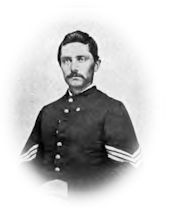
Diary of Alexander G. Downing; Company E, Eleventh Iowa Infantry
Saturday, 28th—We started at 7 o’clock this morning and dragging along slowly with our heavy trains, went into bivouac when we reached Somerville at 3 o’clock. Most of our road was over very rough country and besides we had to wade one river, the bridges being gone. Somerville is a mere village with a courthouse, a few stores and about twenty dwellings.
Friday, 27th—We remained in bivouac until 2 o’clock waiting for rations. After getting our rations we crossed the Tennessee river by pontoon bridges and started on our way for Rome, Georgia. The railroad bridge of the Memphis & Ohio, here at Decatur, was destroyed by our gunboats soon after the battle of Shiloh. It took seventy-two pontoon boats to make our bridge. Our road today lay through a large swamp which it took some time for the artillery and provision trains to cross; besides we had some very rough country to cross, and did not get into bivouac until midnight.
Thursday, 26th—We left our bivouac at 6 o’clock this morning and marched twelve miles. Within a few miles of Decatur we went into bivouac for the night. Advance brigades of our army were skirmishing with the rebels today and it is reported that the colonel of the Seventeenth New Jersey Regiment was killed. Our men captured a provision train and also took some prisoners. Our corps teams have been sent out for fodder.
Wednesday, 25th—We packed our knapsacks and sent them by rail to Rome, Georgia. The advance of our corps started early this morning for Decatur, Alabama, but our brigade taking up the rear did not leave Huntsville till in the afternoon. From Decatur we are to proceed to Rome, Georgia. We marched through fine farming country with good buildings, but as usual the people are gone and the farms are idle. Such is the effect of war, the citizens being afraid to remain while our armies are marching back and forth.
Tuesday, 24th—We remained here at Huntsville all day resting. I went to the camp of the Fifty-ninth Indiana and found my cousin, Hamilton Shepherd, and the sons of some of our old friends from my old home at Bloomfield, Indiana. The order is that we are to start for Chattanooga[1] in the morning, and we again had to turn over our tents and baggage to the quartermaster, who will put them in storage.
Huntsville is a nice little town among the hills, and as in the case of most all of the villages here in the South, its citizens fled on the approach of the “mudsills,” as they call us. There is a large spring here with a strong, steady flow of water, coming off a rocky cliff one hundred feet high, which supplies the town with water. The water runs into a large pool, from which it is pumped into an elevated tank by means of a water-wheel set near the cliff, and distributed over town through pipes.
[1] Rome, Georgia. The order was later countermanded and the army, instead of going to Chattanooga, went to Rome via Decatur. Alabama. —A. G. D.
Monday, 23d—It has been very warm but pleasant for several days. Reveille roused us this morning at 3 o’clock and at 4 our brigade started, taking the advance. Our last night’s bivouac is just twelve miles northwest of Huntsville and we had a fine road to travel on coming into town. There is some very fine country with splendid farms around Huntsville. We entered the town at 10 o’clock and went into camp, lying here the rest of the day. Here we got our knapsacks and a large mail. I received a letter and likeness from Miss G ——. All of the non-veterans joined their regiments this afternoon. Our quartermaster received a consignment of clothing for the regiment.
Sunday, 22d—We started at 5:30 this morning and marched till 2 o’clock, when we again went into bivouac. Our brigade today was just in front of the rear. We passed through some very fine country with well-improved farms. Today we bade old Tennessee farewell and entered Alabama.
What a cruel thing this war is! May God hasten the day when it will be brought to a close and our nation enjoy peace once more. Here in the army we have to march on Sunday as other days. A soldier has to go through a great many hardships not thought of by others.
Saturday, 21st—Reveille sounded at 3 o’clock and at 5 we took up the line of march, our company being rear guard for the brigade. We marched seventeen miles and went into bivouac several miles beyond Elkhorn, which we reached at 1 o’clock. Here we waded the Elkhorn[1] river, which is from three to five feet deep and two hundred feet wide. The boys had a great deal of fun in wading across. The country is very rough and rocky, and the hard turnpike over which we marched most of the day made our feet very sore.
[1] Now called Elk river. The town which our diarist calls Elkhorn was probably what is now Aspen Hill.—Ed.
Friday, 20th—We are having nice weather. We lay here at Pulaski all day in order to draw rations and to rest. We spent the day in washing clothes and cooking navy beans and fresh beef. The troops of our corps were ordered to pack all extra clothing in their knapsacks and turn them over to the quartermaster, who would then send them by rail to Huntsville, where they are to be stored. We are to go in light marching order from now on, having but a blanket apiece. There is but little sickness in the corps and the men are in fine spirits. All are anxious to get through to the main army.


