Tuesday, 1st—We lay here at Bayou Mason all day to rest. The boys are very tired after marching for twelve days, with the weather much of the time so fearfully hot. Then on account of the bad water, exposure and fatigue, a large number are sick, many of them not able to carry their accouterments, while others are too sick to walk and have to be hauled. The boys made the sweet potatoes suffer today. Received orders to start tonight at midnight and march to the Mississippi river.
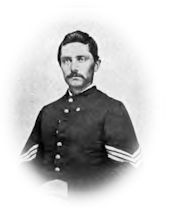
Diary of Alexander G. Downing; Company E, Eleventh Iowa Infantry
Monday, 31st—We left Heff river and marched through to Bayou Mason, eighteen miles, and stopped for the night. While marching today some of us heard the report of a rifle, and we learned that a member of the Seventh Missouri had committed suicide by shooting himself. He stepped out of rank into the brush and putting the muzzle of his gun under his chin, touched off the trigger with his toe and blew his head off. We were mustered for pay upon reaching Bayou Mason.
Sunday, 30th—We left Oak Ridge and covering but ten miles went into bivouac on the banks of Heff river. Some of the men on account of the bad water and climate are suffering with the chills and fever. The boys were raiding all the sweet potato patches they found along the way, today.
Saturday, 29th—We had a heavy rain during the night and the day opened cloudy and dismal. Our entire expedition started on the return journey for Vicksburg. We covered twenty-six miles and camped for the night on Oak Ridge. Some of the men had found too much of the “Southern bay rum,” and imbibing quite freely, became so top-heavy on the way that they had to be hauled all day.
Friday, 28th—We had company inspection this morning and then started out for Monroe, expecting to have a little fight in taking the town. But upon reaching the place we found that the rebels had withdrawn, leaving at 6 o’clock in the morning. General Logan’s Division entered the town at 10 o’clock, while our brigade had come within a mile of town, where we again went into bivouac. In the afternoon there was a heavy rain. The rebels have a hospital here, with about fourteen hundred sick and wounded. Monroe is a nice town, well situated, and has some fine buildings. Strict orders had been given us not to kill any livestock on this expedition; all persons caught in the act were to be arrested. But some of the boys of our regiment had killed a hog and were in the act of cutting it up when the general of our division came riding along with his staff. The boys were caught in the very act. General Stephenson halted, and wanting to know by what authority they had killed the hog, he was going to have them arrested on the spot. But they had one fellow equal to the occasion, who explained that they had killed a wild hog. They were out in the timber getting wood with which to build fires, when some wild hogs there made a charge upon them, and in self-defense they had killed the boldest one; they then thought that as they had killed it they might as well bring it in and have some fresh pork. The general rode on.
Thursday, 27th—Leaving our Oak Ridge bivouac early this morning we journeyed fifteen miles more and stopped for the night on the banks of Bayou Said, only seven miles from Monroe, our destination. During the day we crossed another ridge known as Pine Ridge, which is eight miles across and about twenty feet above the surrounding land. It is beautifully covered with yellow pine, growing so straight and tall, seventy-five to one hundred feet. We noticed a few small clearings with log huts. This is the worst bivouac we have yet occupied. It is full of poisonous reptiles and insects, centipedes, jiggers, woodticks, lizards, scorpions and snakes of all kinds—I have never seen the like. Some of the boys killed two big, spotted, yellow snakes and put them across the road—they measured about fifteen feet each. The ground is covered with leaves ten inches deep, and the water of the bayou has a layer of leaves and moss fully two inches thick.[1]
[1] This proved to be our most dangerous Journey in all our four years’ service. The natives told us the next morning that no Southern soldiers could have been hired to do what we did. I have often wondered and would like to know, just as we did then, why we were sent into this forsaken section of the country, and during the most sickly time of the year, at that! The natives we saw were a white-livered set; they were all ardent sympathizers of the secession cause.—A. G. D.
Wednesday, 26th—Getting an early start again this morning, we covered sixteen miles and camped for the night on Oak Ridge. This ridge is on a dead level and only about twenty feet higher than the bottoms where the cypress grow so luxuriantly. It is covered with oak and fine large walnut, also magnolia and a few other semi-tropical trees. To reach the ridge we had to wade across Bayou Lee. Our cavalry had preceded us and routed a small detachment of rebel cavalry. They were nicely fixed up at this place. Our boys went in on their nerve at foraging.
Tuesday, 25th—We took up our march at 4 o’clock this morning and journeyed seventeen miles, when we stopped for the night. Our brigade took the rear, the Eleventh Regiment acting as rear guard. The day’s march was through swamps and bayous and land heavily timbered. Now and then we noticed a field with a little log hut in it, occupied by a poor white family, whose head was away with the rebel army, or with a cavalry squad in this section.
Monday, 24th—Spending the night here we started early this morning and moved on to Bayou Mason only seven miles further on. Here we remained during the balance of the day and for the night. There being no bridge, we had to wade the bayou to enter the town. Our cavalry routed about one hundred and fifty of the rebels in a camp on the west bank of the bayou. Most of our way today was shaded by forest trees. The country here is low and heavily timbered with cypress and the ground is covered with masses of palm leaf. We noticed driftwood high up in the trees, some forty or fifty feet, and were told by the natives that it was carried there last winter when the “Yanks” cut the levee up at Lake Providence, flooding the whole country. So we were permitted to see some of the results of our attempt at directing the waters of the Mississippi.
Sunday, 23d—Our expedition broke camp this morning and started for Monroe, Louisiana, on the Washita river, seventy-five miles northwest of Vicksburg. By 1 o’clock we had covered ten miles, in a burning hot sun,[1] without water to drink, and through neglected fields of hemp standing from ten to fifteen feet high. The cavalry went in front to break down the hemp, and were followed by a six-gun battery and our army wagons, after which the hemp was pretty well flattened for the infantry to pass over. The men and animals suffered awfully. Many artillery horses gave out and some of the men were sunstruck. Many of the boys fell out of the ranks during the trip and had to be cared for by the doctor. Finally at the end of the ten-mile journey we reached the banks of the Tensas river, and though the water was stagnant, in mere pools, we threw ourselves down, brushed aside the green scum and drank that hot, sickly water to quench our thirst.
[1] Oh, that hot sun on our heads! It was frightful! There was no air to stir even a leaf; It was like going through a fiery furnace! But stopping in that God-forsaken country to hunt for water would have been a greater punishment than going on without water—so we kept straight on.—A. G. D.


